
On the Monday after spring daylight saving time, the problem is usually not motivation. You sit down at the usual time, the meetings start, and the useful thinking shows up late. In a University of Oregon analysis of 174,505 GitHub users, software productivity did not really normalize until after 10 a.m. that Monday; related research found cyberloafing rose 3.1% to 6.4%, work engagement fell at one day and one week after the switch, and workplace injuries rose 5.7% on the Monday after spring-forward, with lost workdays up 67.6%.[1][2] Chmura estimated the avoidable annual cost at about $672 million.[3] That hits on top of a 40 to 60 minute sleep debt that can hang around for 5 to 7 days and, for some workers, up to 14 days.[1]

Why the first week matters
The useful way to read that data is simple: DST creates a short but real circadian mismatch, not a character test. Evening types usually feel it more, and workers who are already short on sleep take longer to recover, which is why a one-night fix rarely works.[1][4]
Start before the clock changes
The fastest recovery starts before Sunday night. CDC/NIOSH recommends shifting bedtime 15 to 20 minutes earlier for three nights before DST, and chronotype-specific guidance pushes that farther for night owls: start five days out, pair the shift with morning sunlight, and reduce evening blue light.[4][5]
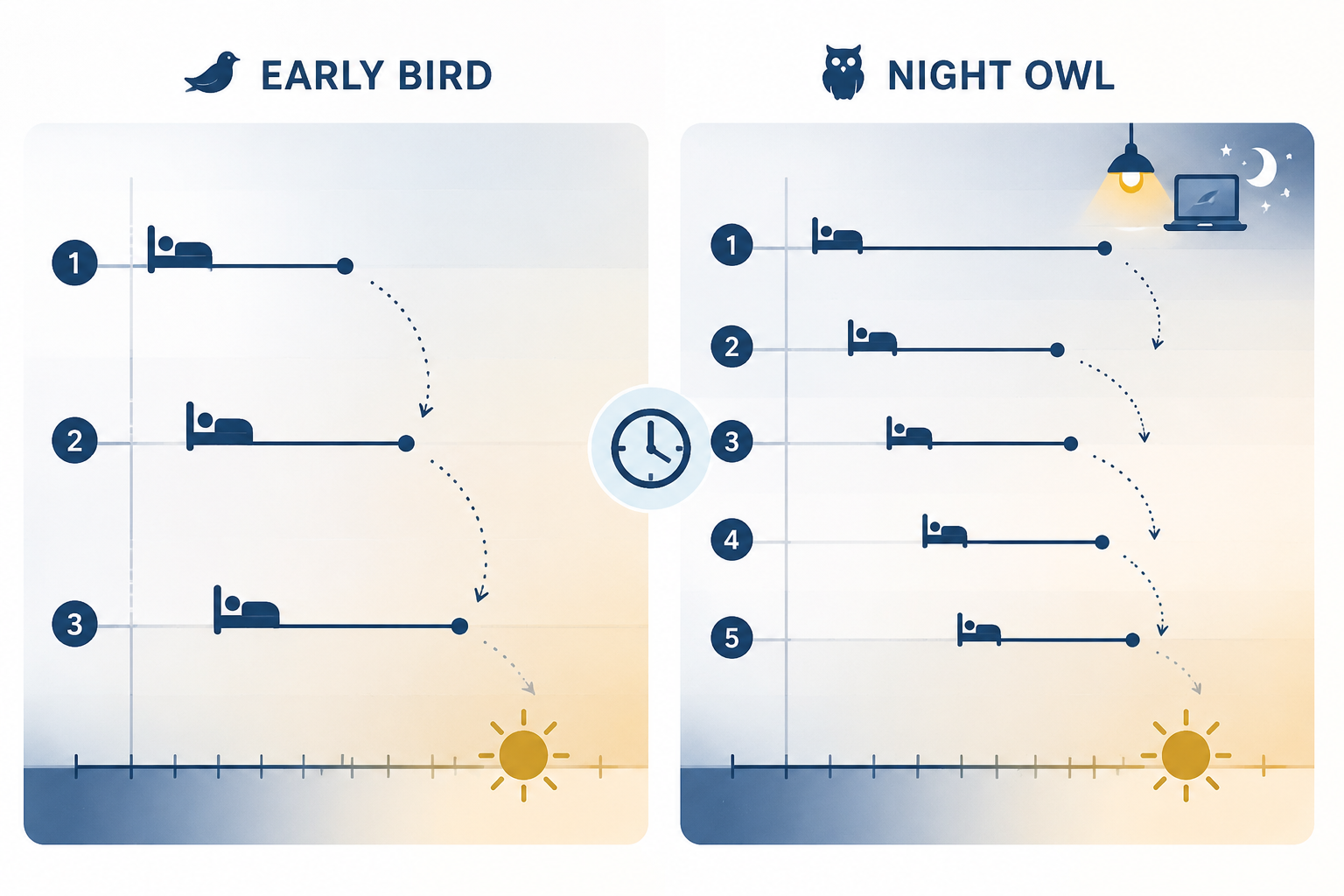
| Track | When to start | What to do | What to expect |
|---|---|---|---|
| Early bird | 3 days out | Move bedtime 15 to 20 minutes earlier each night, get outside or bright light soon after waking, and keep evenings dim.[4][5] | Usually enough to make the first workweek manageable. |
| Night owl | 5 days out | Move bedtime 15 to 20 minutes earlier over five nights, take morning sunlight seriously, and cut evening blue light more aggressively.[4][5] | Better odds of avoiding the steeper engagement drop seen in evening types.[4] |
Do not try to solve the whole problem by sleeping more on Saturday night. The body adjusts over several nights, and if you are already carrying sleep debt, the transition stacks on top of it.[1]
The first 72 hours
Treat the first Monday like a low-gear day until after lunch. The University of Oregon data found developer productivity did not normalize until after 10 a.m., so the sensible move is to reserve the first block for admin, review, and easy communication, then push deep work into late morning or early afternoon.[1]
- Keep 9 a.m. for triage, email, and status work, not writing, coding, or other tasks that need clean attention.
- Move the heaviest work to late morning or after lunch, when alertness has had time to catch up.
- Shorten work blocks if focus is patchy; Pomodoro-style blocks make a bad hour less expensive.
- If your afternoon crashes, a 15 to 20 minute nap can restore enough cognitive function to smooth the dip.[6]
- Move non-critical meetings later in the day, or out of the first week entirely.
- If a meeting must happen, reduce the overhead by using automated notes or a designated scribe so the live discussion carries less load.
What managers can change
For managers, the highest-return move is to reduce the number of decisions and meetings that depend on a fully alert Monday morning brain. Flexible starts, a work-from-home Monday option, async-first mornings, and no 9 a.m. meetings in the first week are not perks here; they are a way to protect output while the team re-anchors its sleep schedule.[1][5]
- Push recurring standups to late morning for the DST week.
- Let people start later if their work is mostly computer-based.
- Keep Monday remote when commuting would add another timing penalty.
- Put decisions, reviews, and brainstorming after people have had daylight and a second cup of coffee.
- Revisit any recurring 9 a.m. meetings for the DST week, because the first hour is where the mismatch is most visible.
If you shift sleep 3 to 5 days ahead, use morning light, protect the first 72 hours from early-morning deep work, and give the team a lighter Monday, the adjustment window usually shrinks from roughly a week or two to a few days.[1][4][5][6]
References
- Daylight saving time linked to lost worker productivity — University of Oregon News
- Work engagement after the transition to daylight saving time — PubMed
- Daylight Saving Time and productivity costs — Chmura, 2024
- Daylight Savings Time — CDC/NIOSH, 2016
- How to Prevent Lost Productivity When Daylight Saving Time Starts — Forbes, 2025-03-07
- Daylight Saving Time Kills Our Productivity. How You Deal — NBC News
Comments
Join the discussion with an anonymous comment.