
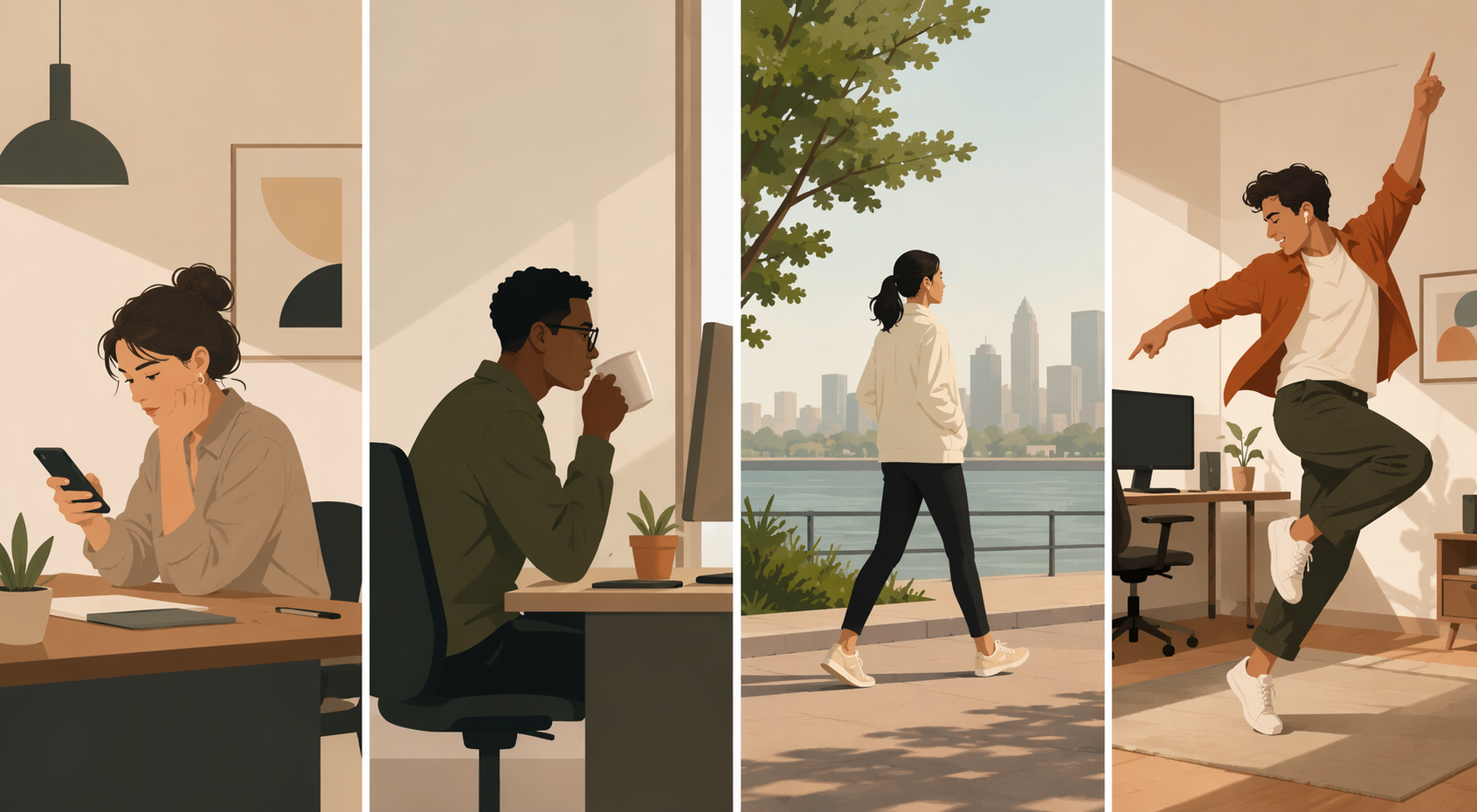
The danger point is not usually the dramatic crash. It is the softer one: the paragraph you have read three times, the spreadsheet cell you keep clicking without changing, the moment when opening another tab feels like a break even though it is just the same chair, the same screen, and a faster feed.
That is where the brain benefits of short dance breaks for focus become more interesting than the phrase “dance break” first suggests. A two-to-five-minute dance break is not just a cute way to move around. Done at the right moment, it combines a real task switch, a small cardiovascular lift, rhythm, coordination, novelty, and emotional reward in one compressed interruption. Scrolling gives you stimulation. Coffee gives you arousal. A walk gives you movement. Dance can stack several attention-relevant levers at once.

The strongest case for trying it does not start with self-expression. It starts with a fairly unromantic problem in attention research: sustained focus gets stale. In a University of Illinois study on brief diversions and vigilance, participants who received short mental breaks avoided the usual decline in performance; their performance at minute 50 was effectively the same as at minute 1.[1] That finding matters because it shifts the blame. A mid-day focus slide is not always a character flaw. Sometimes the brain has simply been asked to hold the same target for too long.
Interrupting Vigilance Decrement
Vigilance decrement is the research term for a familiar desk-worker experience: attention fades during a continuous task even when the task still matters. The Lleras finding is useful because it shows that a brief diversion can refresh sustained attention instead of merely consuming time.[1]
A short dance break fits this mechanism cleanly. It asks you to stop parsing the same information channel and do something categorically different. Your visual attention leaves the document. Your motor system comes online. Your timing and spatial awareness get recruited. The interruption is not long enough to become a second activity that eats the afternoon, but it is different enough to stop the stale loop.
This is also why a “break” that keeps you in the same cognitive posture can fail. If you move from a work dashboard to a social feed, the content changes, but the brain is still scanning, reacting, comparing, and absorbing rapid visual stimuli. It may feel like escape because the feed is easier than the report. It is not necessarily a reset.
Why Dance Is More Than Movement
The honest version of the claim is not “dance is always better than walking.” Walking is useful, especially if it gets you away from a chair and a screen. The more precise claim is that dance adds layers walking does not always include: rhythm, sequencing, novelty, coordination, music, and emotional reward. Those layers matter because focus is not a single switch. It depends on arousal, inhibition, working memory, mood, and the ability to return to a chosen task without being dragged around by every stimulus.
The most directly relevant acute dance evidence is still narrower than an adult workplace study. A 2024 study on five-minute dance active breaks found that synchronized dance improved children’s inhibition and subsequent task focus more than other aerobic activities.[2] Children in a study are not remote professionals trying to finish a client deck. Still, the result points to the part of dance that generic “move more” advice misses: coordinated, sequenced movement appears to add a cognitive demand beyond simple exertion.
| Break choice | What it changes | What it may miss |
|---|---|---|
| Scrolling | Novelty and stimulation | A clean task switch away from screen-based stimulus mode |
| Coffee | Arousal and alertness | Motor reset, coordination, and attention reorientation |
| Walking | Movement and circulation | Rhythmic sequencing and music-linked reward, unless deliberately added |
| Short dance break | Task switching, movement, rhythm, sequencing, and mood shift | It is still a short intervention, not a substitute for sleep or workload repair |
That comparison is not meant to turn a two-minute song into medicine. It is a way to be specific about why dance can feel disproportionately effective. It changes more variables at once than most desk breaks do.
The Workplace Timing Is Shorter Than People Think
The useful window is small. Micro-break guidance summarizing workplace movement research points to two-minute movement breaks every 30 minutes as a plausible timing frame, with reported benefits including higher sustained attention and more end-of-day energy.[3] That evidence is about movement breaks generally, not dance specifically, so it should not be inflated into a dance-only finding. Its practical value is simpler: the break does not need to be long to be neurologically plausible.
For knowledge work, this matters. A 20-minute wellness ritual may be lovely and still useless at 2:17 p.m. when someone is between meetings and trying to recover enough control to finish one meaningful task. A two-minute track, or even half of one, is more likely to survive contact with a real calendar.
What Longer Dance Studies Can and Cannot Prove
The brain-plasticity evidence around dance is impressive, but it needs careful handling. In a 2018 PLOS ONE study of older adults, six months of dance training was compared with conventional fitness training. Dance was the only intervention that significantly increased BDNF plasma levels and brain volume, including regions such as the hippocampus and corpus callosum.[4]
That does not mean two minutes beside your desk grows your hippocampus. It means dance, practiced repeatedly over time, appears capable of driving neuroplastic changes in ways that repetitive exercise may not. The likely reason is the same layered demand that makes a short dance break attractive: learning movement patterns, adapting to rhythm, coordinating balance, and responding to novelty rather than repeating one mechanical action.
A 2023 review in Frontiers in Aging Neuroscience likewise describes dance as a neuroplasticity-based activity associated with increased prefrontal cortex activation and enhanced connectivity among the basal ganglia, cerebellum, and prefrontal cortex.[5] Those regions are relevant to attention and motor coordination, but the review is not a direct test of a two-minute remote-work intervention. The safer conclusion is that dance has credible long-term brain-training properties, and those properties make the acute workplace version mechanistically plausible.
BDNF, Blood Flow, and the Prefrontal Cortex
BDNF, or brain-derived neurotrophic factor, often gets flattened into a wellness buzzword. Its more useful role here is as a marker in the broader story of learning, plasticity, and brain adaptation. The Rehfeld study’s BDNF finding is meaningful because it separates dance from conventional fitness training in a controlled long-term comparison.[4]
For a short work break, the immediate effect is more likely to be about activation than structural change. Movement can increase blood flow and physiological arousal. Dance adds cognitive control: you have to map sound to motion, inhibit the awkward half-move you did a beat too late, adjust, and continue. That is a small prefrontal workout, not just a circulation break.
This is where dance differs from simply standing up and wandering to the kitchen. The kitchen trip may move the body, but it often leaves attention drifting. A short dance break gives the brain a temporary job with boundaries: follow the beat, coordinate the next move, and stop when the timer or track segment ends.
The Default Mode Network Gets a Little Breathing Room
The default mode network is often discussed in relation to mind-wandering, memory, and internally directed thought. For focus, its value is not that it keeps you locked on the task. It is that stepping away from directed effort can allow the brain to reorganize, incubate, and stop hammering at the same blocked pathway.
A dance break gives this system a useful kind of cover. You are not sitting still trying very hard to “clear your mind,” which is just another task for many people. You are occupied enough by music and movement that the work problem can drop out of the foreground for a minute. That short release can make returning to the document feel less like re-entering a wall.
This mechanism is harder to pin to a single workplace dance study than vigilance decrement is. It is better treated as a plausible part of the reset: brief disengagement from the focal task may help the brain return with less friction, especially when the break is embodied rather than another form of screen consumption.
Why It Feels Better Than It Looks on Paper
There is also the mood piece, which productivity advice tends either to ignore or overpromise. A 2025 narrative review on dance and stress regulation reports that dance can modulate dopamine, oxytocin, and β-endorphin systems, describing a multi-level stress-regulation effect.[6] Modulate is the important word. This is not a guarantee that every song produces a measurable chemical upgrade in every person.
Still, the emotional shift is not incidental. Focus is easier to recover when the nervous system is not clenched around irritation, boredom, or low-grade dread. Music can provide reward. Rhythm can provide predictability. Movement can discharge some of the agitation that otherwise turns into tab-hopping. If the break makes returning to work feel slightly less punitive, that is not fluff; it changes the conditions under which attention has to operate.
How to Make a Two-Minute Dance Break Actually Work
The move is simple enough that over-designing it can ruin it. You do not need choreography, a fitness app, or a personal transformation narrative. You need a short boundary, a song segment, and enough movement that your body is unmistakably no longer in typing mode.
- Use it when attention has become dull, not when you are already in a good flow.
- Set a two-to-five-minute limit so the break does not turn into avoidance.
- Pick music with a clear beat; the rhythm is part of the cognitive scaffolding.
- Include coordination: steps, arm patterns, turns, or any sequence that makes the brain track what comes next.
- Return to one defined task immediately afterward, before opening messages or a feed.
The last step is the one that protects the benefit. A reset is only useful if it has somewhere to land. Before standing up, leave a visible next action: rewrite the second paragraph, check the last three formulas, answer the one email that blocks the project. The dance break clears the ramp; it does not choose the destination.
Where the Evidence Is Still Thin
The evidence is strongest for brief diversions restoring sustained attention, for movement breaks being practical inside a workday, and for longer dance training producing brain and cognitive effects.[1][3][4][5] The evidence is narrower for acute, five-minute dance breaks, and the most direct study cited here involved children rather than adult knowledge workers.[2]
That boundary does not make the practice weak; it keeps the claim usable. The fair claim is not that a tiny dance break reproduces months of dance training. It is that, during a normal workday focus slump, dance is an unusually efficient interruption because it combines mechanisms that are usually split across separate breaks: task switching, movement, rhythm, coordination, reward, and brief mental disengagement.
The idea has also moved into popular discussion. A July 2026 BBC Future piece framed the five-minute dance break as a timely experiment in everyday cognitive recovery, though a journalist’s self-experiment is a cultural signal rather than proof.[7] The stronger reason to try it remains the convergence of attention research, movement-break evidence, and dance-specific neuroplasticity studies.
The Bounded Verdict
A short dance break will not fix burnout, compensate for too little sleep, or make an impossible workload humane. It should not have to. Its value is more modest and more practical: when focus fades during an ordinary workday, two to five minutes of music-led, coordinated movement can interrupt vigilance decline, activate the body, recruit attention networks, create a little emotional reward, and give the overworked task system a clean exit and re-entry.
That is a better break than pretending another screen is rest.
References
- Brief diversions vastly improve focus — University of Illinois, 2011
- Acute Effects of 5-Minute Dance Active Break on Executive Functions — IEJEE, 2024
- Best Micro-Break Strategies for Sustained Focus — Neurosity
- Dance training is superior to repetitive physical exercise in inducing brain plasticity in elderly — PLOS ONE, 2018
- Unleashing the potential of dance: a neuroplasticity-based approach — Frontiers in Aging Neuroscience, 2023
- Dance and stress regulation: A multidisciplinary narrative review — ScienceDirect, 2025
- The surprising benefits of a five-minute dance break — BBC Future, July 2026
Comments
Join the discussion with an anonymous comment.