
Most coffee productivity hacks for deep work fail because they treat coffee like a mood button. You wake up, pour the first cup because the kitchen is there, refill when the inbox starts biting, and then wonder why the same drink that gave you a clean 9 a.m. lift leaves you scattered by 2 p.m. or staring at the ceiling at 11 p.m.
A better protocol starts with a less romantic assumption: caffeine is useful, but it has timing, dose, tolerance, and cleanup costs. The goal is not to drink more coffee. It is to stop spending your best stimulant window on shallow work.
Here is the whole working version before the physiology arrives: delay your first cup 90–120 minutes after waking; calculate a daily caffeine range from body weight; drink the most useful dose 20–30 minutes before a 90-minute deep work block; use a coffee nap only as an occasional afternoon rescue; stop caffeine 8–10 hours before bed; and cycle tolerance so the same amount keeps working instead of quietly becoming maintenance.
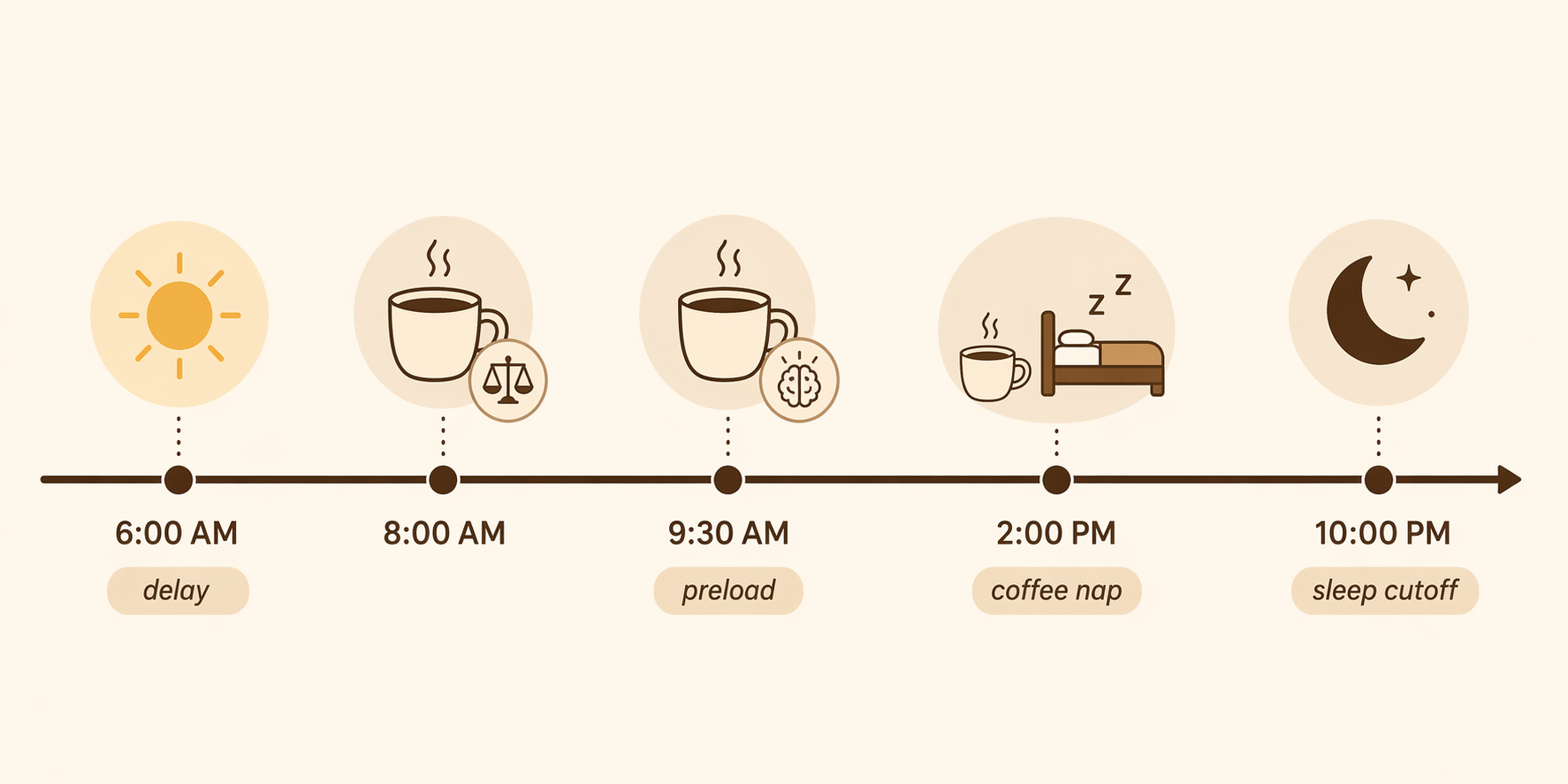
The Protocol In One Day
| When | Action | Why it matters |
|---|---|---|
| Wake + 90–120 minutes | Have the first coffee, not immediately on waking | Keeps the cup from colliding with the body’s normal morning alertness rhythm |
| Morning planning | Set a daily caffeine budget at roughly 3–4 mg/kg of body weight | Turns “another cup” into a measured dose instead of a reflex |
| 20–30 minutes before deep work | Drink the main focus dose before a 90-minute block | Lines up caffeine’s rise and peak with the work that needs it |
| Early afternoon, if needed | Use a coffee nap: caffeine quickly, then 15–20 minutes of rest | Combines light sleep with caffeine onset when the timing is still safe |
| 8–10 hours before sleep | Stop caffeine | Protects sleep from the tail end of caffeine’s half-life |
| Weekly | Consider a 5-days-on, 2-days-off tolerance cycle | Keeps coffee from becoming background noise |
That table is intentionally plain. It does not require a new grinder, a supplement stack, or an app that turns breakfast into a compliance audit. The hard part is behavioral: giving coffee a job before you drink it.
Do Not Spend The First Cup On Waking Up
The first change is also the most annoying one: wait 90–120 minutes after waking before drinking coffee. Jake Knapp and John Zeratsky, the former Google designers associated with this timing protocol, argue that delaying caffeine lets the body’s natural morning cortisol rise do some of the early alertness work before caffeine enters the picture; CNBC and Fast Company both describe the same 90–120 minute window, along with split dosing and an 8–10 hour pre-sleep cutoff.[1][2]
This is not a moral test. If you have a newborn, a brutal commute, or a 7 a.m. meeting with people who say “circle back” before sunrise, the first cup may happen earlier. But for a home-based knowledge worker with some control over the morning, delaying coffee changes the day’s first decision: caffeine becomes a tool you deploy, not the liquid equivalent of opening your laptop.
A practical morning can look like this: wake, hydrate, get light, handle low-friction setup tasks, sketch the day, then drink coffee when the first serious work block is within sight. That small delay often separates “I need coffee to exist” from “I am using coffee for the work that deserves it.”
Set A Caffeine Budget Before The Refills Start
Once the first cup has a place, dose comes next. The most usable starting range is 3–4 mg of caffeine per kilogram of body weight per day, with a split-dosing strategy that puts about 60–70% of that caffeine in the morning and 30–40% in the afternoon if a second dose is needed.[3]
For a hypothetical 70 kg person, that range would be 210–280 mg of caffeine for the day. That does not mean everyone at that weight should drink that amount. It means the vague category of “a couple coffees” gets translated into a number you can test against focus, jitters, crash, and sleep.
The split matters because deep work rarely needs maximum stimulation all at once. A morning dose can support the main cognitive block, while a smaller early-afternoon dose can cover a second demanding session without pushing caffeine too close to bedtime. Teaorcoffee.com’s 2026 guide also notes caffeine’s 30–60 minute peak window and its multi-hour half-life, which is why late-day “just one more” coffee so often survives long past the task that justified it.[3]
The measurement does not need to be precious. Use the approximate caffeine listed by your usual coffee source, keep the same cup size for the week, and adjust from there. Precision is helpful; pretending your kitchen is a pharmacology lab is not.
Preload Coffee For The Work, Not The Mood
The practical center of the protocol is the preload: drink coffee 20–30 minutes before a 90-minute deep work block. That timing gives caffeine time to rise toward its 30–60 minute peak while you are already inside the work, not while you are still deciding which tab to close.[3]
Cal Newport’s “deep work” frame is useful here because it names the kind of work worth protecting: cognitively demanding, distraction-resistant effort that creates real value. Coffee does not create that environment by itself. It only helps if the block is already fenced off: one task, visible notes, notifications off, and a clean entry ritual.[4]

A good preload block is boring in the best way. At 9:00, decide the deliverable. At 9:05, remove the obvious distractions. At 9:10, drink coffee. At 9:30, start the 90-minute block. The cup is not the ritual’s whole point; it is the bridge between intention and execution. If you need a fuller focus framework around that block, a broader personal productivity system can sit around the caffeine protocol without making the coffee do all the work.
This is where many coffee routines go wrong. They drink caffeine after the work has already gone sideways. By then, the problem may be unclear priorities, attention residue, sleep debt, or a calendar chopped into confetti. Coffee can sharpen attention, but it cannot choose the target.
A Simple Two-Block Workday
For many remote workers, the cleanest version is one protected morning block and one lighter afternoon block. The morning block gets the larger dose because it usually carries the hardest writing, coding, analysis, planning, or decision work. The afternoon block either gets a smaller dose or no caffeine at all, depending on sleep sensitivity and bedtime.
- Morning: delayed first coffee, then a 90-minute block for the highest-value cognitive task.
- Midday: food, movement, meetings, admin, review, or collaboration.
- Early afternoon: optional smaller dose only if there is a real second focus block.
- Late afternoon: no caffeine-dependent heroics; use lower-stakes tasks or a non-caffeine reset.
If your best work shifts with heat, caregiving, classes, or meetings, match the caffeine window to the actual energy rhythm of the day rather than copying someone else’s 9 a.m. ideal. The same logic applies to rhythm-based scheduling: the point is to put demanding work where the body is most likely to cooperate.
Use The Coffee Nap As A Rescue Tool
The coffee nap sounds like the kind of productivity trick that should come with a suspiciously cheerful diagram. The mechanism is more reasonable than the name. Sleep pressure is partly tied to adenosine, a chemical that builds while you are awake; caffeine competes with adenosine at receptor sites. A short nap can reduce adenosine pressure, and caffeine begins taking effect as you wake, binding to receptors that have been partly cleared during light sleep.[5]
The usual protocol is specific: drink about 200 mg of caffeine quickly, then nap for 15–20 minutes. Sleep Foundation describes this short nap window and notes evidence that coffee naps can improve alertness more than caffeine or napping alone.[5] Inc. also summarizes studies finding improvements in alertness and logical reasoning from the coffee nap approach.[6]
The boundaries matter. A coffee nap is not a loophole for bad sleep, and it is not a daily permission slip to drink caffeine at 4 p.m. It works best as an early-afternoon recovery move when there is still enough distance from bedtime and when the next task genuinely requires alertness. If you are caffeine-sensitive, prone to insomnia, dealing with a sleep disorder, or unable to nap without waking groggy, skip it.
Done well, the sequence is almost comically unglamorous: coffee down, timer on, eyes closed, get up when the alarm rings. Do not add a podcast, inbox check, or “quick scroll” between the cup and the nap. That gap is where good intentions go to become twenty-seven minutes of nothing.
Protect Sleep Like It Is Part Of The Protocol
The least exciting coffee productivity hack is the one that saves the next day: stop caffeine 8–10 hours before sleep. The same CNBC and Fast Company coverage that discusses delayed caffeine also emphasizes this pre-sleep cutoff.[1][2] Teaorcoffee.com’s half-life discussion supports the same practical caution: caffeine’s usefulness during work is tied to the fact that it does not vanish when the document closes.[3]
If bedtime is 11 p.m., a conservative cutoff lands around 1–3 p.m. That can feel early if your afternoon slump arrives at 3:30, but the bill for a late rescue cup is often paid in lighter sleep, delayed sleep onset, or a groggier morning that demands more caffeine. The loop is tidy and miserable.
This is also where commercial “more deep work” claims deserve a raised eyebrow. Coffeeanalytica.com’s reported 40% deep work extension comes from its own lab-style commercial data, not peer-reviewed independent evidence. It is reasonable to treat that kind of number as directional marketing, not as a promise that your 90-minute block becomes 126 minutes because a chart said so.[7]
Adjust For The Body You Actually Have
The standard formula is a template, not a prescription. Caffeine response varies with genetics, including CYP1A2 gene variants, as well as chronotype, sensitivity, sleep debt, medications, stress, food intake, and tolerance. Two people can drink the same coffee at the same time and have very different afternoons.
Start by changing timing before increasing dose. If the morning cup feels flat, move it closer to the work block rather than automatically adding another. If the afternoon dose damages sleep, move it earlier or remove it. If you get anxious, hot, impatient, or oddly fragmented, the dose is probably too high for the work you are asking it to support.
- Fast metabolizers may tolerate a later or slightly larger afternoon dose, but sleep data should have the final vote.
- Slow metabolizers may need a lower total dose, a stricter cutoff, or one morning-only coffee.
- Early chronotypes often benefit from moving the whole protocol earlier.
- Night owls may shift timing later by 30–60 minutes, while still protecting the 8–10 hour sleep cutoff.
- Highly sensitive drinkers should treat the 3–4 mg/kg range as too aggressive until proven otherwise.
Tolerance is the quieter variable. Teaorcoffee.com suggests a 5-2 weekly approach: use caffeine for five days, then take two lower-caffeine or caffeine-free days to preserve sensitivity.[3] For a weekday knowledge worker, that might mean normal coffee Monday through Friday and a gentler weekend. For a student or shift worker, the “off” days may need to move. The useful principle is planned variation, not caffeine guilt.
If that sounds like habit design rather than coffee advice, good. Tolerance cycling works only if it fits a life someone will repeat. A sustainable approach to off-days belongs closer to habit building than to purity culture.
A Few Coffee Details Matter Less Than You Think
Coffee origin can shape flavor, and flavor can shape whether a ritual feels pleasant enough to repeat. Milestone Brewed Coffee connects coffee choice to deep work and suggests, for example, Ethiopian coffees for more creative sessions and Colombian coffees for balance.[8] That may be a useful preference note if you already care about beans.
For productivity, though, origin is secondary to dose, timing, and sleep. A perfectly described washed Ethiopian does not fix a 4 p.m. caffeine habit that keeps you awake. A humble diner-style cup, used deliberately, can beat a beautiful pour-over used reactively.
Try It For One Week
Run the protocol for one normal workweek before judging it. Do not overhaul your diet, buy new gear, or add five other productivity experiments at the same time. Keep the test clean enough that you can tell what coffee changed.
- Delay the first cup 90–120 minutes after waking.
- Set a daily caffeine range using 3–4 mg/kg, then start at the lower end if you are unsure.
- Drink the main dose 20–30 minutes before one protected 90-minute deep work block.
- Use a smaller early-afternoon dose only when a real second focus block needs it.
- Stop caffeine 8–10 hours before bedtime.
- Track focus quality, jitters, afternoon crash, and sleep.
At the end of the week, adjust one variable. Lower the dose if the work felt speedy but shallow. Move the preload earlier if focus arrived too late. Cut the afternoon coffee if sleep worsened. Add a deliberate focus reset between the cup and the work if attention residue keeps following you into the block; a simple focus-reset ritual can matter as much as the caffeine.
Coffee earns its place in deep work when it becomes calmer and more measurable. Same cup, better timing. Same habit, clearer job. Less hoping the next refill will rescue the day, and more knowing what you are asking caffeine to do.
References
- Former Google designers' protocol. CNBC.
- Former Google designers' protocol. Fast Company.
- Best Coffee for Productivity, 2026 Guide. teaorcoffee.com. 2026.
- Deep Work. Cal Newport.
- What Is a Coffee Nap?. Sleep Foundation.
- Science Says This 20-Minute Coffee Nap Hack Boosts Energy. Inc.
- Coffeeanalytica lab data. coffeeanalytica.com.
- Coffee for Focus and Deep Work. Milestone Brewed Coffee.
Comments
Join the discussion with an anonymous comment.