
The aspartame-and-xylitol question does not show up as a medical dilemma first. It shows up at 2:30 p.m., when a diet soda, sugar-free energy drink, or xylitol gum feels like the cleanest way to stay sharp without spending the afternoon on sugar or calories. For knowledge workers, that trade now looks less trivial: a 2026 Neurology study linked higher artificial-sweetener intake to faster cognitive decline over 8 years, with the high-intake group averaging about 191 mg a day versus about 20 mg a day in the low-intake group.[1]

What The Study Found
The cohort included 12,772 adults. Over the follow-up period, high consumers showed 62% faster decline in overall cognitive function, 173% faster decline in verbal fluency, and a decline equivalent to 1.6 additional years of brain aging.[1] The result that matters most for work is the verbal-fluency hit: that is the speed at which words come when you are drafting, presenting, answering, or trying to sound composed in real time.
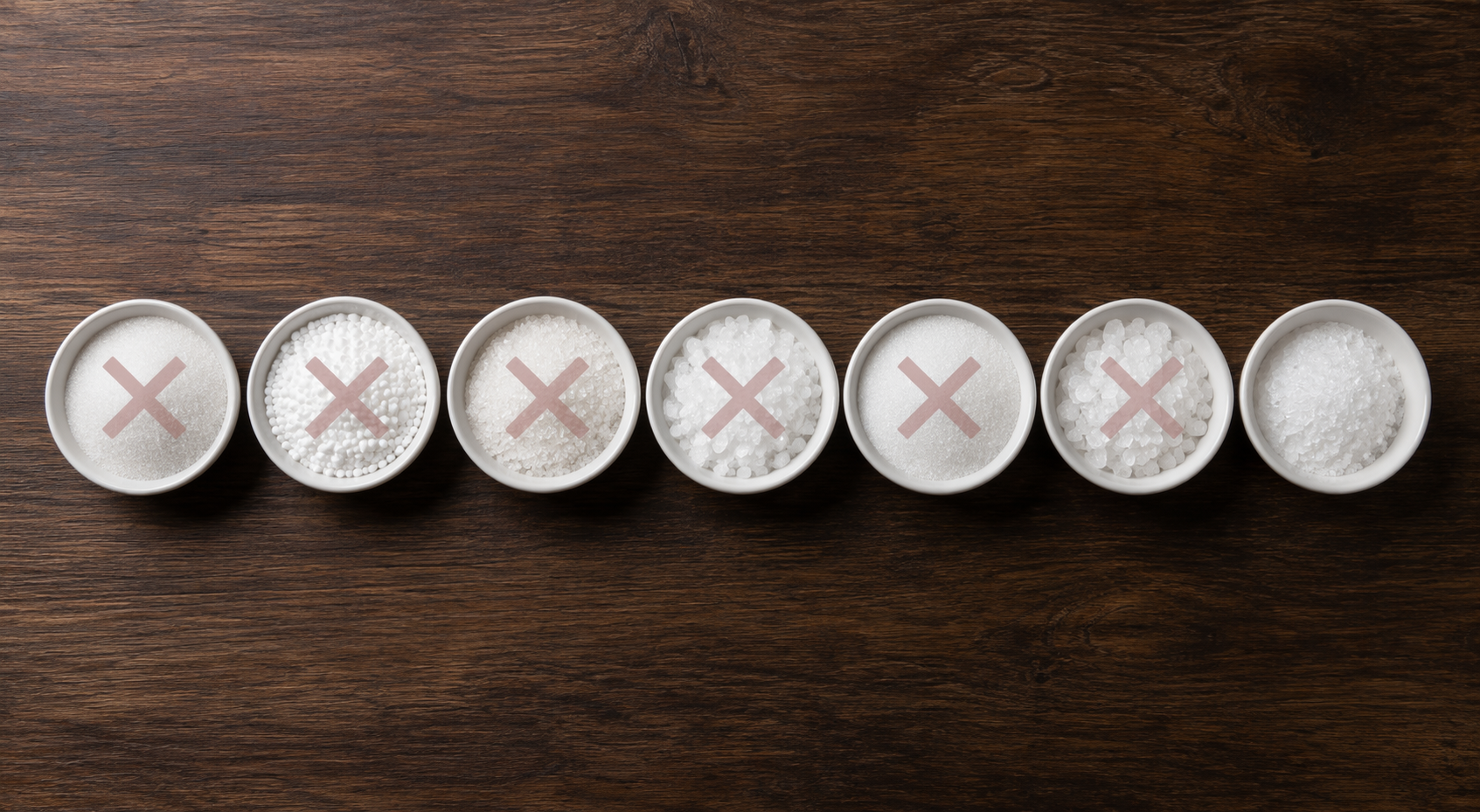
The association showed up in adults under 60, not over 60, which is the age band where many people are still carrying the heaviest meeting load, writing load, and decision load.[1] It also did not single out aspartame alone. Six of seven sweeteners examined — aspartame, saccharin, acesulfame K, erythritol, sorbitol, and xylitol — were linked with faster decline; only tagatose was not.[1]

Where Focus Breaks First
The study did not measure productivity directly. It measured the mental machinery that makes productivity possible. That is why verbal fluency stands out. When words slow down, so does the work that depends on them.
| Cognitive domain | What it looks like at work | Why it matters |
|---|---|---|
| Verbal fluency | Slower drafting, clunkier email rewrites, more pauses in meetings | Ideas lose momentum when words arrive late |
| Memory | Forgetting next steps, losing the thread in reading, reopening tabs to rebuild context | More rework and more mental friction |
| Overall cognitive function | Slower task switching and less steady attention across the day | The whole workday gets more expensive |
That is why the result is more than a generic brain-health warning. It points to the parts of a workday that become expensive first: the extra pause before a sentence lands, the slower recovery after losing a thought, the small delay before a meeting answer feels ready.
Why The Supporting Evidence Matters
The cohort is the main story, but it is not the only reason the concern is hard to dismiss. In a controlled human trial, healthy adults given 25 mg/kg/day aspartame for 8 days showed measurable worsening in mood, spatial orientation, and irritability, even though the dose sat below the FDA's acceptable daily intake.[2] Preclinical work also adds plausibility: one study reported aspartame-driven microglia-mediated neuroinflammation in the brain,[3] and another found learning and memory deficits passed to offspring in male mice after aspartame exposure.[4]
What Still Needs Caution
None of that turns the cohort into proof. The Neurology study was observational, with self-reported intake measured at baseline only. It can show that higher sweetener consumption traveled with faster decline, not that the sweeteners caused it. People can change habits over 8 years, and food-frequency recall is imperfect.[1]
That is the right place for the regulatory counterargument too. FDA and EFSA approval matters for safety thresholds, and sweetener-industry groups will point to that quickly. But approved is not the same claim as irrelevant to everyday focus, especially when the question is what a daily habit does to writing speed, recall, and verbal agility over time.
Xylitol deserves the same restraint. The cohort linked it with faster decline, so it is not a clean escape hatch from aspartame. At the same time, separate animal-model work has pointed in a more protective direction in Alzheimer's contexts, so the preclinical picture is not simple enough to flatten into a one-note villain story. The practical answer is narrower: treat xylitol as a swap worth auditing, not a guaranteed free pass.
What To Do With The Habit
- Audit the products that show up automatically: diet soda, sugar-free energy drinks, gum, mints, and low-calorie snacks.
- Track routine intake for a week before assuming the amount is trivial.
- If focus, recall, or meeting sharpness is already fragile, test a lower-intake stretch rather than changing nothing.
- Do not assume xylitol is the safe replacement just because it sounds more natural.
- Treat within-approved-limits as a regulatory threshold, not a productivity guarantee.
For knowledge workers under 60 who reach for these products every day, the evidence is strong enough to justify an intake audit and a reduction in routine exposure. That is not a claim that every sweetener is dangerous; it is a practical reminder that "within approved limits" is different from "no measurable cost to focus and output."
References
- Artificial sweeteners and cognitive decline — Neurology
- Effects of aspartame on mood, performance, and spatial orientation in humans — PMC/NIH
- Aspartame-induced microglia-mediated neuroinflammation in the brain — PubMed
- Aspartame consumption in male mice causes heritable learning and memory deficits — Nature Scientific Reports
Comments
Join the discussion with an anonymous comment.