
The first sign is often embarrassingly small. A familiar word will not come during a client call. An email that should take seven minutes takes twenty because the sentence keeps arriving slightly wrong. A spreadsheet reconciliation that used to feel almost physical — scan, compare, resolve — starts to feel sticky.
Most capable people over 50 do not treat those moments as health events. They treat them as performance failures. They sleep less, tighten the calendar, rewrite the to-do list, and keep the usual desk supplies close: diet soda, sugar-free yogurt, gum, flavored water, a low-calorie creamer, maybe a protein bar with a sweetness that does not come from sugar.
That is why the newer artificial sweetener research deserves attention from people who are still working, managing projects, leading meetings, caring for families, and trying not to lose cognitive traction during a long day. In an eight-year prospective study of roughly 13,000 adults, the highest consumers of several low- and no-calorie sweeteners had 62% faster decline in memory and thinking than the lowest consumers, a difference the authors described as equivalent to about 1.6 years of additional brain aging.[1]

That number is large enough to make any sensible reader sit up. It is also not permission to panic. The study found an association, not proof that sweeteners caused the decline. It did not diagnose every diet soda drinker with future dementia. What it does do is bring an ordinary habit into the same room as verbal fluency, working memory, and processing speed — the exact mental tools many older adults still depend on every workday.
What the 62% finding means for a workday
The highest-consumption group in the Neurology study averaged about 191 mg per day of the sweeteners being analyzed, an amount described in coverage of the study as roughly the level found in one diet soda.[1] That matters because “high consumption” can sound like a laboratory excess or a private vice. In practice, it may look like a disciplined lunch choice.
The cognitive measures were not vague. The study looked at changes in memory and thinking over time, including domains that map closely onto workplace friction. Verbal fluency is the ability to retrieve words and generate language under pressure. Working memory is the mental scratchpad used to hold three moving facts while deciding what to do next. Processing speed is the pace at which the brain takes in information and responds accurately.
A decline in those areas does not always announce itself dramatically. It may look like rereading a planning document because the first pass did not stick. It may look like pausing too long before naming a vendor on a call. It may look like needing a printed checklist for a monthly task that used to live comfortably in your head.
The middle-consumption result is the part that removes some comfort. Participants in the middle group, averaging about 66 mg per day, showed 35% faster cognitive decline than the lowest-consumption group.[2] That does not establish a precise danger threshold. It does make casual daily use harder to wave away as a problem only for heavy consumers.
There is one tension that should be stated plainly. The study reported significant associations in people under 60, but not in participants over 60.[1] For an article aimed at older adults, that sounds inconvenient. It is also exactly the kind of detail that keeps the evidence honest.
Lead author Dr. Claudia Suemoto framed the finding as a possible sign that midlife exposure to sweeteners may be particularly harmful, while Harvard neurologist Dr. Andrew Budson cautioned that the lack of a significant finding in adults over 60 likely reflects how difficult it is to detect small effects in older adults, rather than proving safety.[2] The practical reading is not “ignore this after 60.” It is closer to this: if you are 50 to 65 and using these products daily, this is a reasonable time to reduce exposure without waiting for perfect certainty.
The six sweeteners to look for
The sweeteners named in the study were aspartame, saccharin, acesulfame K, erythritol, sorbitol, and xylitol.[1] The practical problem is not that every reader needs to become a biochemical detective. The problem is that these names appear in ordinary products marketed as sensible substitutes for sugar.
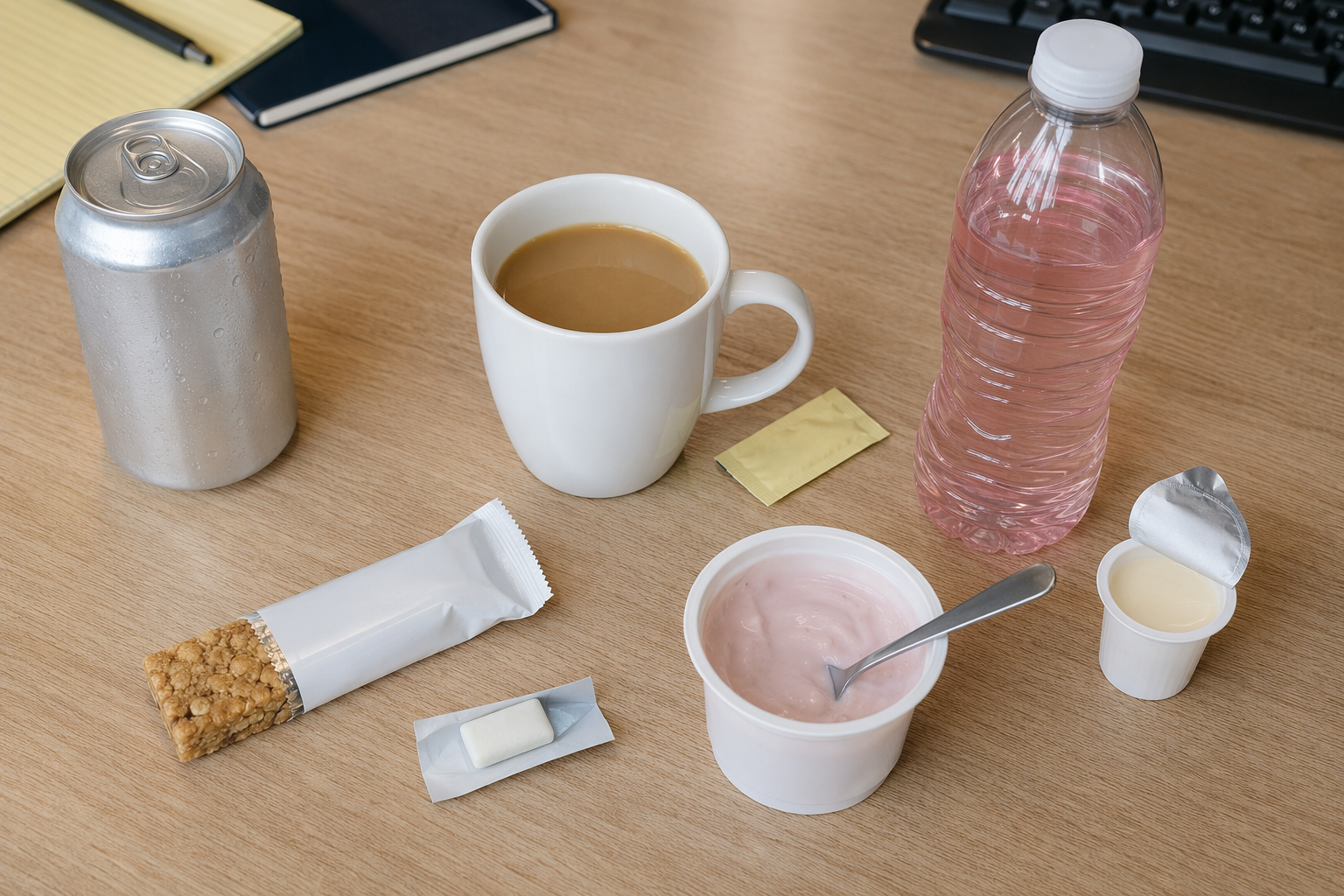
A typical workday inventory can reveal more exposure than memory alone will catch:
- Morning coffee: tabletop sweetener packets, sugar-free syrups, or low-calorie creamers.
- Midmorning food: sugar-free yogurt, a low-sugar protein bar, or a “keto” snack.
- Lunch: diet soda, flavored water, or a powdered drink enhancer.
- Afternoon focus aids: gum, mints, or another sweetened drink during a long meeting block.
- Evening “better choice” dessert: low-calorie pudding, ice cream, candy, or baked goods using sugar alcohols.
This is where vague label language becomes irritating. “No sugar added,” “light,” “keto,” “low carb,” and “diabetic friendly” do not tell you what sweetener is doing the work. A label can be perfectly legal and still unhelpful to a person trying to understand why the third meeting of the day feels mentally heavier than it used to.
| Name on label | Where it commonly appears in a workday |
|---|---|
| Aspartame | Diet soda, powdered drink mixes, tabletop sweeteners, some sugar-free foods |
| Saccharin | Tabletop sweeteners, diet beverages, some processed low-calorie foods |
| Acesulfame K | Diet beverages, flavored waters, protein products, low-sugar packaged foods |
| Erythritol | Keto snacks, low-sugar desserts, protein bars, sugar-free baked goods |
| Sorbitol | Sugar-free gum, mints, candies, some low-calorie desserts |
| Xylitol | Sugar-free gum, mints, dental products, candies |
The label audit should be boring on purpose. Choose three normal workdays. Do not change anything yet. Write down every sweetened item that is not plainly sugar, fruit, or unsweetened food. Then check only the ingredient list for the six names above. The goal is not moral accounting. The goal is to see whether “one diet soda” has quietly become one diet soda, two pieces of gum, a sweetened creamer, and a low-sugar snack.
Why the biology is plausible, but not settled
Several proposed pathways could explain why sweeteners might be linked to cognitive changes, including effects on the gut microbiome, neuroinflammation, and microglia, the brain’s immune-support cells. Dr. Austin Perlmutter has summarized this gut-brain line of reasoning as a plausible route by which diet-related exposures might influence brain function.[3]
Plausible is not the same as proven. The Neurology study was prospective, which is stronger than a one-time survey, but it was still observational. People who consume more artificial sweeteners may differ from low consumers in other ways, including health status, food patterns, or metabolic risk. Researchers can adjust for many factors, but adjustment is not magic.
Industry groups, including the Calorie Control Council and the International Sweeteners Association, have challenged the study’s methodology and interpretation.[1] That pushback is worth knowing, especially because sweeteners are already approved for use and widely consumed. It does not erase the observed association. It does mean the cleanest sentence is still: high daily intake was associated with faster cognitive decline.
A two-week taper that protects the next workday
For people using artificial sweeteners because weight, glucose control, dental health, or calorie intake matters, “just quit everything sweet” is a lazy instruction. A better plan reduces the most frequent exposures first, preserves routines where possible, and tracks whether attention, word retrieval, or afternoon stamina changes.
Use two weeks because it is long enough to see patterns and short enough not to become a life renovation project.
| Days | Action | Productivity check |
|---|---|---|
| 1–3 | Audit without changing. Record every product containing aspartame, saccharin, acesulfame K, erythritol, sorbitol, or xylitol. | Note one daily friction point: word retrieval, rereading, spreadsheet speed, or afternoon focus. |
| 4–6 | Remove the easiest repeat exposure, usually gum, mints, flavored water, or a second sweetened drink. | Watch whether cravings cluster around fatigue, meetings, or skipped meals. |
| 7–10 | Replace the highest-dose habit, often diet soda or a sweetened coffee routine, with an unsweetened or lower-exposure option. | Compare one recurring task with the prior week: email drafting, meeting notes, reconciliations, or document review. |
| 11–14 | Keep one intentional sweet option if needed, but eliminate accidental stacking across the day. | Rate end-of-day mental residue: clearer, same, or worse. |
The most useful swap is the one that removes a repeat cue. If diet soda is tied to lunch, replace the first can with sparkling water, unsweetened iced tea, or water with citrus. If sweetened creamer is tied to the first hour of email, try plain milk, unsweetened creamer, cinnamon, or a smaller amount of the usual product while you transition. If gum is the meeting crutch, replace every other piece with water, a walk between calls, or plain mints if they work for you.
Tagatose deserves a narrow mention because it was the only sweetener in the Neurology study that showed no association with cognitive decline.[1] That is not a lifetime guarantee, and it does not mean tagatose should become a new all-day habit. It does make it a reasonable candidate to discuss with a clinician or dietitian if you need a sweetener for specific dietary reasons.
Stevia is another cautious option. A randomized controlled trial reported that stevia had no measurable neuropsychological impact in the study conditions, while sugar and sucralose were associated with increased “daydreaming brain waves” on qEEG.[4] That is a different kind of evidence from the eight-year Neurology study, and it should not be stretched beyond its design. Still, for a person trying to cut aspartame or acesulfame K from a daily beverage, stevia may be a practical bridge.

Replace the habit with something the brain can use
Removing a sweetener does not automatically improve the quality of the rest of the day. If the missing diet soda becomes a pastry every afternoon, the plan has only moved the problem. This is where the broader dietary evidence is useful, not as a sermon, but as a replacement map.
In 2026 reporting on the MIND diet, greater adherence was associated with slower brain aging; a three-point increase in adherence was linked to 2.5 years slower brain aging, and berries and poultry were highlighted among the most protective individual foods.[5] That does not mean berries cancel out a daily stack of sweeteners. It does suggest that the best swap is not merely “less artificial.” It is more food that supports the work your brain is being asked to do.
For a workday, that can stay simple:
- Replace a sugar-free yogurt with plain yogurt plus berries if that fits your dietary needs.
- Replace a low-sugar bar with nuts, berries, or a protein food that does not require a sweetener.
- Replace a sweetened lunch drink with unsweetened tea, sparkling water, or water with citrus.
- Use poultry, beans, eggs, or another satisfying protein at lunch so the 3 p.m. sweetness search is less predictable.
The productivity check should be as concrete as the label audit. Pick one recurring task before you start: drafting a weekly update, reconciling a report, preparing meeting notes, reviewing a contract, or reading a dense article. During the two-week taper, record only three things: time to start, number of rereads or corrections, and whether word retrieval felt normal, slower, or better. Subjective notes are imperfect, but they are often good enough to tell whether a habit is costing more than it gives.
Daily artificial sweetener intake has not been proven to cause memory loss. The current evidence is not final, and people managing diabetes, weight, or other medical priorities should not make abrupt changes without appropriate guidance. But for older knowledge workers, the association is strong enough, the exposure ordinary enough, and the consequences close enough to the next meeting that a deliberate reduction is a low-regret move.
References
- Low- and No-Calorie Sweeteners and Cognitive Decline: A Prospective Cohort Study, Neurology, 2025.
- Artificial sweeteners may harm brain health, Harvard Health Publishing.
- Artificial Sweeteners and the Brain, Psychology Today, July 2025.
- The effects of stevia, aspartame, and sucrose on neuropsychological function, Nutritional Neuroscience, 2022.
- MIND diet associated with slower brain aging, Journal of Neurology, Neurosurgery & Psychiatry, March 2026.
Comments
Join the discussion with an anonymous comment.