
“Desire is the key to motivation, but it's determination and commitment to an unrelenting pursuit of your goal that will enable you to attain success” is widely attributed to Mario Andretti. A dated record shows the wording used as the Kim Monson Show Quote of the Day on January 19, 2021, but that record documents circulation, not authorship. No primary interview or biography source in the available materials verifies that Andretti said it. [1]
That uncertainty does not make the sentence useless. It changes how to use it. Treat the quote as a prompt to design a behavior, not as evidence that a famous driver discovered a secret formula for discipline. For a note-taking habit, commitment has to become a repeatable sequence that still works when opening the notes app feels like one more task.

Commitment needs a place in the day
Motivation can begin a change, but motivation-initiated changes are vulnerable to ordinary fluctuations in energy, attention, and convenience. A cue–routine–reward loop gives the behavior a more stable structure: something reminds you, a small action follows, and a useful result gives the action a reason to recur. [2]
Applied to note-taking, the evidence supports the habit design, not a direct conclusion that this exact digital routine has been proven in a study. The following is a practical inference from cue–routine–reward guidance and low-motivation fallback advice.

Build the daily capture before optimizing the app
Choose one cue that already happens reliably. The end of your last meeting, the moment you close your laptop, or the first drink of your afternoon can work. The cue should be visible in your actual schedule rather than placed next to an idealized version of your day.
Immediately after the cue, complete the daily capture. Open one designated note and record the useful information you encountered that day. This can include a decision, a question, a follow-up, a concept worth revisiting, or a link with one sentence explaining why it matters. The objective is not to produce polished notes. It is to preserve enough context that the note will be useful later.
| Part of the loop | Note-taking version | What to protect |
|---|---|---|
| Cue | A fixed event, such as ending the last meeting | Use the same trigger often enough that it becomes recognizable |
| Routine | Capture the day's useful ideas, decisions, and follow-ups in one place | Keep the action small enough to complete on a normal workday |
| Reward | Mark the capture complete and leave one clear item ready for later use | Make the benefit visible instead of relying on praise or enthusiasm |
The reward should arrive immediately and remain connected to usefulness. A checkmark can provide closure, but the stronger reward is reducing tomorrow's search: one decision is easy to find, one follow-up is not lost, or one idea is ready for the weekly review. Avoid adding a second system just to celebrate the first one.
Set a boundary around capture. If every note must be tagged, summarized, linked, and filed before the routine counts, the capture becomes an administrative project. Use a simple format at first: date, short note, and—when needed—next action or source. Refinement belongs in the review.
The weekly review is what makes capture worthwhile
Schedule one weekly review at a time when you can make decisions about the notes. The review is not a ceremony for admiring a growing archive. It answers what the captured material is for.
- Scan the week's captures without rewriting everything.
- Mark items that require action, a future reference, or a conversation.
- Move only the durable or active material into the place where you will actually look for it.
- Delete, archive, or leave behind notes that no longer deserve attention.
- Choose one adjustment for the next week, such as changing the cue or shortening the capture.
This division keeps the daily routine light while giving it a consequence. Daily capture gathers raw material; weekly review turns some of that material into retrieval, action, or understanding. If the review never happens, the system may still preserve memories, but it provides less evidence that capturing them is worth the interruption.
Plan the low-motivation version before you need it
A routine that counts only on good days has an obvious failure point. Decide in advance what the reduced version looks like when you are tired, traveling, overloaded, or simply unwilling.
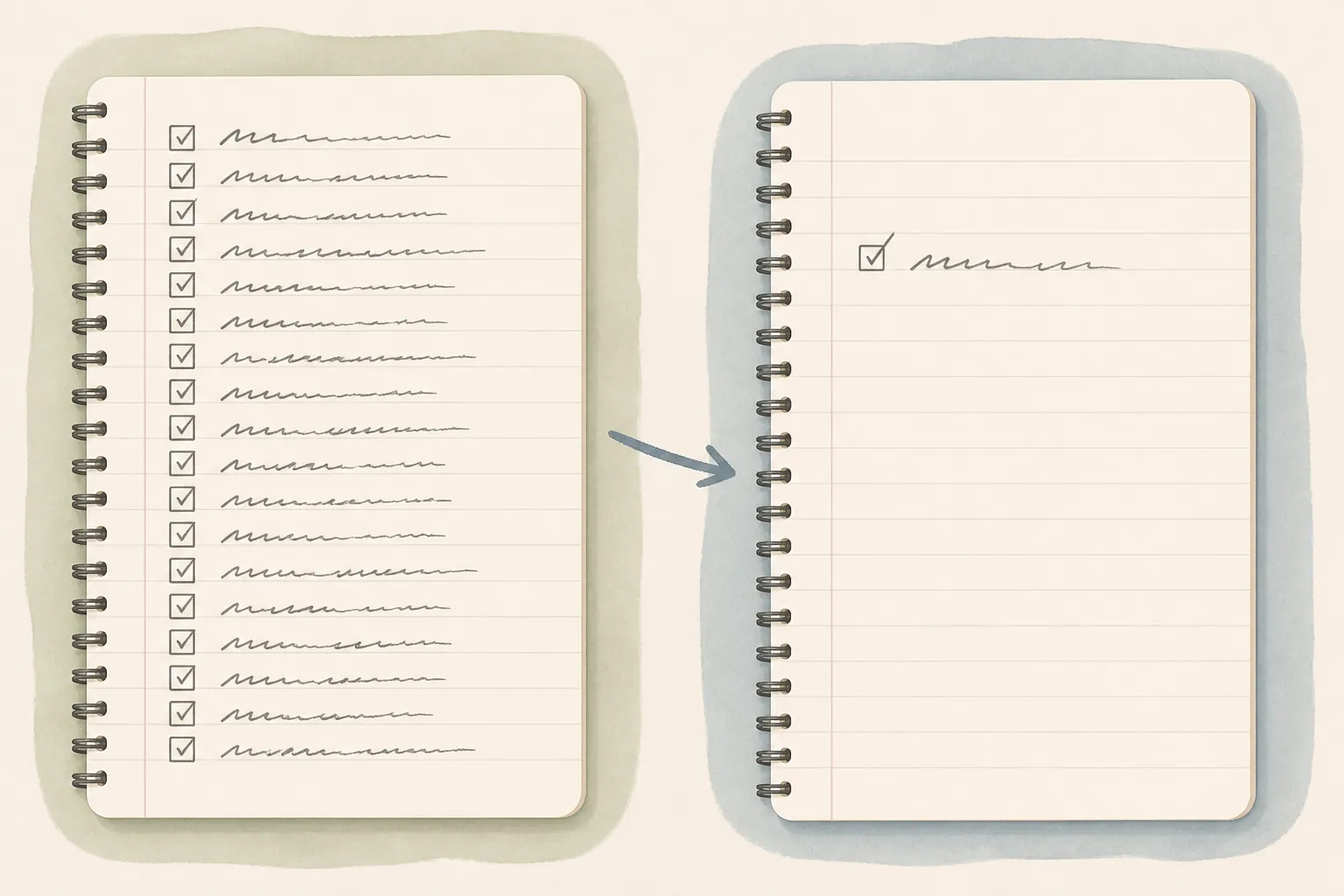
For example, the full version might capture three useful items and identify a next action. The fallback might open the same note, write one sentence about the most important thing from the day, and add a checkmark. If even that is too much, write a single keyword that will restore the context tomorrow. The exact size is yours to set; the important feature is that it is specified before motivation drops.
The fallback is not a dishonest substitute for the real habit. It is the real habit at reduced capacity. It preserves the cue, the location, and the act of recording, while postponing depth until conditions improve. The low-motivation routine should not trigger a catch-up assignment the next day. Resume the full version when it is practical.
- Keep the same cue.
- Use the same note or capture location.
- Reduce the amount of writing rather than removing the behavior.
- Do not judge the day by the full routine when the fallback was the plan.
Do not use 21 days as a deadline
The familiar claim that a habit forms in 21 days is not a habit-formation research finding. It traces to a plastic-surgery anecdote that was later simplified into a general rule about behavior. Research reviewed by Gardner, Lally, and Wardle found that habit automaticity developed over a much wider range of individual timelines, with an average of about 66 days of daily repetition—roughly 10 weeks—before leveling off. [3]

That average is a planning horizon, not a guarantee. It does not mean every note-taking routine will feel automatic on day 66, nor that missing one day resets the process. It does mean that abandoning the experiment after three weeks may happen before the behavior has had a fair chance to become easier.
Track repetitions for about ten weeks, while noting whether the cue still fits and whether the notes produce a useful result. A missed capture is information about the system: perhaps the cue was too vague, the note was too hard to find, or the full version was oversized. Adjust those conditions instead of turning one omission into a verdict about your discipline.
Start with tomorrow's smallest credible version
Tomorrow, attach the daily capture to one event already on your calendar. Record a few useful lines in one place, then schedule the weekly review. Write down the fallback before you need it: one sentence and a checkmark is enough for a difficult day. Keep the routine under observation for roughly 66 days rather than expecting automaticity after 21.
Comments
Join the discussion with an anonymous comment.