
The uncomfortable part of buying AI productivity tools is not the demo. It is the boardroom question that follows it: if this system is so useful, why do so many companies still report no measurable return? In PwC's Global CEO Survey, 56% of CEOs said they saw zero ROI from AI in the past 12 months, while only 12% reported both revenue increase and cost reduction [1]. That gap is the real evaluation problem.

Once that gap is visible, the feature list stops being the main event. Model quality, prompt libraries, polished summaries, and agent demos may all be fine capabilities, but they do not answer the harder question: what has to change in a specific workflow for the tool to pay for itself? If the answer still depends on manual checking, duplicate entry, or status chasing, the purchase is probably buying activity, not value.
The ROI-first filter
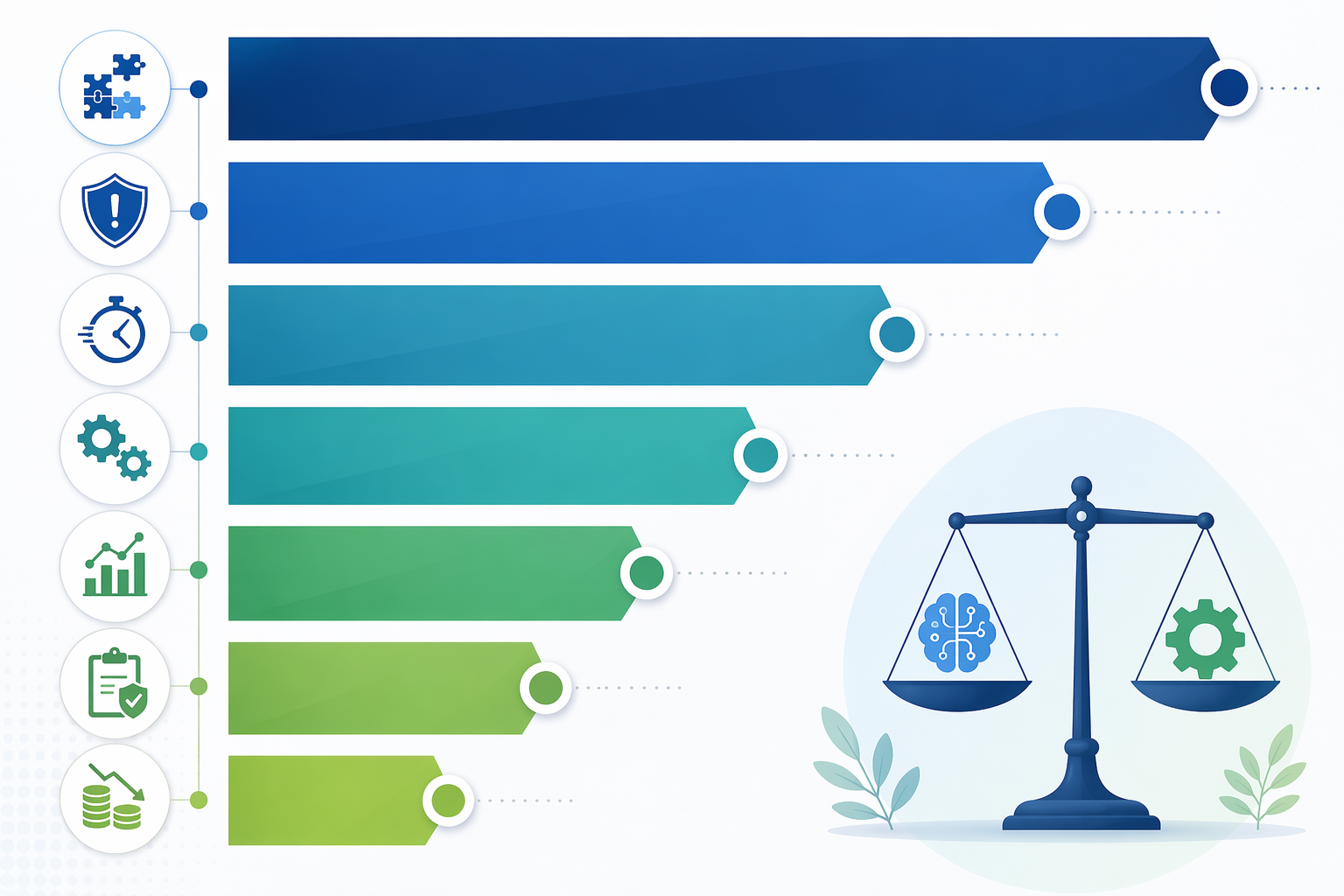
A useful screening method starts with seven questions, but not all seven matter equally. Integration depth, rework risk, and time to proof deserve the most weight because they decide whether AI stays a sidecar or reaches the systems where work actually happens.
| Criterion | Priority | What to check | What usually goes wrong |
|---|---|---|---|
| Integration depth | Highest | Does it connect to CRM, project management, communications, approval, and reporting systems? | People still copy, paste, reconcile, and chase updates by hand. |
| Rework risk | High | How much review, correction, or exception handling does the output create? | A faster first draft just moves labor into cleanup. |
| Time to proof | High | Can the pilot show a workflow-level result in 90 days or less? | Budgets stay open long enough for anecdotes to replace evidence. |
| Automation depth | Medium-high | Does it remove steps or only assist within the same broken process? | The tool helps a person work faster without changing the process cost base. |
| Measurement capability | Medium-high | Can value be tracked at the workflow level from day one? | Teams argue about impressions because telemetry was never built. |
| Governance readiness | Medium | Are RBAC, audit logs, and approval flows in place before launch? | Risk owners get involved late and slow adoption down. |
| Scaling economics | Medium | Does cost rise with headcount faster than measurable value? | A pilot looks fine and the expanded rollout does not. |
The hard rule behind the framework is simple: if a tool cannot save 3–5 hours per user per week in a specific workflow, it is unlikely to pay for itself. That is not a universal law; it is a forcing function. It keeps evaluation anchored to a workload, not a promise. The same caution shows up in the usage pattern data: ActivTrak points to a 7%–10% sweet spot for AI use, with productivity flattening or falling once AI is spread too broadly across work hours [3].
Integration depth is where most pilots break
This is the first place to spend time because it is where the tool-sprawl problem shows up in operations, not in vendor slides. The average organization now runs 7 AI tools, up from 2 in 2023, and 78% of teams struggle to integrate them [3][4]. That is why integration should mean more than a plug-in or an export button. It should mean the tool can touch the systems where work is created, approved, updated, and reported.
In practice, that means asking whether the tool can write back to CRM records, update project status, trigger approval flows, or surface outputs where managers already review work. If it only produces a nicer draft in a separate window, the human still has to carry the work across systems. The friction does not disappear; it just moves.
Rework risk can erase the gain
Workday-linked 2026 data in DigitalApplied's roundup shows task-level speed improvements in the 14% to 55% range, but also indicates that 37% to 40% of the time saved can be lost to fixing low-quality AI output [2]. That is the part feature demos almost never price in. A tool that makes the first draft faster but shifts quality control onto already-busy staff can look productive in a pilot and still fail the ROI test.
This is where finance reviews often get misled. The team sees shorter generation time and records a win. The hidden line item is the review tax: checking facts, cleaning structure, correcting tone, and re-entering output into the actual system of record. Unless that correction time is measured, the apparent gain is not a gain.
Time to proof and measurement belong together
A pilot that cannot show something real within 90 days is usually too slow for budget discipline. The point is not speed for its own sake; it is forcing a decision while the workflow is still legible. DigitalApplied's roundup, citing Bain-linked guidance, says programs that define success metrics at kickoff, instrument output as telemetry from day one, and treat evaluation infrastructure as core budget see 2x to 5x higher ROI [2].
That does not mean every team needs a heavy analytics stack. It means the evaluation needs a named workflow, a baseline, a success definition, and a way to tell whether the tool improved throughput, reduced rework, or shortened cycle time. If those measures are improvised after launch, the result is usually a story about adoption, not a reading on business impact.
Automation depth separates assistants from process change
McKinsey's widely cited point in the same DigitalApplied roundup is that only about 6% of companies capture outsized AI value because they redesign workflows end to end rather than bolting AI onto an existing process [2]. That is the difference between a tool that helps someone work faster and one that changes how the work is done.
The practical test is blunt. If the tool still requires the old intake, the old handoff, the old approval chain, and the old reporting path, it is an assistant. If it collapses steps, removes handoffs, and changes where the work waits, it has a chance to create actual operating leverage.
Governance and scaling are the budget sanity checks
RBAC, audit logs, and approval flows are not compliance ornaments. They matter because adoption slows when risk owners are brought in late, and late governance usually shows up as delays, exceptions, or blocked expansion. Once a pilot is approved, scaling economics become the last check: if cost rises with headcount faster than measurable value, the rollout is just a larger version of the pilot's problem.
That is why the buying motion should stay narrow until the workflow proves itself. Name the process. Estimate savings only after subtracting review and correction time. Give the pilot a 90-day proof window. Expand only when the measurement shows value at the workflow level, not just a cleaner demo.
References
- “56% of CEOs See Zero ROI From AI: Here’s What The 12% Who Profit Do Differently,” Forbes, Jan. 28, 2026
- “AI Agent Productivity Statistics 2026: ROI Data Points,” DigitalApplied, 2026
- “2026 State of the Workplace,” ActivTrak, 2026
- “Best AI Productivity Tools,” Zapier, 2026
Comments
Join the discussion with an anonymous comment.