
Hint’s most interesting promise is not that Martha Stewart has put her name on a home app. It is that the app begins before the homeowner has built a checklist. You enter a street address, and Hint says it can pull together public property characteristics, climate zone, soil type, flood risk, air quality, and weather patterns, then turn that into a living profile of the house. After that, the homeowner can add appliance manuals, warranty cards, inspection reports, insurance policies, and other documents that usually live in drawers, inboxes, or contractor text threads.[1]
That is the right place to start a review of Martha Stewart’s Hint app for home organization, because “organization” is the least useful word for the problem. A house does not merely need its documents labeled. It needs someone to notice that the HVAC filter is overdue, that a warranty may matter before a repair visit, that drought conditions can affect a foundation, or that an insurance policy will be impossible to find when water is already coming through the ceiling.

As of July 24, 2026, Hint looks genuinely more ambitious than a digital binder. It also remains unproven in the ways that matter most to homeowners: pricing has not been disclosed, Android support has not been announced, and there are no independent hands-on reviews or user ratings yet. The concept is strong enough to watch closely. It is not yet strong enough to call worth paying for.
The Home Profile Is the Real Product
Most home management apps ask the homeowner to do the unpaid data-entry job first. Add the refrigerator. Add the model number. Upload the manual. Create the maintenance task. Set the reminder. If you are already tired, which is usually when home maintenance falls apart, the app becomes another chore.
Hint’s claim is different. The address supplies the first layer of context, and the homeowner’s documents deepen it over time. Fortune described the app as using public data on property characteristics, climate zone, soil type, flood risk, air quality, and weather patterns, then combining that with uploaded home records to create a continuously updated digital home profile.[1] That matters because the same maintenance reminder can mean different things in different houses.
A furnace filter reminder is useful. A furnace filter reminder that understands local air quality, seasonal use, the age of the equipment, and the documents tied to that system is more useful. A foundation reminder is easy to ignore in a generic app. A foundation-watering alert tied to drought conditions in Texas, which CEO Yih-Han Ma gave as an example in a Realtor.com interview, is the kind of specific nudge that could plausibly prevent damage instead of merely documenting it afterward.[2]
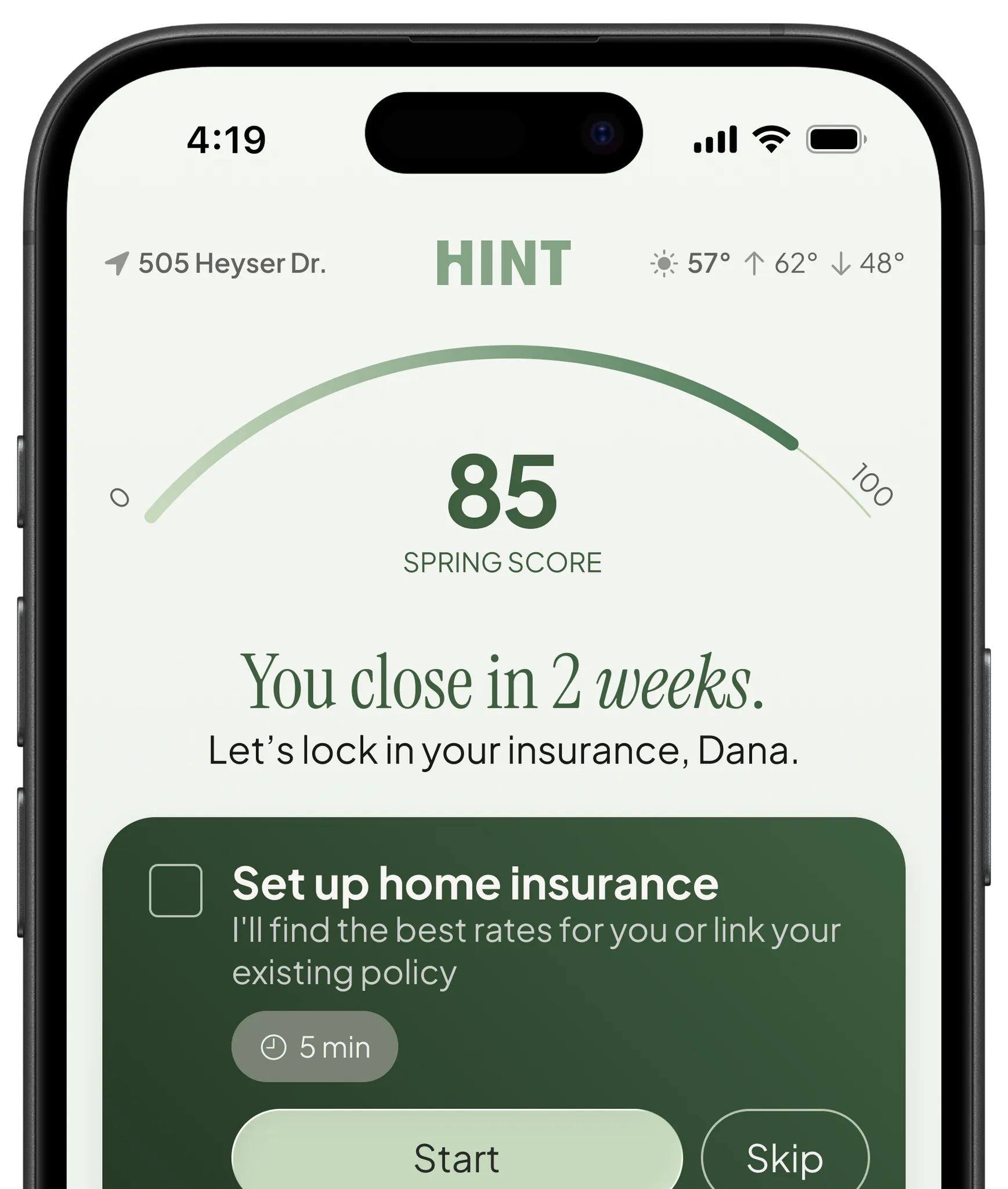
The strongest version of Hint is not a prettier home inventory. It is a monitoring layer that knows enough about the structure, local conditions, and household records to reduce surprise work. That is a meaningful distinction. A home inventory helps after something breaks, during a move, or when an insurance claim begins. A maintenance intelligence tool has to be useful before the bad weekend starts.
Why Homeowners Might Actually Care Now
The timing is not accidental. Americans spend more than $500 billion annually on home renovations and repairs, according to the Harvard Joint Center for Housing Studies figure cited in Fortune’s launch coverage. The same article cited Angi’s finding that 62% of homeowners were more worried about affording maintenance than they had been the prior year.[1]
Those numbers do not prove that an app can lower repair bills. They do explain why the burden feels less like a niche productivity problem and more like household risk management. In many homes, one person quietly becomes the facilities manager: scheduling the HVAC service, checking the sump pump, remembering which contractor said what, finding the warranty card, and making the decision when a small smell in the basement might become an expensive claim.
There is also a practical opening in the market. Centriq, a popular appliance-tracking app, shut down in January 2026, leaving some homeowners without the tool they used to store model numbers, manuals, and appliance records. Hint is arriving just as a familiar category has lost one of its more useful names.
The question is whether Hint can do more than replace the appliance binder. If it can connect records to local risk, seasonal timing, and actual recommendations, it belongs in a different category from a static vault. If it mostly stores PDFs and sends reminders, the celebrity launch will have dressed up a problem that several tools already understand.
What Martha Stewart Adds, and What She Does Not Prove
Martha Stewart’s involvement is relevant because Hint is selling household judgment, not just software infrastructure. The official MarthaStewart.com announcement says the app incorporates her tested household strategies, seasonal guidance, and standards for managing a home.[3] That is more useful than a generic chatbot voice telling you to “stay on top of maintenance.”
There is a real difference between an app that says “clean gutters in fall” and an app that has an editorial standard for what a well-run household should notice by season, by room, and by material. Stewart’s career gives Hint a bank of domestic expertise and an aesthetic expectation that could make the product feel less like enterprise software pasted onto a house.
But taste and authority are not the same as verification. Stewart’s involvement can improve the quality of the guidance library. It cannot, by itself, prove that the app correctly interprets property data, prioritizes maintenance tasks, avoids bad product recommendations, or saves anyone money. That evidence has to come from use.
The Promises Are Specific, but Still Company Claims
Ma has offered several examples of what Hint might do when the profile and recommendation engine are working well. In the Realtor.com interview, she said the app could analyze energy usage and recommend tailored plans that save more than 40%, help homeowners get 5 to 10 additional years out of HVAC equipment through regular tracking, and send drought-related foundation-watering alerts in Texas.[2]
Those are the right kinds of examples because they point to outcomes homeowners can feel: lower utility costs, longer equipment life, fewer preventable structural problems. They are also not independent findings. There are no public third-party studies showing that Hint users save more than 40% on energy plans, extend HVAC life by 5 to 10 years, or avoid foundation damage because of app alerts.
So the fair reading is narrow: these examples show the ambition of the system, not its proven effectiveness. A homeowner evaluating the waitlist should treat them as scenarios to test once the product is available, not as guaranteed returns.
| Claimed capability | Why it matters | What remains unverified |
|---|---|---|
| Address-based home profile using property and environmental data | Reduces the blank-page setup problem and may make guidance more relevant | Accuracy, coverage, and usefulness across different property types |
| Uploaded manuals, warranties, inspections, and policies | Keeps documents available when repair, resale, or claim decisions happen | How well the app extracts, organizes, and retrieves details from messy documents |
| Energy-plan recommendations | Could turn home data into recurring savings | Actual savings for real users and whether recommendations remain unbiased |
| HVAC tracking and maintenance guidance | Could help homeowners service equipment before expensive failures | Whether tracking changes behavior enough to extend equipment life |
| Location-specific alerts such as foundation watering during drought | Moves from generic reminders to risk-aware maintenance | How precisely alerts match local conditions and individual homes |
The Recommendation Problem Is the Hardest Part
Hint raised a $10 million seed round led by Slow Ventures, and the most revealing detail from Fortune’s reporting was not the size of the round. It was Kevin Colleran’s concern about affiliate fees. Colleran told Fortune that, as a condition of investment, he required Hint to commit that recommendations would be “blind to commercial deals.”[1]
That is a credit to the investor and to the company for naming the issue plainly. It is also a warning label. If a home app recommends an energy plan, contractor, appliance filter, water sensor, service visit, or insurance-related product, the homeowner needs to know whether the recommendation is good for the house or good for the revenue model.
Affiliate revenue is not automatically disqualifying. Plenty of useful tools earn referral fees, and homeowners may prefer a lower subscription price if the tradeoff is transparent. The risk is that home maintenance recommendations carry higher stakes than a shopping list. A bad suggestion can waste money, delay a repair, or send someone toward a service provider who is not the best fit for the property.
The phrase “blind to commercial deals” is therefore central to whether Hint deserves trust. It needs more than a launch-window promise. It needs visible product design: clear labeling, an explanation of why a recommendation appears, separation between paid relationships and ranked advice, and enough user experience in the wild to see whether the rule holds when revenue pressure arrives.
Where Hint Sits Among Existing Home Apps
The competitive landscape makes Hint easier to understand, but it should not be mistaken for a simple feature comparison. Human concierge services such as Honey Homes and Birdwatch can help with home maintenance by putting people into the loop, but that model is expensive and hard to scale; Honey Homes has been cited at about $350 per month.[1]
On the software side, tools such as HomeZada, HomeBinder, Homer, Tody, and Upkeepify cover parts of the job: document storage, home inventory, chore schedules, reminders, budgeting, or maintenance tracking. The reported price range in the category runs from free products to annual or monthly subscriptions, including HomeZada at $59 to $189 per year and Upkeepify at $5 to $9 per month.[1][2]
Those tools can be useful. The distinction is that most are reactive. They depend heavily on the homeowner knowing what to enter, what to track, and when a reminder matters. Hint is trying to begin with the house itself: the address, the public data around it, the documents attached to it, and the seasonal or environmental conditions that change what maintenance should rise to the top.
That approach is the reason Hint is worth watching. It is also the reason the product has to be judged carefully. The more an app claims to know before the homeowner tells it much, the more important accuracy, source quality, and recommendation logic become.
The Launch-Window Caveats Are Not Small
As of July 24, 2026, Hint is still a waitlist product. The planned summer 2026 launch is for desktop and iOS. There is no announced Android support, web app timeline beyond the stated desktop experience, or tablet-specific timeline in the available materials. That immediately limits who can use it at launch.
Pricing is the biggest missing piece. A home intelligence app can be worth paying for if it catches one expensive problem early, keeps records usable during a claim, or helps avoid unnecessary service calls. But no one can judge that exchange honestly without knowing whether Hint costs a few dollars a month, a premium annual fee, or something closer to concierge pricing.
There are also no independent user reviews yet. The available picture comes from company materials, friendly launch coverage, interviews, and the official website. That does not make the claims false. It means the evidence is still launch evidence, not homeowner evidence.
One small but practical search note: Martha Stewart’s product is Hint by Hint Home Intelligence, found at hinthome.com. It is not the unrelated astrology app that appears in some search results as Hint.app.
Who Should Join the Waitlist
Hint is most compelling for homeowners who already feel the drag of fragmented home information: first-time homeowners learning how much the house expects from them, busy households where maintenance lives in one person’s head, owners of older homes with uneven records, and anyone who has had to search email for a model number while a technician waits in the driveway.
It is less compelling, at least for now, for Android-only users, renters with limited maintenance responsibility, homeowners who only want a simple chore checklist, or anyone who needs proven savings before sharing home documents with a new platform.
- Join the waitlist if you want proactive maintenance guidance and are comfortable evaluating a new tool before pricing and reviews are public.
- Wait for independent reviews if your main concern is whether the app’s recommendations are accurate, unbiased, and worth the cost.
- Skip the launch window if Android support is essential or if you only need a document vault today.
The honest verdict is conditional. Hint has one of the more interesting ideas in home organization because it starts with the property, not with a blank checklist. If the app can turn address-based context, household documents, seasonal expertise, and unbiased recommendations into fewer surprises, it could become genuinely useful. But until pricing, platform support, and real user experience are visible, no one can honestly say it is worth paying for.
References
- Exclusive: Martha Stewart's new AI startup wants to manage your home before things break, Fortune, 2026/05/13
- With Martha Stewart's Help, This New AI App Is Reshaping Homeownership, Realtor.com, 2026
- Martha's Latest Launch Makes Managing Your Home Easier Than Ever, MarthaStewart.com