
The useful lesson about using AI in your workflow from Hank Green’s July 2026 mess is visible in the timeline before it is visible in any theory. On July 30, an Ask Hank Anything episode went up. Viewers noticed an unusual cluster of correction cards attached to claims in the video, and Green replied in the comments, “I appreciate the pushback.” By July 31, multiple outlets had reproduced his fuller Reddit statement: he had used ChatGPT for research, had been “relying too much on generated notes,” and described it as “a bad habit at a time when I’ve overcommitted myself.”[1][2][3]
Last verified: August 2, 2026, UTC. This is still a fresh story, and the precise origin of every corrected claim has not been established.
The public argument quickly became larger than the episode: AI, creator trust, whether a science communicator should know better. Fine. But that is not where the failure becomes useful. The useful part is smaller and more mechanical. Green did not say an AI wrote his opinion for him. He said he had been using ChatGPT to “surface papers and resources,” then leaning too hard on generated notes before turning that research into a script.[1][2]
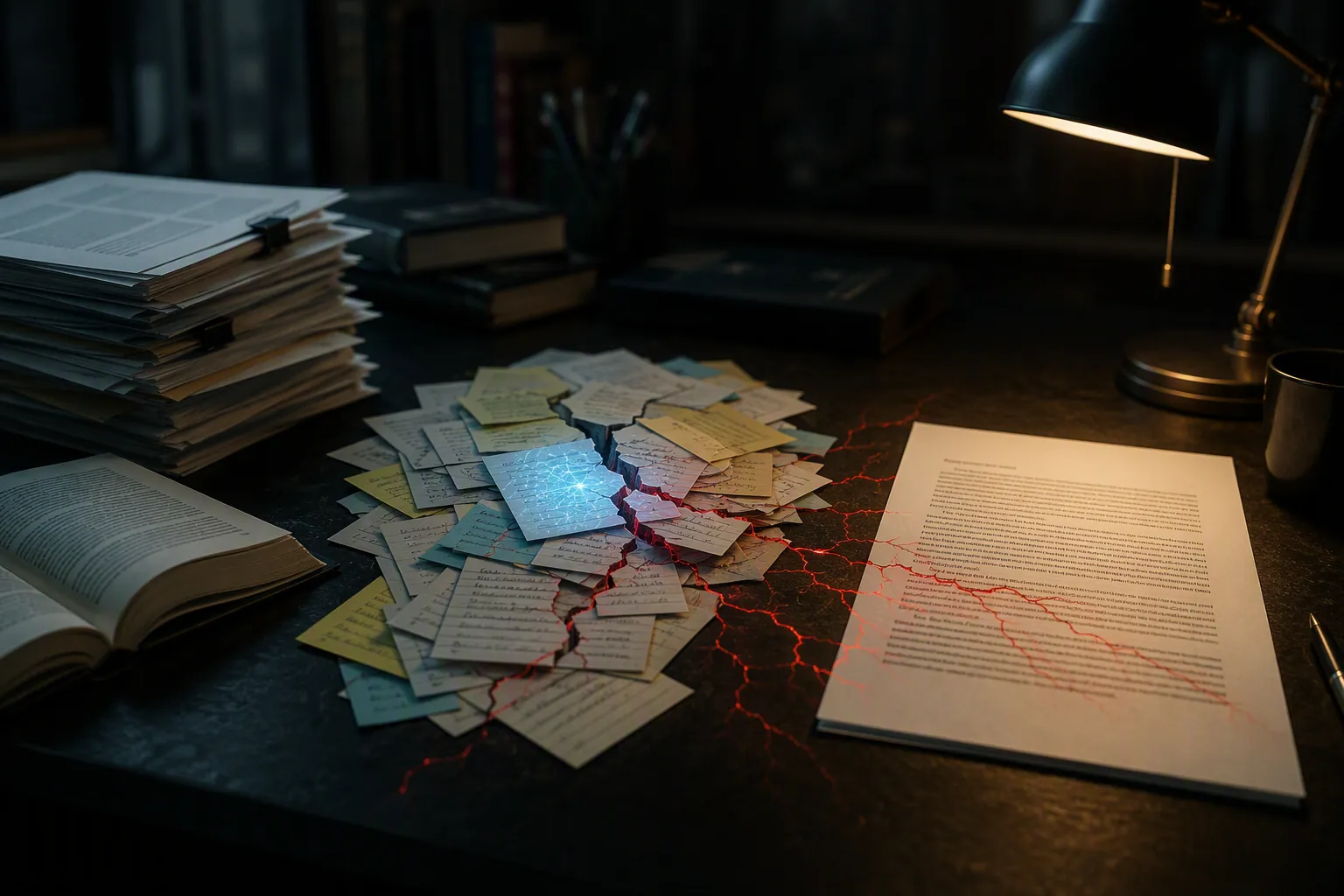
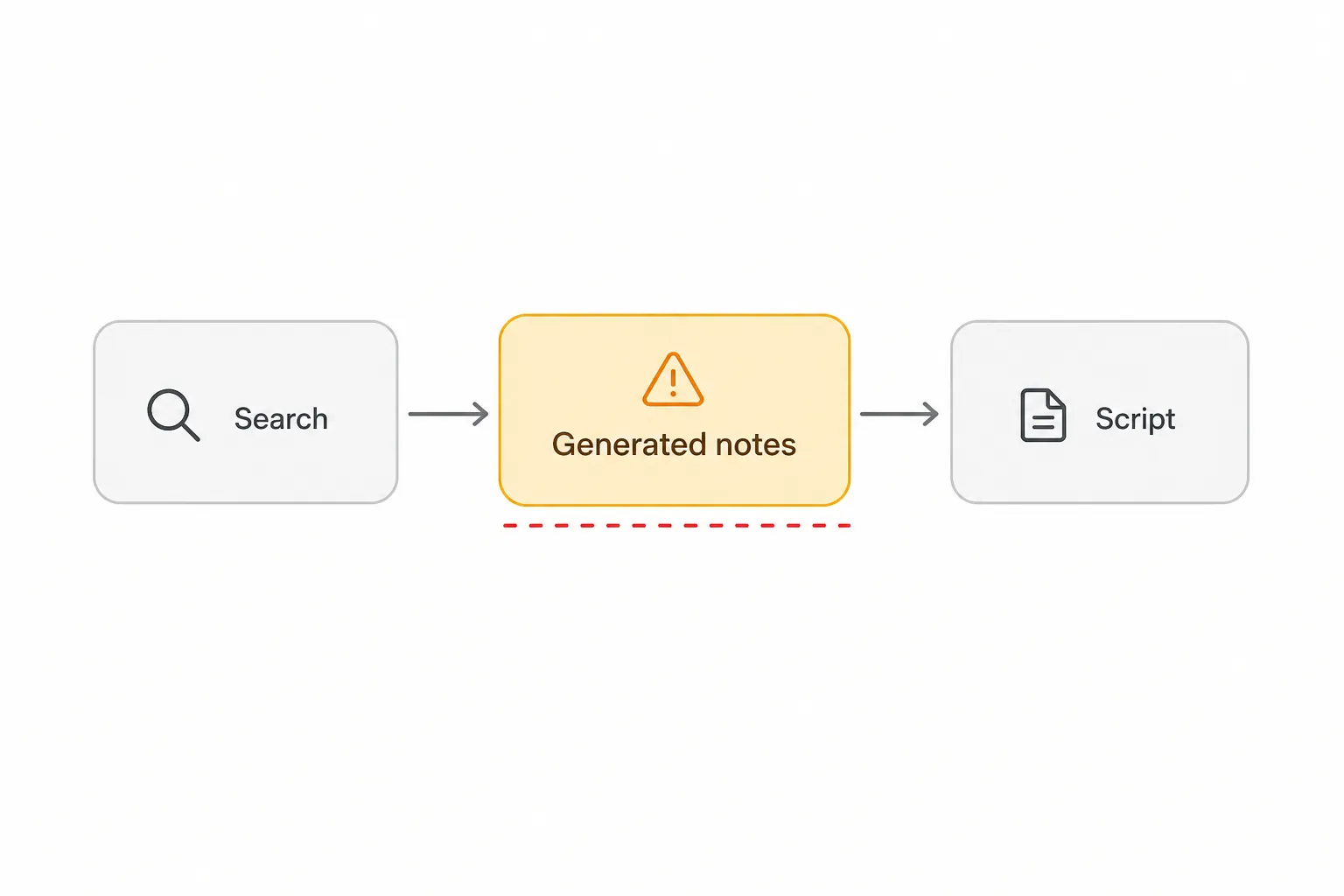
That middle layer is the problem. Search is a lead-generation step. A script is an accountable public claim. Notes sit between the two, and in many knowledge workflows they acquire a kind of undeserved authority: once something has been captured, tagged, summarized, and placed next to other research, it starts to feel handled.
What Green said his workflow had become
Green’s own description matters because it draws a line that the pile-on often blurred. He said the viral phrasing that drew attention was an ad-lib, not something produced by AI, but he also conceded that the episode “definitely get[s] an AI feel.” He added that the habit had “disconnected me from where people are on this.”[1][2]
| Stage | What happened in the described workflow | Where accuracy can fail |
|---|---|---|
| Search | ChatGPT was used to surface papers and resources. | A surfaced item can be irrelevant, misread, weakly related, or nonexistent. |
| Generated notes | The surfaced material was converted into notes Green later relied on. | The note can preserve the confidence of a source without preserving the source itself. |
| Script | The notes fed an audience-facing episode. | An unchecked note becomes a public factual claim. |
The correction-card cluster is the visible symptom. Reports pointed to claims involving cat saliva, mantis shrimp vision, and artificial sweeteners. Dexerto noted the claims had prompted corrections, but it remains unconfirmed whether those specific errors originated in AI-generated notes.[3] That distinction is not pedantry. It is the difference between a documented failure mechanism and a satisfying accusation.
The documented mechanism is already enough. A tool surfaced material. Generated notes became easier to trust than they deserved to be. Those notes moved downstream into a script. The audience encountered the result not as a draft, not as a lead, and not as a half-checked research scratchpad, but as a finished Hank Green video.
The notes layer is where an AI lead turns into a “fact”
Most AI workflow advice spends too much time on the final artifact: Did the model write the post? Did it generate the script? Did it imitate a voice? Those are disclosure questions, but they are not always the highest-risk accuracy questions. For research work, the more dangerous moment often happens earlier, when the model gives you something that looks like a useful source trail.
An LLM can make the boring part of research feel faster. Ask for papers. Ask for a reading list. Ask for “what should I know before writing about this?” The tool returns names, claims, summaries, and apparent structure. Some of it may be useful. Some of it may be wrong. The irritating part is that both kinds often arrive in the same tone.
That tone is what contaminates a notes system. A raw search result still looks provisional. A paper you have opened, skimmed, and annotated has friction attached to it. A generated note has neither. It can arrive polished, compressed, and ready to paste. If it enters the same repository as verified reading notes, it borrows the credibility of the system around it.
This is why “I only used AI for research” is not a minor admission when the output depends on accuracy. Research is not an ornamental phase. It is where claims are selected, framed, and normalized. If a false or unsupported claim gets admitted there, the script stage may simply make it smoother.
Source surfacing is not source verification
There is a defensible version of using ChatGPT or another LLM as a source surfacer: ask it for possible leads, then go find the primary source yourself. The lead has not earned entry into the notes system until the human has opened the source, checked that it exists, checked what it actually says, and recorded where the claim came from.
The bad version is quieter. The model names a study. The model summarizes a finding. The user asks for more. The model gives more. The conversation feels productive, so the notes file fills up. Later, under deadline pressure, the notes look like research instead of a to-do list for verification.
Green’s explanation fits that second risk pattern closely enough to be instructive without pretending we know more than we do. He described the interaction as dopamine that was “not healthy for me or good for the world,” and said his wife Katherine and brother John had both told him the behavior was unhealthy.[1][2][3] That matters less as confession and more as workflow evidence: the tool was not merely saving a few keystrokes. It had become a habit loop.
Pressure explains the shortcut. It does not absorb the risk.
“Overcommitted” is a real explanation. Anyone who has maintained a public output schedule, a research queue, and an audience relationship at the same time should recognize the temptation. The machine is available, fast, flattering, and apparently tireless. It can make a backed-up person feel like the work is moving again.
It is not an excuse. The person who publishes the final claim still owns the claim. If the claim is wrong, the audience does not get to inspect the chat history. Editors, fact checkers, collaborators, and viewers inherit the cleanup. The tool does not sit in the correction card.
The consequences around Green’s channels made the stakes more than personal embarrassment. The Verge reported that hankschannel “may need to pause,” while SMUSH and 4x3 were paused; Complexly’s staffed channels, including Crash Course, SciShow, and PBS Eons, continued operating.[2] TechTimes also noted the contrast with Complexly’s February 2026 move to nonprofit status, framed around producing trustworthy content through a process involving researchers, writers, editors, and fact checkers.[4]
That contrast is the part worth sitting with. A staffed editorial process exists partly to make provenance visible before a claim reaches the audience. A solo shortcut can bypass the same discipline even when the person taking the shortcut knows exactly why the discipline exists.
This is not just a Hank Green problem
A single creator controversy would be too thin a basis for broad rules. The broader evidence does not say every AI-assisted research workflow fails. It says the failure mode is real, already visible in high-stakes environments, and easy to underestimate.
TechTimes reported that a GPTZero analysis of accepted NeurIPS 2025 papers found more than 100 hallucinated citations across 53 papers, citing a ScienceDirect-published analysis.[4] That example is useful because citations are supposed to be the boring, checkable spine of research. If fabricated or broken citations can survive into accepted academic work, a fast creator or knowledge worker should not assume their personal notes are magically safer.
Duke University Libraries’ 2026 hallucination overview gives the mechanism a clean name: the LLM as a “digital Yes Man.” The point is not that the model intends to flatter. It is that the system can produce plausible, confirmatory material aligned with the user’s implied framing, whether or not the underlying claim has been nailed down.[5]
That is exactly why generated research notes are so treacherous. They do not merely answer a question. They often answer the version of the question the user seems to want answered. If the user is rushed, the model’s helpfulness can become a filter that removes friction at the moment friction is still needed.
The behavior is also mainstream now. A Wondercraft survey of 514 creators conducted in March and April 2025 found that roughly 83 percent used generative AI in at least part of their workflow, with chat tools the most-used category at 37.6 percent. Digiday also cited a January 2025 Nielsen study finding that 55 percent of respondents were uncomfortable consuming AI-generated media.[6]
Those two numbers sit awkwardly together, which is where the real market is: creators and knowledge workers are using the tools, while a large share of the audience is uneasy about the result. That gap does not disappear because the AI use happened upstream in research rather than downstream in prose.
The disclosure gap is part of the accuracy problem
Disclosure often gets treated as a reputational add-on: something to say after the work is done so the audience can decide how annoyed to be. In accuracy-critical work, disclosure is more basic than that. It tells collaborators, editors, and readers where extra scrutiny should be applied.
If a script says, “Researchers have found X,” the fact checker needs to know whether that claim came from a primary paper, a secondary article, a human researcher’s notes, or an LLM-generated summary of something that may or may not have been opened. Without that provenance, every polished sentence becomes equally suspicious. That is an expensive way to edit.
Green’s case is unusually instructive because the trust standard was not vague. His public brand and Complexly’s institutional premise were built around explanatory reliability. When a workflow quietly inserts generated notes between sources and script, the audience is not given the information it would need to calibrate trust until after something breaks.
This does not mean every use of AI in research deserves a dramatic warning label. It does mean that when accuracy is the product, undisclosed AI-assisted research is not a private productivity detail. It changes the verification burden.
What to audit in your own workflow
The practical fix is not to pretend the tools will go away. It is to stop letting generated material enter the notes system with the same status as verified research. A decent workflow has to preserve the difference between a lead, a source, a note, and a claim.
- Treat LLM-surfaced papers, statistics, names, and examples as leads. A lead can be useful and still be untrusted.
- Do not move a claim into permanent notes until you have opened the primary source or a clearly identified secondary source and checked what it says.
- Keep the citation with the note, not in a separate “sources later” pile. “Sources later” is where provenance goes to die.
- Date the note. Record whether the original lead came from ChatGPT, Claude, search, a database, an interview, a paper, or a human collaborator.
- Separate generated summaries from verified reading notes visually or structurally. A tag, folder, field, or prefix is enough if it survives deadline pressure.
- Before publication, fact-check from the script back to the source, not from the script back to the generated note.
- Disclose AI-assisted research when the audience is being asked to trust the factual accuracy of the output.
A hypothetical example makes the distinction plain. If an LLM suggests that a certain study supports a claim, the next action is not to paste that claim into a research note. The next action is to find the study, confirm that it exists, read the relevant passage, and write the note from the source. The LLM can remain in the provenance trail as the place the lead came from. It should not become the authority for the claim.
This discipline is dull, which is why it works. It does not require a new moral theory of artificial intelligence. It requires refusing to let a confident middle layer harden into fact before anyone has checked where it came from.
References
- Famous Science YouTuber Admits He Has ‘Unhealthy Relationship’ With AI After Facing Backlash Over Recent Video — Kotaku, July 31, 2026.
- Hank Green says his YouTube channel may need to pause after admitting to relying on AI for research — The Verge, July 31, 2026.
- Hank Green faces major backlash after admitting he used ChatGPT to research YouTube script — Dexerto, July 31, 2026.
- ChatGPT Research Habit Cost Hank Green Accuracy His Brand Was Built — TechTimes, Aug. 1, 2026.
- It’s 2026. Why are LLMs still hallucinating? — Duke University Libraries, Jan. 5, 2026.
- In graphic detail: How creators are using generative AI to shape video and design — Digiday, May 14, 2025.