
Hank Green’s AI note-taking backlash began with an uncomfortable kind of evidence: not a manifesto against AI, but a finished video that viewers said sounded wrong. In late July 2026, Green acknowledged that he had used ChatGPT while researching an episode and had been “relying too much on generated notes,” describing it as “a bad habit at a time when I’ve overcommitted myself.” Press accounts also reported that the disputed episode date is not perfectly settled, with coverage placing it on July 29 or July 30, so “late July” is the safest framing rather than a cleaner timestamp the record does not quite support. [1][2]
The detail that made the story spread was almost too neat: viewers noticed what appeared to be AI prompt feedback left in a script, and then argued over whether a line in the video — “I appreciate the pushback” — had been generated. Green said that line was an ad lib and was not present in either the notes or the script, a useful reminder that not every awkward phrase is proof of machine authorship. [1][3]
The more durable part of Green’s response was not the forensic argument over one sentence. It was his description of the workflow itself. In follow-up coverage, he said he needed to “readjust” and described the dopamine pull of large language models as “not healthy for me or good for the world,” while reporting that Katherine and John Green had raised concerns with him about his AI use. [4][2]
That is the version of the story worth taking seriously: a capable communicator, under pressure, using an assistant to make research feel more finished than it was. The lesson is not that AI notes are automatically false. The lesson is that a note can read as complete before the person using it has done the work that makes the information retrievable, checkable, and usable later.
The Failure Was Not Just Accuracy
Most arguments about using AI assistants for note-taking start with hallucinations. That matters, but it is too narrow. A hallucinated fact is visible once someone checks it. A smoothly organized note that dulls the need to check anything is harder to catch, because it arrives already formatted like understanding.
Green’s “AI feel” problem sits in that gap. The output may be grammatical, organized, and even mostly accurate, while still failing at the job a study note or research note has to do. A usable note should preserve the trail: where the claim came from, why it matters, what is uncertain, what has to be reread, and what the writer actually thinks after touching the material. If an assistant removes too much of that friction, the note becomes less like a memory aid and more like a plausible substitute for memory.
That distinction matters for students and knowledge workers deciding whether to trust AI inside Notion, Obsidian, Apple Notes, Evernote, GoodNotes, Notability, or any other note app. The question is not “Can AI write notes?” It plainly can. The question is what kind of trust is being asked for: trust to capture words, trust to find something later, trust to summarize a meeting, trust to support an exam, or trust to carry the synthesis that a person has not yet done.
The Strongest Evidence Points to the Encoding Step
The controlled research that best matches the Green episode is a pre-registered randomized experiment from Cambridge University Press & Assessment and Microsoft Research. It involved 405 students aged 14 to 15 across seven English schools, with students tested three days after the learning activity. [5][6]
The experiment compared three conditions: students taking notes themselves, students using an LLM, and students combining note-taking with an LLM. The result was not a simple anti-AI result. Note-taking alone and note-taking combined with an LLM both outperformed LLM-only use on comprehension and retention. At the same time, students preferred the LLM and perceived it as more helpful. [5][6][7]
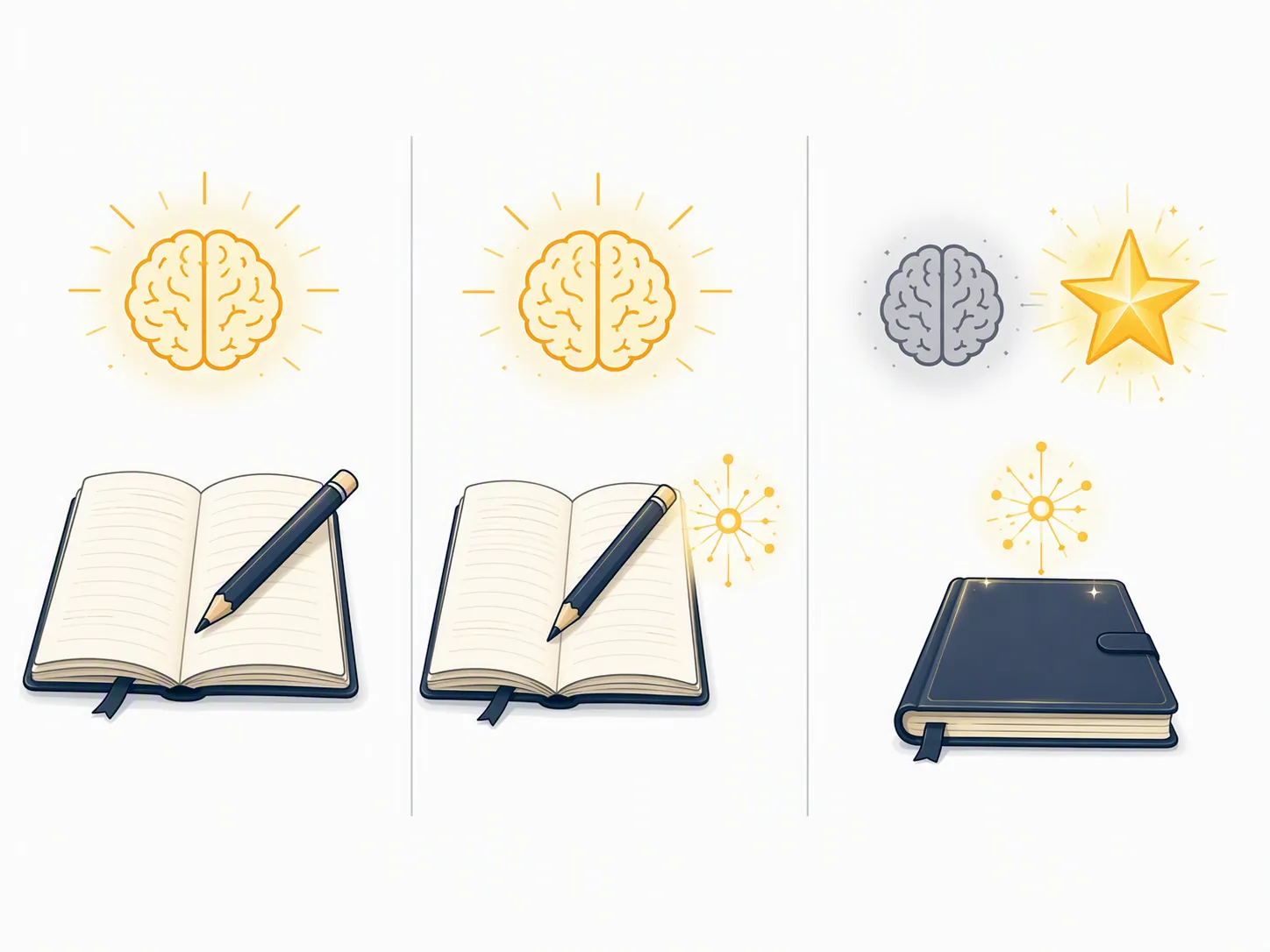
That mismatch is the important part. If students only reported preference, the story would be convenience. If the test only showed weaker learning, the story would be performance. Together, the two findings describe the trap: the tool can feel more helpful at the exact moment it is doing less for later recall.
This is where the common phrase “AI-generated notes” hides too much. A transcript is not the same as a summary. A summary is not the same as a study note. A study note is not the same as a durable understanding. The act of deciding what belongs in the note, what to leave out, what to connect to prior knowledge, and what still feels unresolved is part of learning. It is not just clerical overhead.
The Cambridge/Microsoft result also avoids an easy overcorrection. It did not show that touching an LLM ruins learning. The combined condition — human note-taking plus LLM use — performed better than LLM-only use, along with note-taking alone. The cost appears when the learner hands over the synthesis rather than using the assistant around it. [5][6]
| Use pattern | What the evidence suggests | Trust level |
|---|---|---|
| Human note-taking | Stronger comprehension and retention than LLM-only use in the Cambridge/Microsoft experiment | Trust as a learning activity, assuming the notes are reviewable |
| Human note-taking plus LLM | Also stronger than LLM-only use in that experiment | Trust as assistance, not replacement |
| LLM-only notes | Preferred by students, but weaker for comprehension and retention | Trust only after human audit and reconstruction |
Preference Is Not Proof of Learning
Chen et al. reached a similar warning from a different setup. In a 2025 CSCW paper using a within-subject study with 30 participants, fully automated AI note-taking produced the lowest post-test scores while being the most preferred condition. [8]
That study should not be inflated into a universal law; it is a small study with its own task design. But it reinforces the same practical discrepancy: people may like the notes that cost them the least effort, while the lost effort is exactly where some of the learning happened.
This is also why vendor-friendly review numbers need a careful label. A Genio literature review repeats larger percentage claims about reduced scores, including “35%” and “24%” reductions, but those figures appear in that secondary vendor review rather than as the central finding to attribute directly to Chen et al. or another primary paper among the sources cited here. [9]
The backlash atmosphere had its own numbers too. Dexerto reported that Green’s admission post had about 3 million views, but that figure was not independently verified here and is useful only for scale, not for judging whether the criticism was right. [3]
Trusted for What?
The practical answer depends on the job. AI is easiest to trust when the task is recoverable: recording, transcribing, cleaning up wording, finding a buried phrase, clustering rough notes, or surfacing items the user can inspect. Those tasks still need privacy and accuracy checks, but the assistant is not being asked to become the learner.
AI is harder to trust when the task is interpretive: deciding what mattered, turning sources into a thesis, choosing what evidence belongs, resolving contradictions, or producing the note someone will later treat as knowledge. At that point, the smoothness of the output becomes a liability unless the person can retrace it.
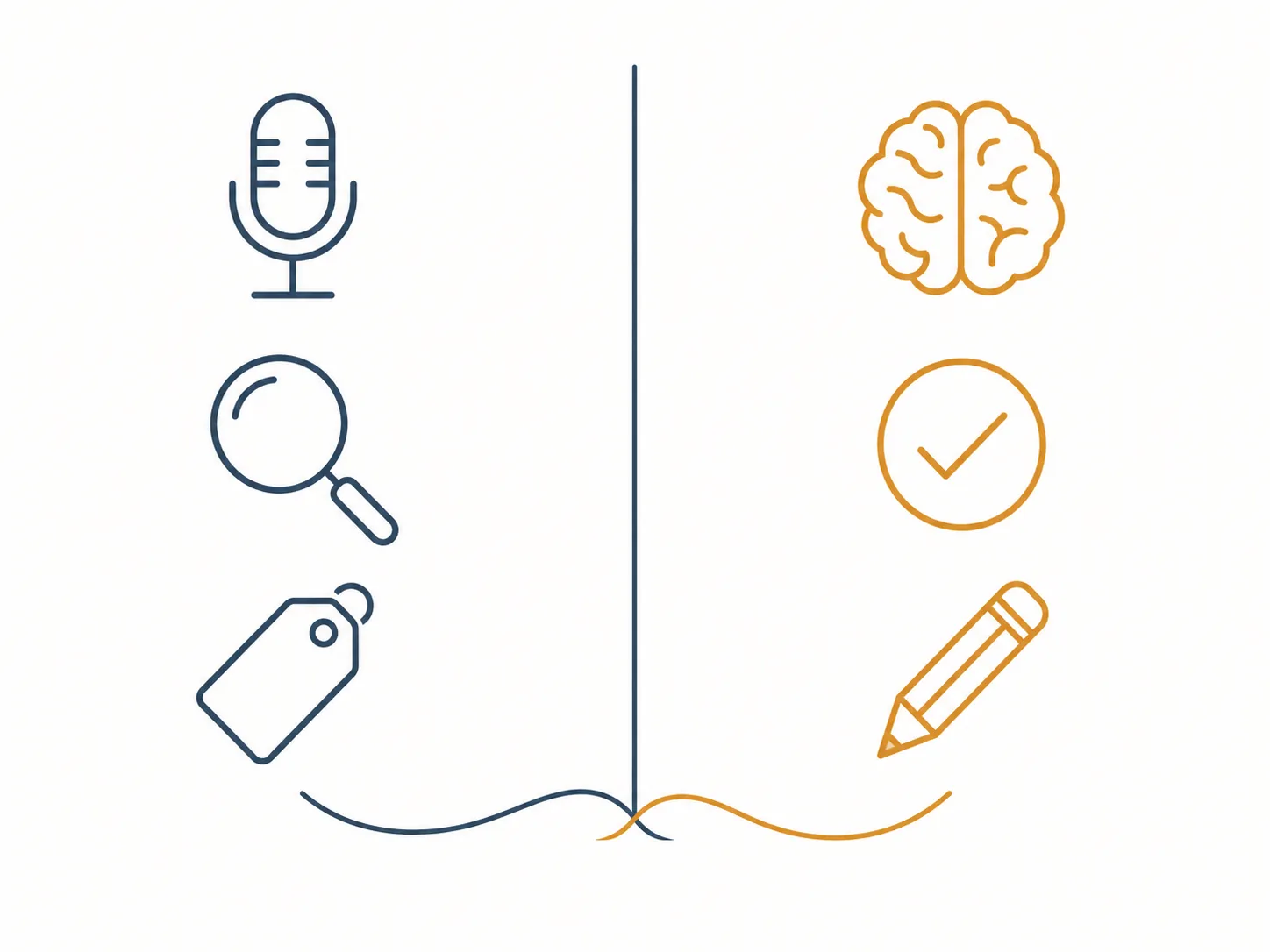
A safer division of labor looks less glamorous than most product demos:
- Let AI capture: transcripts, OCR, meeting notes, imported highlights, rough cleanup.
- Let AI locate: “find where we discussed pricing,” “show every note mentioning this author,” “surface related notes.”
- Let AI propose: possible headings, draft tags, candidate questions, weak summaries clearly marked as drafts.
- Keep synthesis human: the claim, the hierarchy, the connection to prior knowledge, the judgment about what matters.
- Keep verification human: source checks, quote checks, uncertainty notes, and the final decision to rely on the note.
That is also the useful boundary when comparing tools. A note app that helps retrieve your own material is doing a different job from one that generates a finished study guide from untouched inputs. The first can reduce search friction. The second can remove the moment when the user would have found out they did not understand the material yet. For a more operational comparison, the capture-versus-synthesis split is the right lens for evaluating AI note-taking apps as two different kinds of tools.
What Green’s Backlash Teaches
Green’s case does not prove that AI-assisted notes are useless, and it does not prove that every polished sentence in a script is suspect. It does show how quickly assistance can become substitution when a person is overloaded and the machine keeps offering finished-looking material.
The controlled studies make the same warning less personal and more useful. When students or participants fully offload note-making to AI, they can like the experience more while learning less. The note feels helpful because it reduces strain. The later test exposes the cost of that reduced strain.
So the answer to “can AI-generated notes be trusted?” is: only for the layer they actually performed. Trust a transcript as a transcript after spot-checking it. Trust a search result as a lead. Trust a summary as a draft. Do not trust fluent synthesis as knowledge until a human has rebuilt the trail, checked the claims, and done enough of the encoding work to remember why the note exists.
The durable lesson is plain: fluent output is not verified output. Anything that feels complete enough to let the reader skip the encoding step is exactly the thing that needs the most careful audit before it becomes a note worth keeping.
References
- Hank Green admits using ChatGPT after accidentally reading AI prompt feedback left in his script, The Express Tribune
- Famous Science YouTuber Admits He Has Unhealthy Relationship With AI After Facing Backlash Over Recent Video, Kotaku
- Hank Green faces major backlash after admitting he used ChatGPT to research YouTube script, Dexerto
- Hank Green says his YouTube channel may need to pause after admitting to relying on AI for research, The Verge
- Study shows note-taking beats AI for learning, EurekAlert
- Effects of LLM use and note-taking on reading comprehension and memory: A randomised experiment in secondary schools, Microsoft Research
- Note-taking vs using an AI chatbot: which is most helpful for learning?, Cambridge International
- Evaluating the Impact of AI-Assisted Note-Taking on Learning Outcomes and Cognitive Engagement, arXiv, 2025
- The impact of AI on note-taking in higher education, Genio