
Blue Prism still belongs on the 2026 robotic process automation shortlist, but not as a default enterprise answer. It is strongest when the automation estate has to survive audit review, security scrutiny, unattended scale, and handover from the original delivery team. It is harder to justify when the buying driver is low-cost experimentation, broad attended automation, a large developer market, or the fastest AI-native workflow tooling.
| Buyer question | 2026 answer |
|---|---|
| Best fit | Regulated enterprises running high-control, unattended automation across finance, insurance, healthcare, banking, and shared services. |
| Poor fit | Teams that need cheap pilots, citizen-developer breadth, heavy attended automation, or the widest AI-native ecosystem. |
| Pricing reality | Blue Prism does not publish a public price list. Third-party estimates commonly place production digital workers around $10,000 to $20,000 annually, before implementation, training, certification, and support costs. |
| Governance strength | Centralized control, role-based access, audit trails, server-side logging, no local data retention, credential vault integration, and a clean separation between process logic and reusable application objects. |
| AI caveat | The 2026 roadmap is more serious than older perceptions of Blue Prism suggest, but UiPath still has the clearer AI-native breadth and ecosystem story. |
| Last-verified context | Assessment reflects available material through Q2 2026. |
That makes Blue Prism a narrower, more institutional choice than its brand history might imply. It is not the tool I would pick to prove whether automation can work inside a department. It is the tool I would consider when the organization already knows automation matters and now has to make it controllable.
What Blue Prism Is in 2026
Blue Prism is an enterprise RPA platform for building, controlling, and operating software robots that perform rules-based work across business applications. The company was founded in the UK in 2001 and is closely associated with the formalization of the RPA category; it is commonly credited with coining the term "RPA" in 2012. SS&C Technologies acquired Blue Prism in March 2022 in a transaction valued at about $1.6 billion.[1]
Those history points matter only to a point. The useful conclusion is that Blue Prism is a mature platform with a long enterprise footprint, now owned by a financial services software company rather than an automation-only vendor. That gives it credibility in regulated operations, while also making the product roadmap worth examining rather than assuming.
The current portfolio includes Blue Prism Enterprise, Blue Prism Cloud, Blue Prism Next Gen, Decipher IDP, Chorus, WorkHQ, and AI Gateway.[2] In procurement terms, those names matter less than the operating model behind them: Blue Prism is built around centralized control of digital workers, reusable application objects, and automation that can be governed as an enterprise service rather than a local productivity script.
The Main Reason to Choose Blue Prism
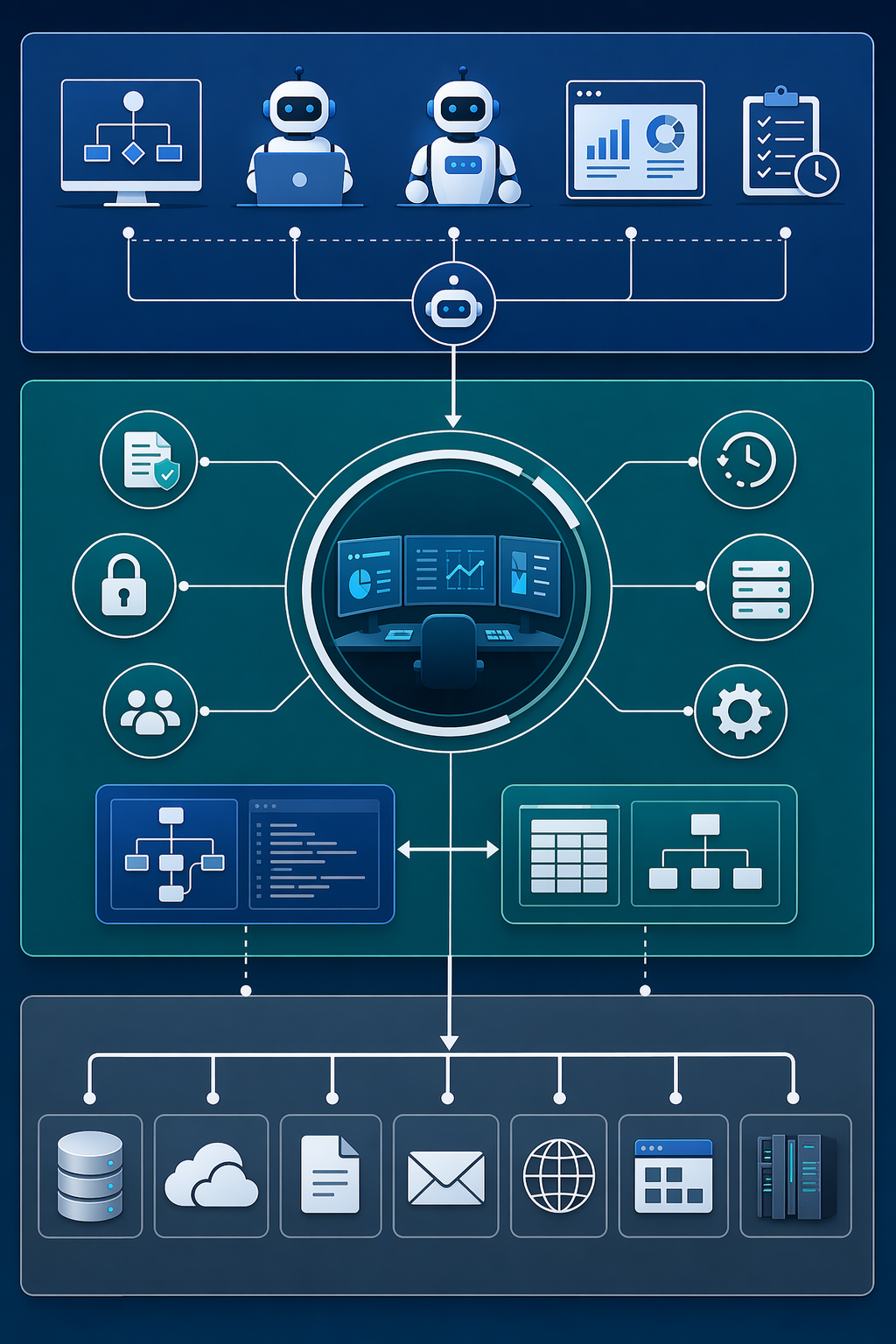
Blue Prism's best argument is not that a developer can draw a process quickly. Most serious RPA platforms can make a demo look tidy. Blue Prism's better argument is that it makes the control model visible: who can change an automation, which object touches which application, what ran on which digital worker, and what evidence remains after the transaction has moved on.
The platform separates business logic in Process Studio from application interaction objects in Object Studio.[3] That distinction sounds like an implementation detail until the estate grows. In a bank or insurer, one application object for a core system may be reused by many automations. If that application changes, a governed object layer gives the Center of Excellence a cleaner place to test and repair the interface instead of hunting through dozens of duplicated process designs.
Control Room is the other important piece. Blue Prism describes centralized audit trails, server-side logging, and no local data retention as part of the platform's operating model.[3] That is exactly the sort of architecture that matters when a bot handles financial transactions, patient administration, claims movement, reconciliations, or customer data. The question is no longer just whether the bot completed the task. The question is whether the organization can reconstruct what happened without trusting a desktop user's local machine.

This is where Blue Prism still earns its place in regulated-industry evaluations. Role-based access, centralized logging, reusable objects, and secured digital-worker operations reduce the number of informal exceptions that accumulate in less disciplined automation programs. They do not make governance automatic. They do make governance enforceable, which is a different and more valuable thing.
Security claims should still be tested in architecture review. Blue Prism materials and third-party feature writeups point to multiple encryption layers and CyberArk Password Vault integration.[4] That is useful for credential governance, especially in environments where shared passwords, local vaults, and bot-specific service accounts can otherwise become a compliance problem. But the platform does not remove the need to define access ownership, credential rotation, exception handling, and segregation of duties before production rollout.
What This Governance Costs
Blue Prism pricing is not publicly listed. Enterprise pricing is negotiated, and available price ranges come from third-party analyses rather than a current SS&C public tariff. O-mega.ai and Kanerika both place Blue Prism's production digital-worker pricing in a broad range of roughly $10,000 to $20,000 annually, with no free production tier.[5][6]
That range is only the visible part of the cost model. A realistic Blue Prism budget also has to include implementation partners, environment setup, training, certification, support, testing capacity, and the cost of keeping enough skilled developers and controllers available after go-live. The smaller the internal capability, the more the buyer is really purchasing a platform plus a delivery dependency.
This is why price comparisons can mislead. A cheap tool used badly in a regulated workflow can become expensive during remediation. A governed tool used on the wrong process can become expensive before it ever produces value. Blue Prism's cost profile makes most sense when the risk profile of the work justifies centralized control, auditability, and a more formal delivery model.
| Cost area | What buyers should test before signing |
|---|---|
| Digital workers | How many production workers are needed for peak load, exception handling, and resilience rather than just average transaction volume. |
| Developer capability | Whether the organization has, or can hire, Blue Prism developers who understand both Process Studio and Object Studio. |
| Implementation support | How much partner involvement is required for the first wave and whether knowledge transfer is contractually explicit. |
| Governance operations | Who owns release approval, audit evidence, credential administration, change control, and bot retirement. |
| Training and certification | Whether training is budgeted as a one-time launch activity or as a standing operating cost for the automation program. |
Where Blue Prism Performs Well
Blue Prism works best in process estates where the work is structured, repeatable, high volume, and operationally important enough to justify formal controls. The platform is a good match for unattended processing in shared services, finance operations, banking back offices, insurance administration, and healthcare administration when the source applications are stable enough for RPA to be a sensible layer.
The public customer examples are worth reading as evidence of what the platform can support under favorable conditions, not as automatic forecasts. Kimberly-Clark has reported more than $140 million in value from Blue Prism automation. ABANCA in Spain processed more than 23,000 financial transactions, paid 99% of loans within 24 hours, and accelerated inquiries by 60%. Alberta Health Services automated more than 100 business processes and reported annual savings equivalent to 250 years of workload. Banorte in Mexico reported 60% faster credit application processing and a 30% throughput increase.[7]
Those are serious outcomes. They also imply serious conditions: enough volume to matter, processes suitable for automation, a delivery model capable of sustaining bots beyond launch, and governance that does not collapse when the pilot team moves on. Blue Prism can support that kind of program. It does not create those conditions by itself.
The Learning Curve Is Part of the Product
Blue Prism's design discipline has a cost in delivery speed and staffing flexibility. The Object Studio and Process Studio split is useful for reuse and maintainability, but it also raises the bar for developers. Teams that are used to lighter no-code builders may find that Blue Prism asks them to think more like an automation engineering function than a productivity team.
That is not inherently bad. In a high-control environment, forcing structure early can prevent a larger mess later. The problem comes when executives buy Blue Prism for its governance story while expecting the speed, informality, and broad citizen-developer participation of a lighter platform. That mismatch usually shows up as slow pipeline conversion, expensive partner reliance, and automations that remain concentrated in a central team long after the business expected broader adoption.
Blue Prism also has a thinner developer market than UiPath. That matters less for a mature CoE with stable internal capability. It matters a lot for a buyer planning to scale quickly across regions or business units while depending heavily on hiring and systems integrators.
AI Has Improved, but the Burden of Proof Remains
Blue Prism's AI story is stronger in 2026 than it was in earlier RPA buying cycles. SS&C Blue Prism's roadmap points to Agentic Workflows, Agent Builder, burst capacity licensing, AI Gateway expansion, and natural-language process creation. The same roadmap says the SS&C Innovation Lab has 3,571 production AI agents, 35 AI agents processing more than 500,000 transactions, and 3,477 automated processes.[8]
Those figures show active investment and production use inside SS&C's own environment. They do not, by themselves, prove that Blue Prism has matched UiPath's broader AI-native ecosystem, developer mindshare, or attended automation depth. For a 2026 procurement cycle, the fair position is that Blue Prism's AI roadmap is credible enough to evaluate seriously, but not strong enough to erase the platform's traditional tradeoff: better governance discipline, less market-leading AI breadth.
Decipher IDP and AI Gateway are relevant when document processing, model access, and intelligent routing are part of the automation roadmap.[2] The evaluation question should be practical: which models are approved, where data passes, what is logged, how exceptions return to human review, and whether the AI component can be governed under the same risk standards as the bot.
Market Signals Need Context
Blue Prism still has analyst recognition. SS&C Blue Prism says it was named a Gartner Magic Quadrant Leader for RPA for the seventh consecutive year in 2025.[9] That is a meaningful signal for enterprise buyers, especially those who need board-level or procurement-level comfort that the platform is not marginal.
It is not a complete market verdict. Gartner's full report detail was not available in the supplied material, so the claim should be treated as a vendor-published summary of analyst recognition. PeerSpot's June 2026 comparison ranks Blue Prism fifth in the RPA category and reports mindshare declining from 9.4% to 4.0% year over year.[10] That is also a signal, but PeerSpot mindshare reflects user engagement on that site, not a formal market-share audit.
The practical reading is not that Blue Prism has disappeared or that it remains the obvious enterprise default. The market has moved. UiPath, Automation Anywhere, and Microsoft all have clearer claims in areas that matter to many buyers: AI breadth, usability, ecosystem, or price. Blue Prism's reason to win has become more specific.
Blue Prism vs. UiPath, Automation Anywhere, and Power Automate
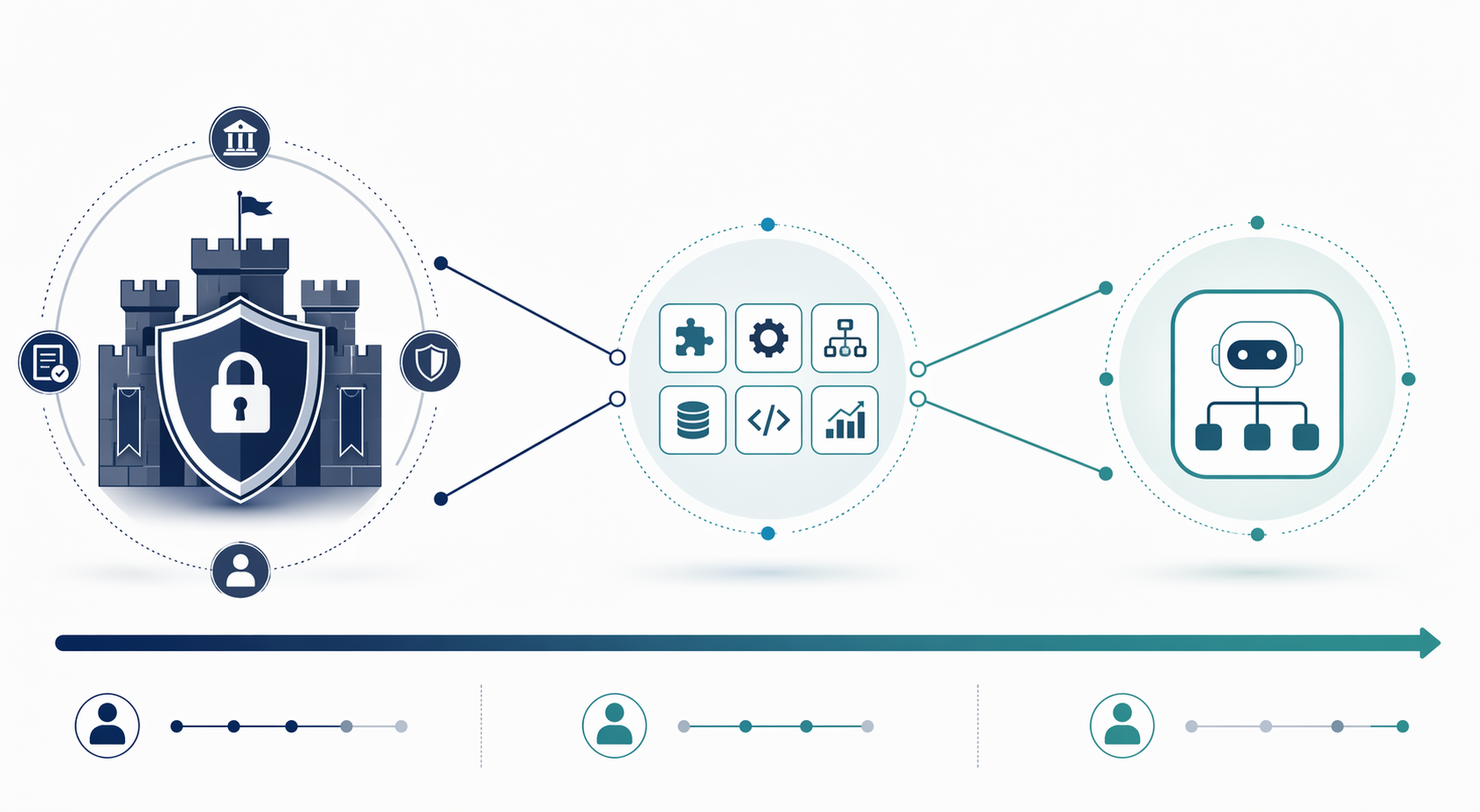
Against UiPath, Blue Prism's strongest case is governance-by-design and auditability. UiPath has the stronger position in AI-native capabilities, attended automation, and developer ecosystem, while Blue Prism remains the cleaner fit for buyers who want centralized control and a more formal unattended automation model.[6]
Against Automation Anywhere, the comparison is closer. Both vendors are credible in enterprise automation, and both can serve regulated organizations. The practical distinction is usually less about whether either vendor can handle enterprise RPA and more about document automation, AI tooling, existing skills, commercial terms, and how each platform fits the buyer's operating model. PeerSpot's comparison places the two in the same competitive frame, with Blue Prism ranked fifth in its RPA category as of June 2026.[10]
Against Microsoft Power Automate, the tradeoff is different. Power Automate is typically easier to justify where the organization is already deep in the Microsoft stack and the automation work is departmental, workflow-oriented, or cost-sensitive. Blue Prism is the more natural fit when the work is high volume, unattended, cross-application, and subject to stricter operational controls. A buyer choosing between them should not ask which platform is generally better. The better question is whether the process needs enterprise RPA control or Microsoft-stack simplicity.
| Platform | Where it tends to lead | Where Blue Prism can still win |
|---|---|---|
| UiPath | AI-native breadth, attended automation, ecosystem, developer availability. | Governed unattended automation, centralized auditability, high-control operating models. |
| Automation Anywhere | AI and document-handling strength, enterprise automation breadth. | Buyers that prefer Blue Prism's control model, architecture discipline, or existing estate. |
| Microsoft Power Automate | Price accessibility, Microsoft-stack integration, lighter workflow automation. | Complex unattended RPA where audit evidence, bot control, and segregation of duties are central. |
Who Should Shortlist Blue Prism
Shortlist Blue Prism when governance is the constraint. That usually means regulated operations, unattended workloads, sensitive data, recurring audit requirements, and enough automation volume to justify a formal CoE. The platform is especially defensible when the organization needs to prove who changed what, which bot ran, how credentials were protected, and how exceptions were handled.
- A financial services company automating reconciliations, onboarding checks, loan operations, or compliance reporting across legacy applications.
- A healthcare organization automating administrative workflows where data handling, access control, and audit trails are non-negotiable.
- A shared-services organization with stable, high-volume processes and an automation CoE capable of owning standards, release control, and bot operations.
- An enterprise that already runs Blue Prism and needs to modernize its estate, rationalize objects, or evaluate AI Gateway and Next Gen capabilities without discarding existing controls.
In these environments, Blue Prism's constraints can become useful guardrails. The organization still has to bring discipline, but the platform gives that discipline places to live: access controls, object reuse, centralized scheduling, audit logs, and operational evidence.
Who Should Be Careful
Blue Prism is harder to justify when the automation program is still trying to discover demand. If the first-year goal is to let many business users experiment cheaply, Power Automate or lighter workflow tools may fit better. If the roadmap depends heavily on attended automation, developer community depth, and fast-moving AI-native capabilities, UiPath deserves a close comparison.
The highest-risk Blue Prism buyer is not the large bank with a mature automation office. It is the organization that wants enterprise-grade control but has not funded enterprise-grade ownership. Without internal standards, trained developers, process selection discipline, and post-go-live support, Blue Prism can become an expensive platform waiting for an operating model.
Procurement Questions That Matter
A Blue Prism evaluation should spend less time on whether a sample bot can be built and more time on whether the automation estate can be explained three years later. The following questions usually reveal more than a polished demo:
- Which automations genuinely need unattended enterprise RPA rather than workflow automation, API integration, iPaaS, or Microsoft-stack automation?
- How will Process Studio and Object Studio standards be enforced across teams and partners?
- Who owns Control Room operations, release approvals, credential governance, bot scheduling, and audit evidence?
- What is the real three-year cost after licenses, implementation support, training, certification, support, and internal staffing?
- Where does the AI roadmap create production value now, and where is it still a roadmap dependency?
- How does the commercial proposal compare with UiPath, Automation Anywhere, and Power Automate for the same process portfolio?
The answer may still be Blue Prism. For the right buyer, it remains one of the most credible platforms for governed, unattended, regulated automation. But the case has to be made by process and operating model. Shortlist Blue Prism when governance is the bottleneck. Compare it carefully against UiPath and Automation Anywhere when AI, ecosystem, and delivery speed carry equal weight. Consider Power Automate when cost, Microsoft integration, and simpler workflow needs matter more than enterprise RPA control.
References
- Blue Prism, Wikipedia
- Products, Blue Prism
- Robotic Process Automation (RPA) Features & Capabilities, Blue Prism
- 20 Most Attractive Features in Blue Prism Robotic Automation, ClarionTech
- Blue Prism Pricing: What Does It Cost You 2026, O-mega.ai
- Blue Prism vs UiPath, Kanerika
- Decoding the Power of SS&C Blue Prism in Business Automation, Devoteam
- Agentic Automation Roadmap 2026, Blue Prism
- Gartner Magic Quadrant for RPA 2025, Blue Prism
- Automation Anywhere vs Blue Prism, PeerSpot