
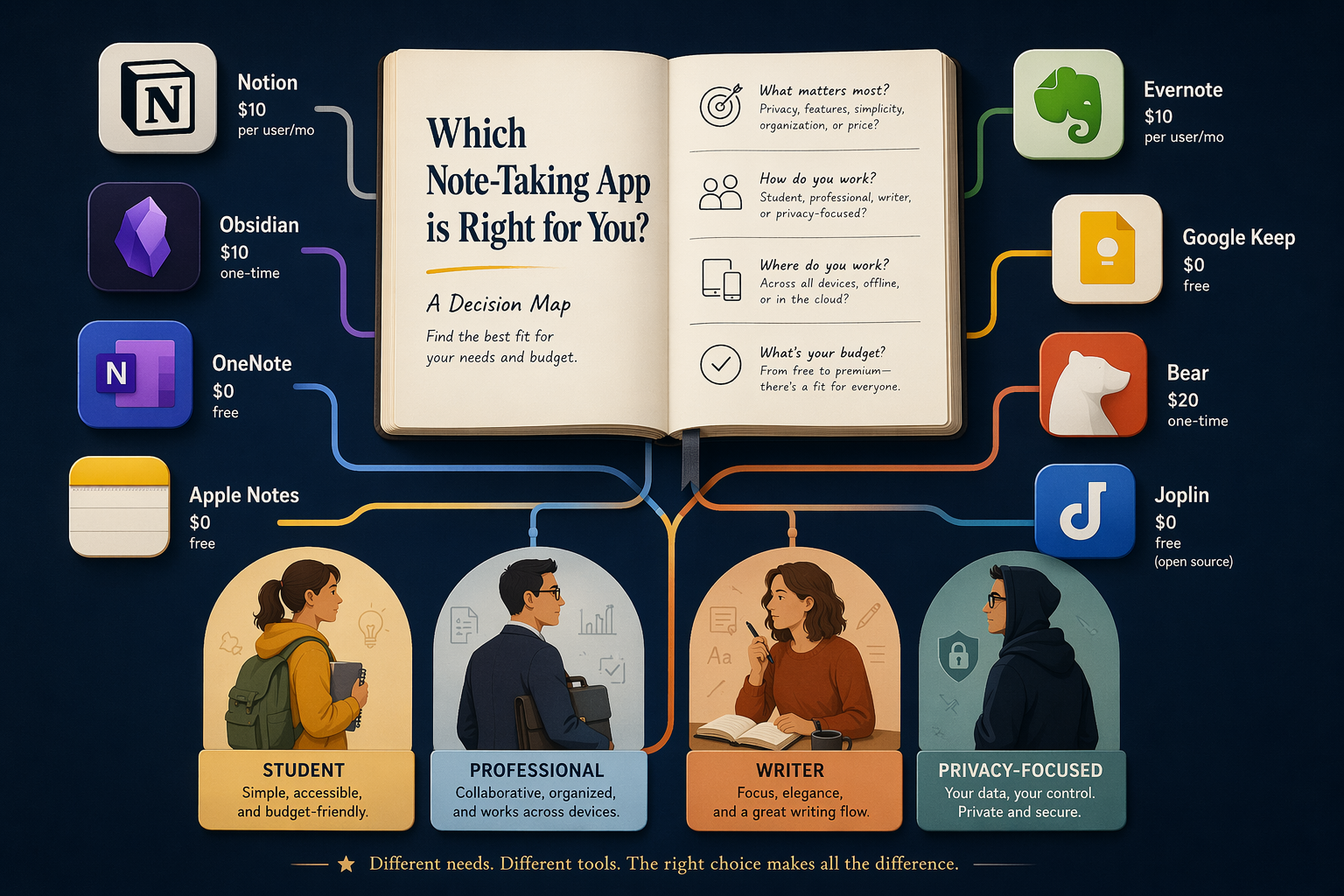
Executive Summary: The Real Cost of 'Free'
The note-taking app market is projected to reach $13.3 billion in 2026, growing at a 20.5% CAGR according to a Research and Markets report. That growth has brought an explosion of pricing tiers, add-ons, and hidden costs that make it nearly impossible to compare apples to apples. The sticker price of a subscription rarely tells the full story.
After auditing the free plans and paid tiers of eight major note-taking apps — OneNote, Apple Notes, Google Keep, Notion, Obsidian, Joplin, Evernote, and UpNote — one pattern emerges clearly: the most expensive free-plan limitations can be more restrictive than a modest subscription, while some genuinely free apps deliver 90% of what most users need at $0.
This guide focuses on hard limits: note caps, device restrictions, storage ceilings, and feature blocks. It does not re-rank free plans by usability — that analysis already exists in our Best Free Note-Taking Apps 2026 article. Instead, it answers a different question: where does the paywall actually hit, and what do you lose at each tier?
Free Plan Deep Audits: Where the Paywall Actually Hits
Not all free plans are created equal. Some are genuinely usable for years without spending a cent. Others are effectively teaser trials designed to frustrate you into upgrading. Below is a side-by-side audit of the hard limits for each app's free tier.
| App | Free Storage | Note / Page Limit | Device Limit | Key Feature Blocks | Verdict |
|---|---|---|---|---|---|
| Microsoft OneNote | 5 GB (OneDrive) | Unlimited | Unlimited | None for basic use | Genuinely free |
| Apple Notes | 5 GB (iCloud) | Unlimited | Unlimited (Apple devices) | None for basic use | Genuinely free |
| Google Keep | 15 GB (shared Google storage) | Unlimited | Unlimited | None for basic use | Genuinely free |
| Notion | Unlimited pages & blocks | Unlimited | Unlimited | 5 MB file upload limit; no team collaboration | Generous solo free tier |
| Obsidian | Local only (no sync) | Unlimited | Unlimited | No built-in sync or publish | Free core app |
| Joplin | Local only (no sync) | Unlimited | Unlimited | No built-in sync | Free open source |
| Evernote | 60 MB monthly upload | 50 notes, 1 notebook | 1 device | No offline access, no PDF search | Effectively a trial |
| UpNote | Unlimited | 50 notes | Unlimited | Limited formatting options | Generous trial |
Comments
Join the discussion with an anonymous comment.