
The morning after a hot night has a particular texture: the laptop is open, the calendar looks normal, and your brain is quietly refusing to arrive. It is easy to file that under motivation. During a heat wave, it is often a sleep problem that has already happened.
Sleep depends on a drop in core body temperature. Before sleep, the body normally sheds heat and lowers core temperature by about 0.5 to 1 degree Celsius; hot rooms interfere with that drop, delay sleep onset, and can reduce the deeper, more restorative stages of sleep that support next-day thinking.[1][2] That matters because the workday does not begin when you sit down. It begins during the night, when your body either gets enough stable sleep architecture to restore attention, memory, and emotional control, or it does not.

The fog is not just a mood. In a Harvard dormitory study reported in Phase for Work, students living in non-air-conditioned dorms during a heat wave had reaction times 13.4% slower and answered 13.3% fewer math questions per minute than peers in air-conditioned dorms.[3] The study does not prove that every missed edit, bad spreadsheet formula, or clumsy paragraph is caused by heat. The buildings were different, and the results may reflect accumulated sleep debt, humidity, fan noise, or other indoor discomfort. Still, the finding gives shape to something many people recognize: after a hot night, small cognitive failures become more likely.
The Damage Starts Before You Open Your Laptop
Hot nights are especially bad for knowledge work because they do not merely shorten sleep; they can fragment the kinds of sleep that make the next day usable. Deep sleep helps the body recover and supports memory consolidation. REM sleep is tied to learning, emotional processing, and flexible thinking. When heat delays sleep onset and keeps the body working harder to cool itself, the night can become lighter, shorter, and more interrupted.
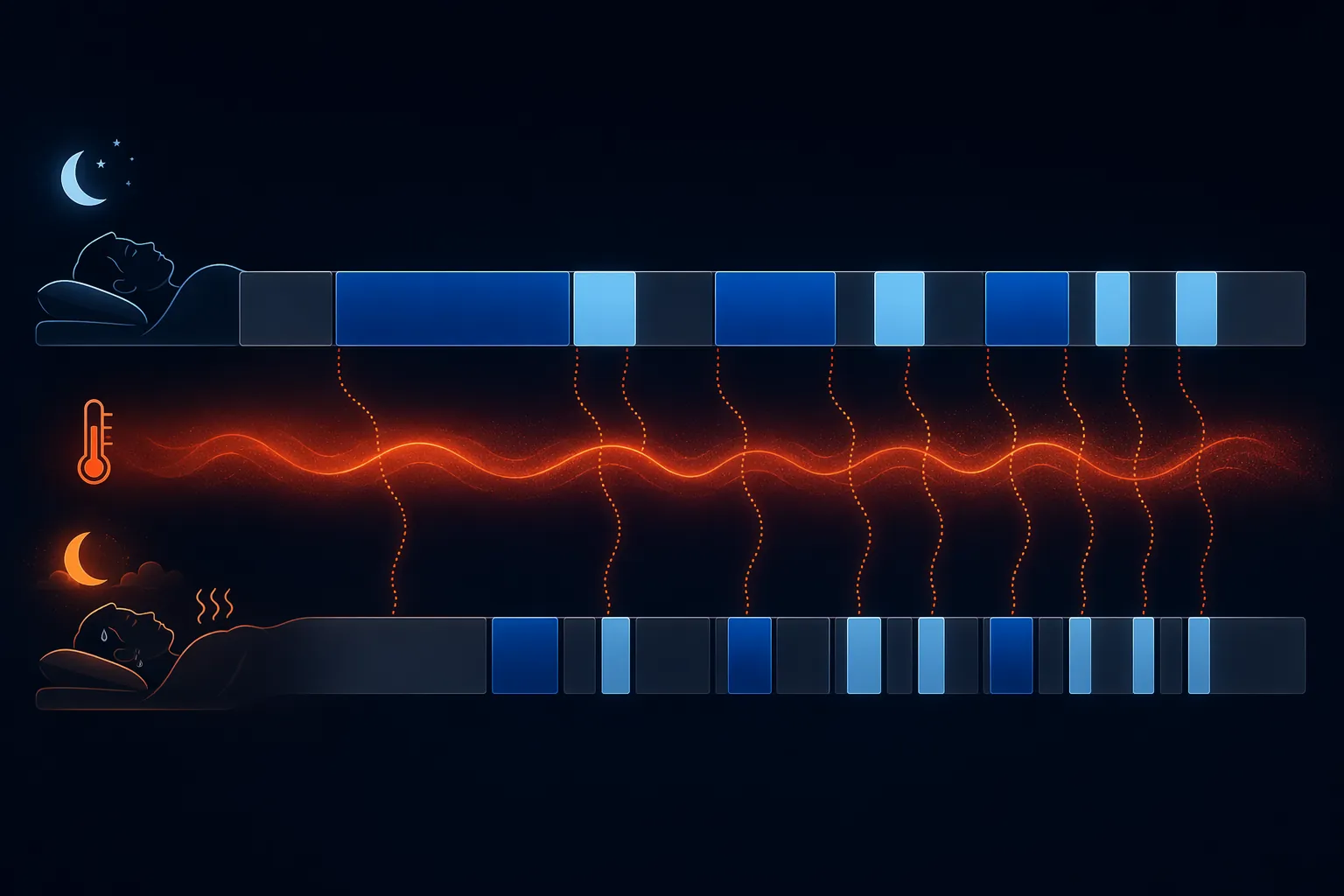
Large sleep datasets point in the same direction. A One Earth study using data from 68 countries and 47,628 participants found that warmer nighttime temperatures reduce sleep duration, with effects concentrated during warm-season months; older adults lost more than twice as much sleep per 1 degree Celsius as mid-age adults, and females lost more sleep than males.[4] A Nature Communications study analyzing 23 million sleep records also found that elderly people, women, and individuals with obesity were among the groups most vulnerable to temperature-driven sleep insufficiency.[5]
The effect is not evenly distributed by region, either. In a USC All of Us study of 14,232 adults and 12 million sleep nights, U.S. West Coast residents lost nearly three times as much sleep from heat as residents of other U.S. regions.[6] That does not mean every person in a hot apartment has the same night. It means the morning-after problem is common enough, and uneven enough, that pretending everyone can simply maintain the same output is not a serious plan.
First, Decide Whether This Is a High-Trust Brain Day
The practical question is not whether you can work at all. Most people still have to answer messages, join calls, move tickets, send invoices, or keep a project from stalling. The better question is which work deserves your trust after a night that may have cut into deep sleep and REM.
Start with a short morning-after check before you let the calendar decide for you. It can be subjective, wearable-based, or both. You are looking for a pattern, not a verdict from a dashboard.
- Subjective signal: Did it take unusually long to fall asleep? Did you wake repeatedly? Are you rereading simple text? Are you already making small mistakes before the day has started?
- Wearable signal: Is your resting heart rate higher than usual, your HRV lower than usual, or your sleep score clearly worse than your normal range? Firstbeat describes elevated resting heart rate, reduced HRV, and poor sleep scores as useful recovery warning signs during heat.[7]
- Workload signal: Does the morning contain decisions, analysis, writing, review, negotiation, or error-sensitive handoffs that would be expensive to repair later?
The mistake is treating a poor readiness signal as trivia. A bad night does not make you useless. It changes the risk profile of your tasks. If your wearable shows a recovery dip and your own check says you are slow, that is enough reason to move the work most likely to suffer from slow reaction time, weak working memory, or missed details.
Move the Work That Punishes Fog
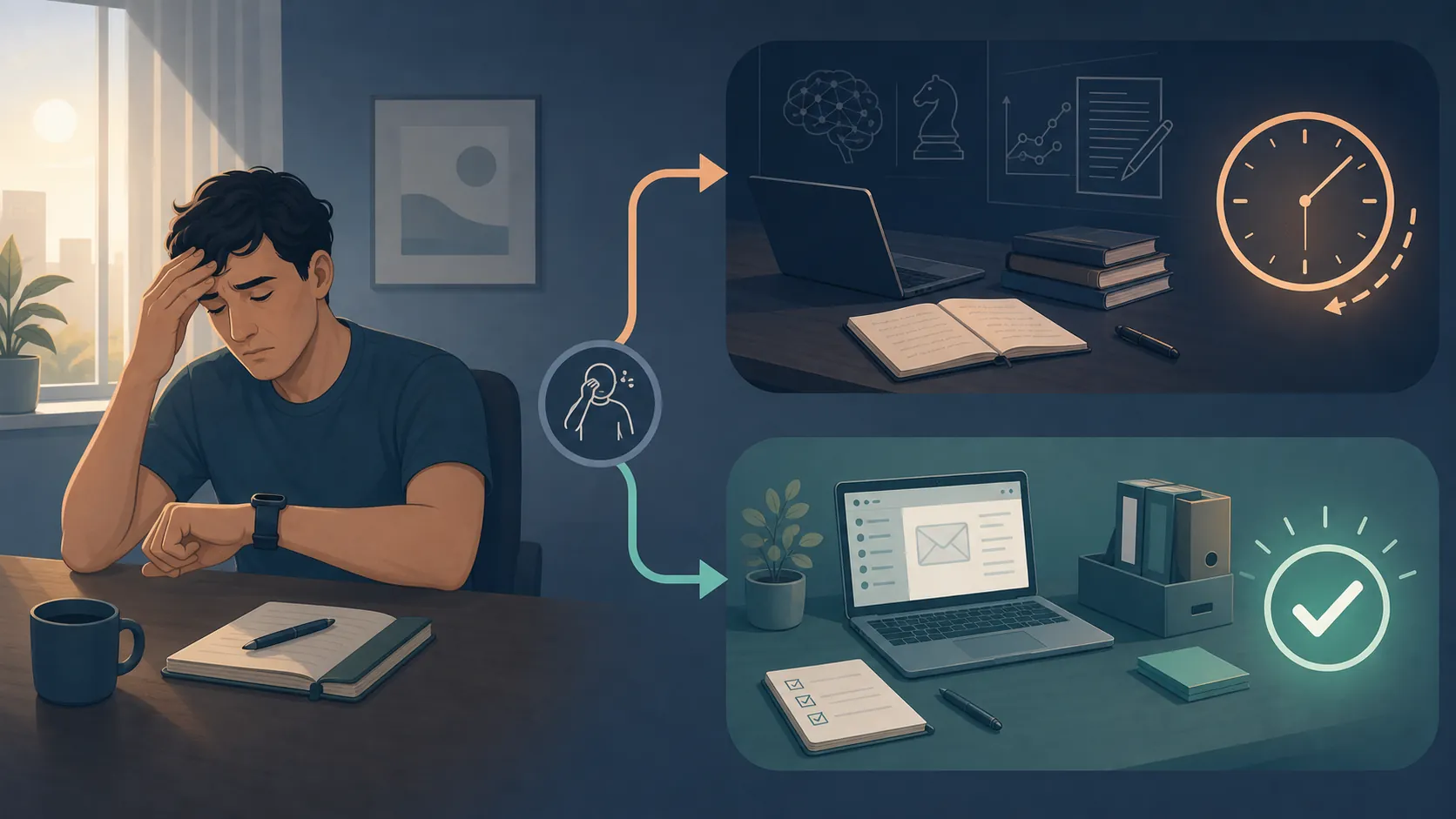
Not all work suffers equally after a hot, broken night. A messy inbox may be annoying but survivable. A contract review, incident postmortem, architecture decision, budget model, or final edit can turn one missed assumption into several hours of cleanup. The useful move is to sort tasks by consequence, not by how responsible they make you feel.
| If the morning signal is poor | Treat these as high-risk | Safer substitutes |
|---|---|---|
| You are rereading, reacting slowly, or seeing poor recovery data | Strategy decisions, complex analysis, final approvals, sensitive writing, code review, legal or financial checks | Inbox triage, scheduling, formatting, meeting notes, routine updates, file cleanup, low-stakes documentation |
| You slept short but feel steady after cooling down and eating | Tasks with irreversible consequences or no second review | Drafting, outlining, first-pass analysis, reversible edits, prep work for later review |
| You have no schedule control | Solo final sign-off while foggy | Add a second reviewer, delay only the approval step, use a checklist, or flag the work as needing later verification |
A downgraded morning is not a wasted morning. It is a different kind of morning. You can still reduce future load by clearing routine work, preparing materials, gathering links, cleaning up notes, labeling decisions that need review, or writing a rough version that nobody else sees yet. What you avoid is pretending that first-pass output and final judgment are the same thing.
For writing work, separate generation from publication. Draft the memo, but do not send the difficult paragraph to the client until later. For analysis, build the sheet, but postpone the conclusion. For meetings, attend the status call, but move the decision call if you can. For code or technical review, read for orientation, but delay the merge decision or ask for another reviewer. The theme is not avoidance; it is reducing the number of places where a tired brain has to be both fast and right.
A Simple Morning Realignment Flow
- Name the heat signal: poor sleep, hot room, repeated waking, elevated resting heart rate, lower HRV, or a sleep score outside your normal range.
- Mark the danger window: usually the first block of the day, before cooling, hydration, food, and movement have had any chance to help.
- Identify work that requires clean judgment: strategy, final review, complex writing, financial analysis, code approval, conflict-heavy communication.
- Move one high-stakes item if possible: even a two-hour delay can be enough to avoid doing the most fragile work at the worst moment.
- Replace it with useful low-stakes work: admin, prep, formatting, documentation, meeting notes, backlog grooming, or reversible drafting.
- Add a review gate: if something must go out, schedule a second look later or ask another person to check the part most likely to contain errors.
This is where wearable data can help without becoming the boss of the day. A single sleep score cannot explain your whole life. It also cannot know that your apartment trapped heat until 3 a.m., that the fan was loud, or that you woke up anxious because the room would not cool. But when a bad score lines up with elevated resting heart rate, lower HRV, and the lived experience of rereading the same sentence three times, it is reasonable to treat that as operational evidence.
If You Cannot Move the Work, Change the Guardrails
Some workers cannot reschedule the morning. A shift starts when it starts. A client presentation is already booked. A manager may not care that the room was 84 degrees at midnight. In that case, the fallback is not to pretend readiness is fine; it is to reduce the number of unsupported decisions you make while impaired.
- Use checklists for recurring error points instead of relying on memory.
- Slow down final submission steps: read the recipient, attachment, numbers, and dates out loud or point to them on screen.
- Separate drafting from sending whenever possible, even if the delay is only 20 minutes.
- Ask for a second review on irreversible work and be specific: “I slept badly in the heat; can you check the assumptions and totals?”
- Move the decision, not the whole task: prepare the materials now, approve later.
The last option matters because it is often more realistic than a full reschedule. You may not be able to cancel the morning. You may be able to stop the foggiest version of yourself from being the final authority.
Cooling Still Matters, Just Keep It Targeted
There is no productivity workflow that compensates for unsafe heat. If you can cool the room, do it. If you have air conditioning, use it strategically before bedtime and during the hottest recovery periods. If you do not, reduce trapped heat where you can: block sun during the day, ventilate when outdoor air is cooler, use fans safely, take a lukewarm shower, wear light sleep clothing, and keep water nearby. These are not personality upgrades. They are attempts to give the body the temperature drop sleep requires.
Hydration also belongs in the morning plan, especially if you woke sweaty or with a headache. But water and cooling should not become a ritual for forcing normal output out of an abnormal night. They improve the conditions around the day; they do not erase the fact that deep sleep and REM may already have been disrupted.
What the Productivity Data Can and Cannot Prove
There is a temptation to turn every heat finding into a precise claim about office output. The evidence is useful, but it is not that neat. The MIT CEEPR working paper found a 0.13% reduction in cognitive performance per 1 degree Celsius above a threshold temperature, with larger effects among people unaccustomed to heat.[8] That is a laboratory-style measure using online brain-training games, not a direct measure of whether your strategy document, Python review, or quarterly forecast got worse.
The scale is still real. The International Labour Organization has projected that heat stress could reduce global working hours by 2.2% by 2030, equivalent to 80 million full-time jobs and $2.4 trillion in economic losses.[3] That figure covers heat stress broadly, not sleep loss alone. For a person at a desk after a hot night, the more useful conclusion is narrower: heat can damage the sleep that supports cognition, and measured cognitive effects show up in controlled and field settings. That is enough to justify changing the day before mistakes accumulate.
Design the Day Around the Night You Actually Had
For productivity, the sleep tips that matter are not only about the pillow, the fan, or the water bottle. They are about trust. After a hot night, decide what your current brain can safely handle. Let the morning signal change the task list. Put fragile work behind a delay, a checklist, or another reviewer. Use the first workable block for tasks that reduce clutter without requiring pristine judgment.
During a heat wave, protecting productivity means recognizing that readiness may have changed overnight and arranging the day around that fact before the errors start to look like personal failure.
References
- Eight ways to sleep well in hot weather, The Conversation
- How to sleep when it's hot at night, Washington Post
- How Heatwaves Wreck Your Productivity, Phase for Work
- Rising temperatures erode human sleep globally, One Earth
- Climate warming may undermine sleep duration and quality, Nature Communications
- Study links rising temperatures to reduced sleep in U.S. adults, USC
- Tips to Maintain Work Productivity and Recovery During the Heatwave, Firstbeat
- Temperature and Cognitive Performance, MIT CEEPR
Comments
Join the discussion with an anonymous comment.