
 Framework
BPM Methodologies Compared: Which Framework Fits Your Team?
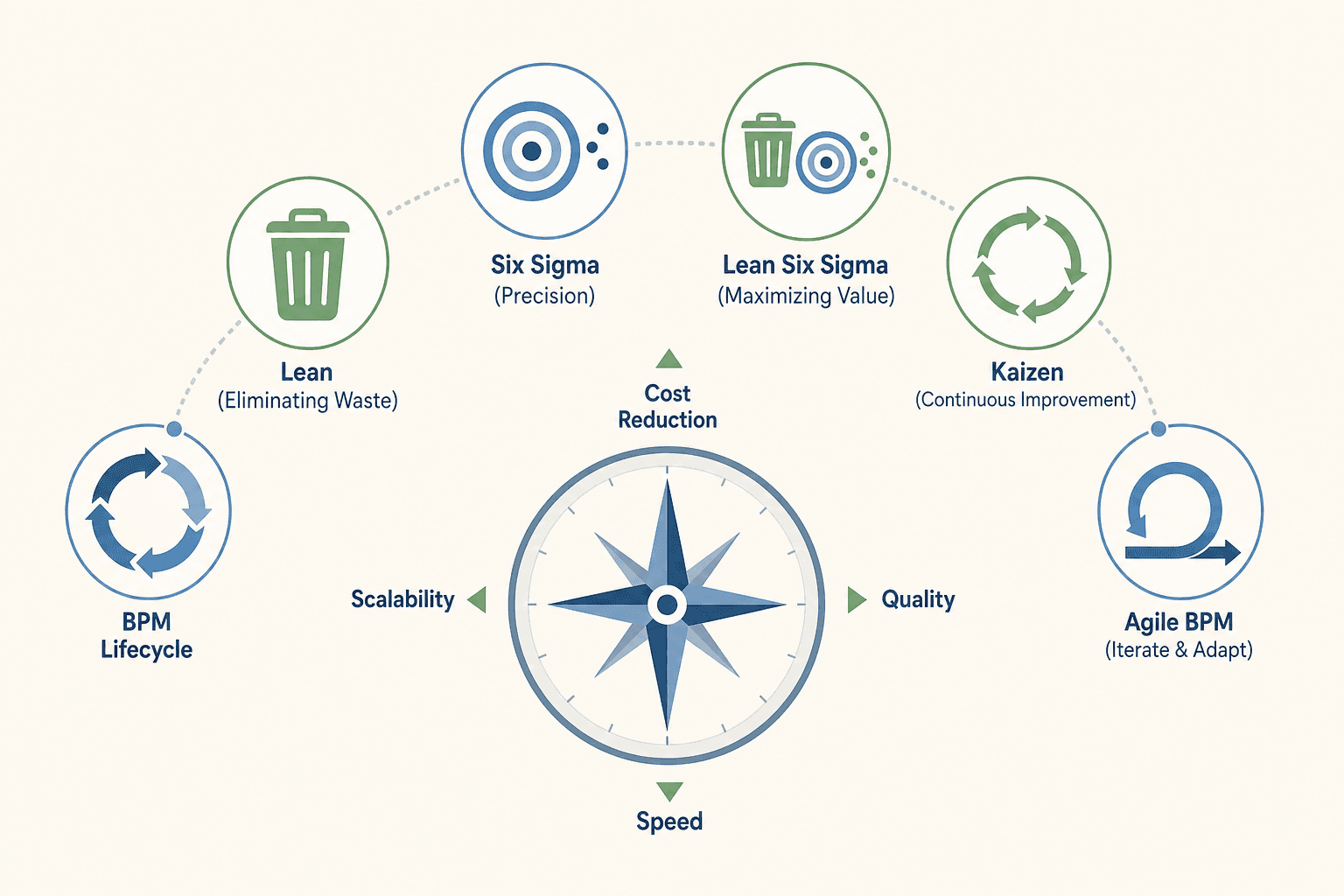
A side-by-side comparison of six major BPM methodologies — BPM Lifecycle, Lean, Six Sigma, Lean Six Sigma, Kaizen, and Agile BPM — to help operations leads and team managers choose the right framework based on their process maturity, primary goal, and team skills.
Origin: Toyota Production System (Lean), Motorola (Six Sigma), Taiichi Ohno (Kaizen)
By Editorial Team
- BPM
- Lean
- Six-Sigma
- Agile-BPM
- frameworks
Why Methodology Matters: From Firefighting to Repeatable Outcomes
Most teams don't set out to improve their processes without a plan. But the reality is that many start by reacting to the loudest fire — a missed SLA, a customer complaint, a bottleneck that slows down the entire department. They patch the immediate problem, declare victory, and move on. A month later, the same issue resurfaces, often in a different form. This cycle of firefighting is exhausting, and it produces inconsistent results because there is no underlying structure to guide the improvement effort.
A structured BPM methodology changes that. Instead of reacting to symptoms, you apply a repeatable set of steps to understand, measure, and improve a process. The methodology becomes the playbook — it tells you what to look for, which tools to use, and how to know if you've actually fixed the problem. Without a methodology, you are guessing. With one, you are building a system that can be taught, scaled, and audited.
This article compares six major BPM methodologies side by side: the BPM Lifecycle, Lean, Six Sigma, Lean Six Sigma, Kaizen, and Agile BPM. Each has a different core focus, requires different team skills, and fits different organizational goals. By the end, you should be able to map your team's current situation to the methodology that gives you the highest chance of success.
Quick-Reference Comparison: 6 BPM Methodologies at a Glance
The table below summarizes each methodology's core focus, best-fit scenario, key techniques, and the skill level typically required to implement it effectively. Use this as a first-pass filter to narrow down your options before diving into the details.
| Methodology | Core Focus | Best-Fit Scenario | Key Tools & Techniques | Skill Level Required |
|---|---|---|---|---|
| BPM Lifecycle | End-to-end process management; continuous improvement through defined stages | Organizations building a scalable, repeatable process management function from scratch | Process discovery, as-is/to-be mapping, simulation, KPI monitoring, optimization | Intermediate — requires process modeling skills and cross-functional coordination |
| Lean | Eliminating waste; improving flow and value delivery | Teams focused on cost reduction, cycle time reduction, or removing non-value-added steps | Value stream mapping, 5S, Kanban, pull systems, waste identification (muda) | Beginner to Intermediate — intuitive principles, but requires discipline to sustain |
| Six Sigma | Reducing variation and defects; data-driven quality control | Environments where consistency and defect reduction are critical (manufacturing, finance, healthcare) | DMAIC (Define, Measure, Analyze, Improve, Control), statistical process control, hypothesis testing | Advanced — requires statistical literacy; Green Belt / Black Belt certification common |
| Lean Six Sigma | Combining waste reduction (Lean) with defect control (Six Sigma) | Complex processes that suffer from both inefficiency and quality issues | DMAIC + value stream mapping, root cause analysis, process capability analysis | Intermediate to Advanced — requires both Lean and Six Sigma knowledge |
| Kaizen | Continuous, incremental improvement through small daily changes | Teams that want to build a culture of improvement without large-scale transformation projects | Kaizen events (blitzes), suggestion systems, Gemba walks, PDCA cycles | Beginner — accessible to all team members; success depends on cultural buy-in |
| Agile BPM | Iterative, adaptive process improvement; breaking changes into sprints | Fast-changing environments (tech, product development) where requirements evolve rapidly | Sprint planning, backlog management, retrospectives, minimum viable process (MVP) | Intermediate — requires comfort with iterative delivery and stakeholder collaboration |
Comments
Join the discussion with an anonymous comment.