

You know the day: the room feels a little stale, the first hour takes more effort than it should, and work that normally moves at an easy pace starts feeling sticky. People reach for sleep, stress, or motivation as the explanation. Sometimes the quieter variable is the air itself.
Poor indoor air can measurably slow thinking, focus, and output within hours, not weeks [1][2]. That matters for knowledge work because the symptoms are not abstract: slower responses, weaker selective attention, and more effort spent staying on task show up in the same work block you are trying to protect.
The evidence is strongest when you keep the categories separate. Harvard's office-worker study tracked response time as fine particles (PM2.5) and carbon dioxide rose [1]. A 2025 study reported that just one hour of PM2.5 exposure impaired selective attention and emotion recognition within four hours in healthy adults aged 18 to 45 [2]. A large call-center study measured real throughput and found that higher pollution reduced calls handled [3]. Those are different methods, which is exactly why they are useful together: they show the same drag from different angles.
Start by measuring the room you actually work in
If you do not monitor the air, you end up guessing at symptoms. A basic CO2 and PM2.5 monitor gives you something concrete to compare against the foggy afternoons, long meetings, and slow starts. Harvard reported 0.8 to 0.9 percent slower response times per 10 ug/m3 increase in PM2.5 and 1.4 to 1.8 percent slower per 500 ppm increase in CO2, with no detectable safe lower threshold [1]. In plain terms, a stale room can be enough to shave performance even before you notice a headache or irritation.
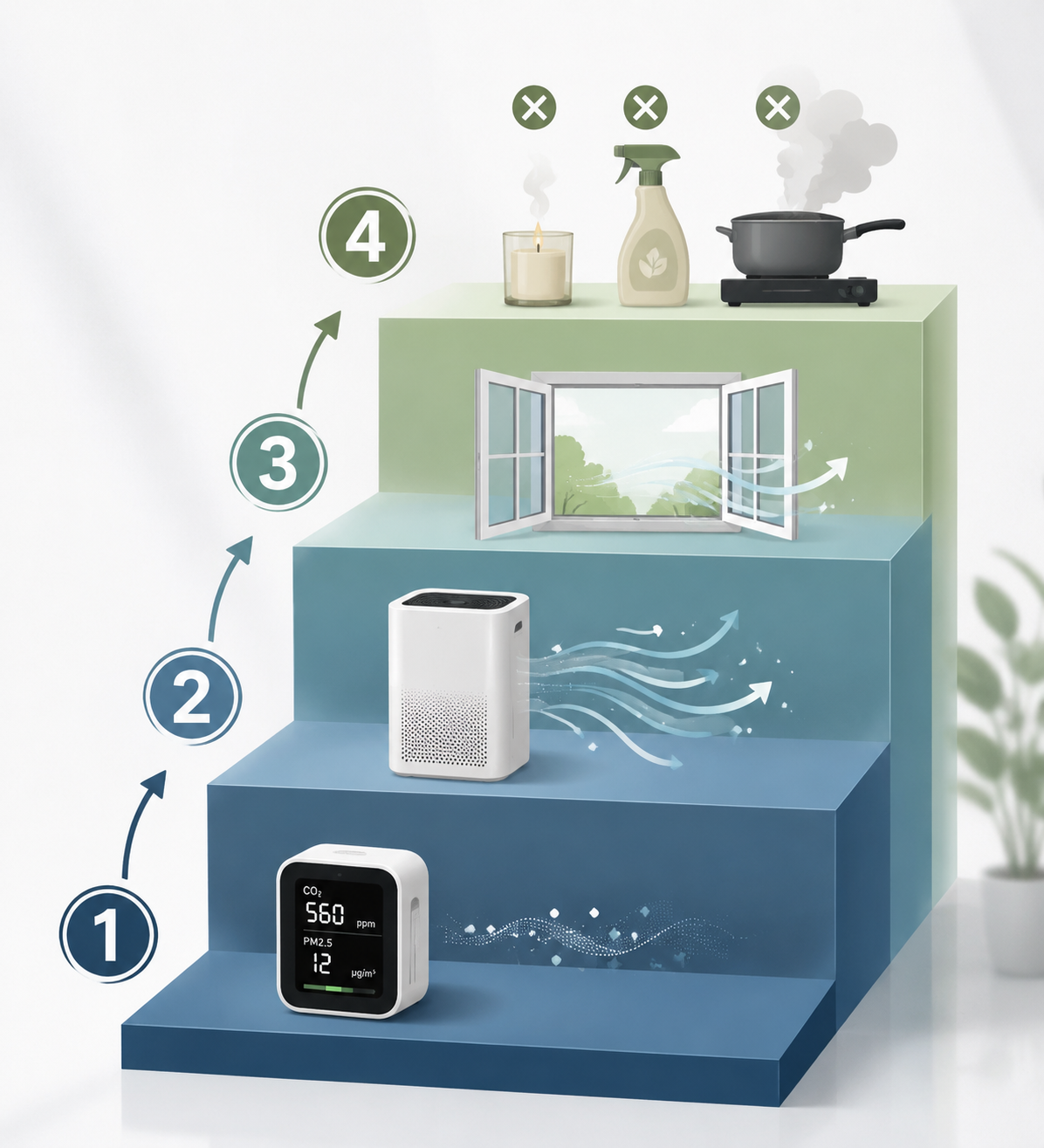
Once you have a reading, the fixes are not equal. Use the smallest system that changes the air where you sit, then escalate only if the first step does not move the numbers.
- Monitor first - track CO2 and PM2.5 in the room where you actually work.
- Filter second - run a HEPA purifier or a DIY Corsi-Rosenthal box in that room.
- Ventilate third - open windows only when outdoor air is cleaner; otherwise recirculate.
- Eliminate indoor sources fourth - pause candles, incense, aerosol cleaners, and smoke-producing cooking.
Filter before you renovate
Filtering is usually the fastest way to buy back attention because it lowers the pollutant you can remove without waiting on the weather. In the field, pollution is tied to output: a large call-center study in China found that each 10-unit AQI increase cut calls handled by 0.35%, and the same pattern was used to estimate about $374 million in annual productivity loss for Los Angeles County on days above federal standards [3]. That does not mean every office will mirror a call center, but it does mean the penalty is large enough to matter in real work, not just lab settings.
For most people, the goal is not a perfect purifier spreadsheet. It is getting one real filter running in the room where the work happens. A purifier in the wrong room is mostly decoration. A cheap DIY box-fan filter is in the same class of solution as a store-bought unit: the point is moving room air through a real filter, not turning the project into a renovation.
Ventilate when the outside helps
Ventilation is useful only when it brings in cleaner air than the room already has. On a good-air day, opening windows can flush out CO2 and VOCs and give the room a reset. On a smoky or polluted day, the same move just imports the problem. That is why outdoor air is a conditional tool, not a universal answer.
Remove the easy indoor sources
The cheap cleanup step is to stop adding particles and fumes while you are trying to recover concentration. That means no extra candles, incense, heavy sprays, or smoky cooking in the work zone on a bad-air day. It is the least glamorous part of the stack, but it keeps the filter from spending the afternoon chasing new pollution.
If you want one move today, measure the room you work in for a few hours, then use the reading to decide whether the first fix is a filter, a window, or a source you should shut off. That is usually enough to stop blaming yourself for an air problem and start changing the room instead.
References
- Impacts of indoor air quality on cognitive function - Harvard T.H. Chan School of Public Health, Healthy Buildings
- Air pollution harms cognition just hours after exposure, study finds - News-Medical.net, February 11, 2025
- The Effect of Pollution on Worker Productivity - NBER Digest, September 2016