
Wildfire smoke is easy to underestimate if the laptop still opens, the meeting link still works, and nobody has told you to evacuate. But a smoky workday is not a normal workday with worse scenery. It changes the air your brain is working inside, and the cost shows up in attention, pace, decisions, and sometimes earnings.
The strongest reason to treat smoke as a productivity problem comes from labor-market evidence, not office folklore. A Stanford SIEPR policy brief estimated that wildfire smoke reduced U.S. earnings by about $125 billion per year on average from 2007 to 2019, and that a single smoke day reduced quarterly per-capita earnings by $5.20.[1] That number is not a mood score. It is a signal that smoke interferes with people’s ability to work, across jobs and places, at a scale large enough to appear in earnings data.
For a knowledge worker, the immediate question is narrower: what happens between the bad air and the bad work session? The Harvard COGfx research is useful here, with one important boundary. It was not a wildfire-smoke study. It compared cognitive performance in different indoor office environments, including enhanced ventilation conditions versus conventional ones. In that setting, cognitive function scores doubled in the enhanced-ventilation environment compared with the conventional environment.[2] That does not prove that every smoke day cuts your thinking in half. It does support the more practical claim: indoor air conditions are part of the cognitive system, not a comfort accessory.

This is no longer a niche problem for a few bad weeks in a few western states. Climate Central reported that per-person wildfire smoke exposure in the U.S. was four times higher during 2020–2024 than during 2006–2019, that every U.S. county now experiences at least 16 smoke days per year, and that some western counties see 90 to 111 smoke days.[3] The practical consequence is blunt: more teams need a smoke-day operating mode, not just an emergency message copied from a public-health page.
The Workday Breaks Before It Fully Stops
Smoke does not need to make someone visibly sick before it damages output. The first losses are often smaller and more expensive to notice: rereading the same paragraph, taking longer to switch tasks, missing a dependency in a project plan, choosing the easier answer because the harder one requires too much working memory.
A review in IZA World of Labor found measurable productivity drops associated with elevated PM2.5 across multiple sectors.[4] That matters because PM2.5 is the fine particulate matter that makes wildfire smoke so operationally disruptive. It is small enough to move through spaces and systems people often assume are protective. The exact effect on a given person’s coding session, client call, or budget review will vary, but the direction is not mysterious: polluted air makes work harder.
The mistake is treating the only valid response as binary: either stop working entirely or pretend nothing changed. Most smoky days sit in the miserable middle. The school pickup still happens. The quarterly report is still due. The remote team is still waiting for decisions. The useful question is not how to achieve perfect performance in bad air. It is how to remove avoidable load from a system that is already under stress.
Start With The Room, Not The To-Do List
The most productive smoke-day intervention is usually not a better calendar block. It is cleaner indoor air. If the room is still taking in outdoor particulate matter, every productivity tactic downstream is compensating for a preventable input problem.
The CDC warns that PM2.5 can penetrate indoors at 70% to 100% of outdoor levels.[5] That is the detail that should end the fantasy that “inside” automatically means “protected.” A closed window helps, but it is not a filtration strategy. A home office, spare bedroom, or conference room has to be treated like work infrastructure: air comes in, particles are removed or not removed, and the people inside pay the difference.
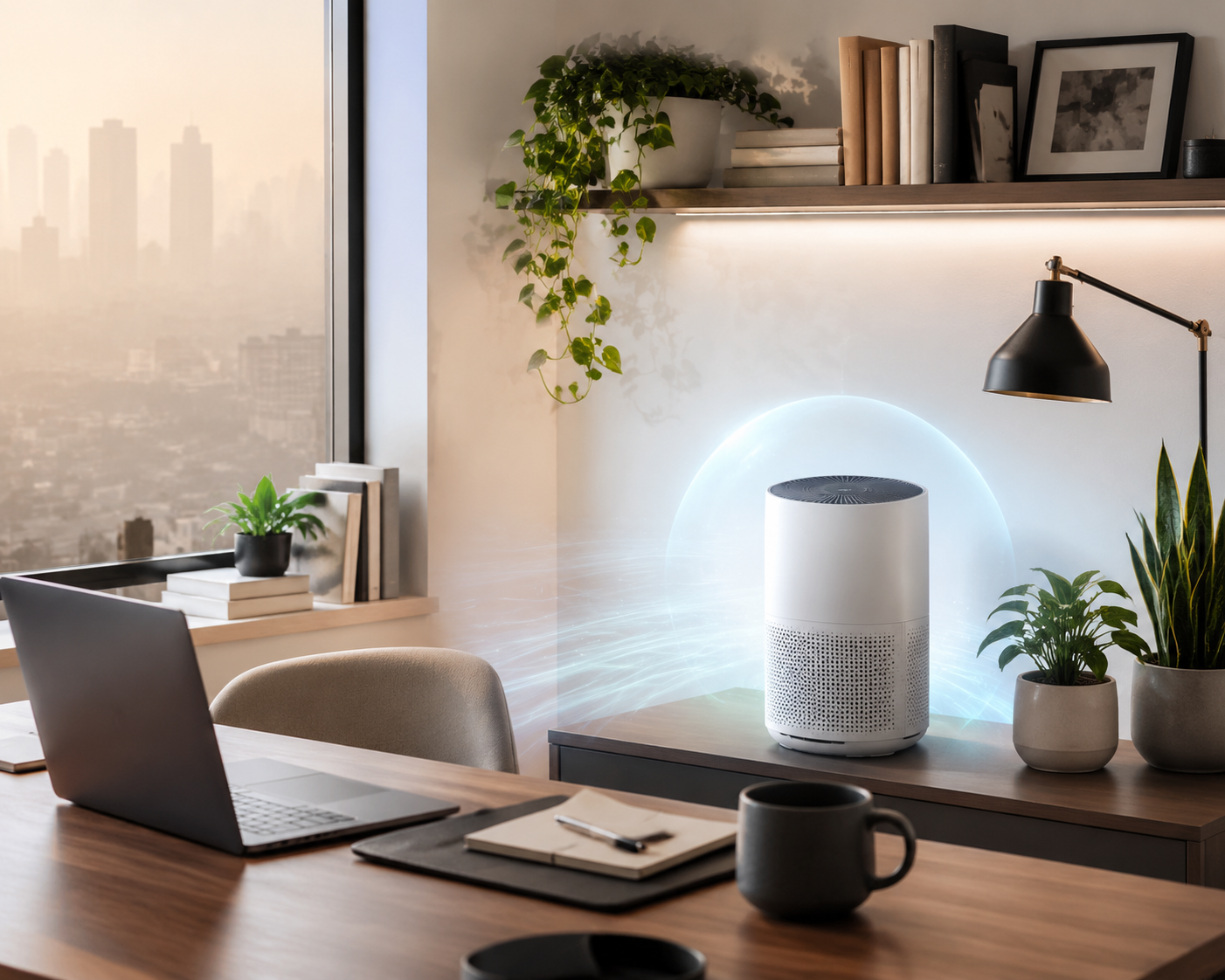
The basic hierarchy is simple: keep smoke from entering, filter what gets in, and concentrate protection where people spend the most time. The CDC recommends using MERV 13 or higher filters when compatible with the HVAC system, portable HEPA air cleaners, and a clean-room strategy during wildfire smoke events.[5] Those are not lifestyle upgrades. They are controls on the exposure that is making the workday worse.
| Control | What It Changes | Practical Use |
|---|---|---|
| Close obvious smoke entry points | Reduces the amount of outdoor smoke entering the workspace | Close windows and doors; avoid bringing smoky outdoor air inside when conditions are poor |
| Use HVAC filtration when appropriate | Filters recirculated indoor air if the system and filter are compatible | Use MERV 13 or higher filters where the system can safely handle them |
| Run a portable HEPA purifier | Removes fine particles from the room where work is happening | Prioritize the room used for focused work, sleep, or vulnerable household members |
| Set up a clean room | Creates one better-controlled indoor zone instead of trying to fix the whole building at once | Choose a room with fewer openings and run filtration continuously during smoke periods |
The clean-room idea is especially useful for remote workers because it matches the actual constraint. You may not be able to correct a whole apartment, an old house, or a shared office. You can often choose one room, close it down, run filtration, and move the highest-value work there. That room becomes the equivalent of a stable internet connection: not glamorous, but foundational.
A team lead has a parallel version of the same job. If employees are working from different smoke conditions, asking everyone to perform as if the environment is equal creates avoidable failure. The better move is to ask what has changed: who has effective filtration, who is sharing a smoky space with children or elders, who is coughing through calls, who can shift deep work to another day, and which deadlines are actually fixed.
A Monitor Helps, But It Does Not Replace Judgment
An air-quality monitor can make invisible failure visible, especially indoors where the air may feel “fine” while particles remain elevated. But product shopping should not become the main project. The core decision is whether the room is good enough for the task you are asking your brain to perform. If the answer is no, the first fix is filtration and exposure reduction, not another hour of optimizing the dashboard.
Move The Hardest Thinking Out Of The Worst Air
Once the room is as protected as you can reasonably make it, the next decision is work design. A smoky day is a bad day to pretend that all tasks draw from the same battery. They do not. Novel strategy, complex writing, debugging, financial review, conflict-heavy management, and high-stakes decisions all require more cognitive margin than routine execution.
This is where “stay productive” needs a stricter definition. On a smoke day, productivity may mean preserving the work that truly needs judgment and moving everything else into a lower-friction lane. That is not defeatist. It is the same logic as rescheduling a deep-work block after a night of poor sleep: the condition changed, so the plan changes.
- Move high-novelty work to the cleanest-air window you can create, not automatically to the earliest open calendar slot.
- Batch shallow work when symptoms are present: inbox cleanup, formatting, status updates, file organization, and routine approvals.
- Shorten meetings that require synthesis or negotiation; fatigue turns vague agendas into expensive drift.
- Add review steps to decisions made during heavy smoke, especially if they affect money, hiring, safety, or external commitments.
- Record assumptions while working. Smoke-impaired work often fails at the handoff, where a missing reason becomes tomorrow’s rework.
The most useful adjustment is often moving from creation to maintenance. If the air is poor and your head feels slow, do not burn the best part of the day forcing a blank-page task. Clean up the project board. Convert meeting notes into next actions. Review a draft for obvious structure problems rather than trying to produce the final version. Prepare the inputs for tomorrow’s deeper work.
For managers, this means smoke-day planning should be visible. If a team is inside a regional smoke event, the operating question is not whether people are “online.” It is which work should be protected from degraded conditions. A reasonable smoke-day standup might ask: what requires clear thinking today, what can wait, what can be reduced, and who needs a backup reviewer?
There is a fairness issue here too. Stanford’s labor-market analysis found that smoke-induced earnings losses were 60% larger in counties with above-median Black population.[1] That does not tell a manager what is happening inside any one employee’s home. It does warn against treating smoke exposure as evenly distributed. Air conditioning, housing quality, commute obligations, neighborhood pollution burdens, and the ability to buy filtration are not evenly distributed either.
Take The Body’s Signals Seriously
The body is not a side channel during wildfire smoke. It is part of the work system. Eye irritation, headache, chest tightness, coughing, unusual fatigue, and shortness of breath are not distractions to be powered through; they are information about exposure and strain.
One useful physiological detail comes from Stanford Medicine: a resting adult breathes about 6 liters of air per minute, while intense exercise can raise that to as much as 60 liters per minute.[6] That is why heavy workouts, brisk outdoor errands, and “just getting some air” can be counterproductive during smoke. The more air you pull through your lungs under bad conditions, the more contaminated air your body has to handle.
Resting does not make dangerous air safe. It lowers demand on a body that is already dealing with an irritant. That distinction matters. The goal is not to become heroic at a lower breathing rate. It is to reduce exposure, reduce exertion, and notice when symptoms mean the plan has to change.
Public-health guidance from UBC and the American Lung Association emphasizes practical behavior during smoke events: limit outdoor exposure, keep indoor air clean, reduce physical exertion, and pay attention to symptoms and local air-quality information.[7][8] For a working adult, those instructions translate into a different kind of calendar discipline. Do the outdoor chore later. Move the walking meeting indoors or cancel it. Do not schedule the hardest call after spending twenty minutes outside moving the car.
When Productivity Advice Should Stop
There is a line where productivity tactics become the wrong frame. If symptoms are significant, if indoor air cannot be made tolerable, or if official guidance calls for stronger protective action, the work plan should yield. A missed focus block is cheaper than treating a health warning as a scheduling inconvenience.
This is also where teams need explicit permission structures. People should not have to perform wellness theater while quietly failing at work. A smoke-day policy can be simple: protect exposure first, reduce meeting load, move judgment-heavy work when possible, and document anything that must proceed under degraded conditions.
A Smoke-Day Operating Mode
The practical plan is short because it has to work on a bad day. First, check the local air situation and make the cleanest indoor workspace you can. Second, run filtration before and during the work block, not only after the room feels stale. Third, assign the day’s tasks by cognitive load. Fourth, reduce exertion and watch symptoms. Fifth, review important decisions made under poor conditions.
| If The Day Requires | Prefer | Avoid When Smoke Is Heavy |
|---|---|---|
| Deep analysis or original writing | Cleanest room, shorter blocks, extra review | Long unsupported sessions in a room with uncertain air |
| Routine execution | Batching, templates, checklists | Constant task switching |
| Management decisions | Documented assumptions and a second look | Fast calls with unclear consequences |
| Meetings | Shorter agendas and fewer synthesis-heavy discussions | Status meetings that could be written updates |
| Physical errands | Delay, delegate, or combine only if necessary | Outdoor exertion treated as a harmless break |
None of this makes wildfire smoke harmless. It does make the next smoke day less improvisational. The ceiling is practical, not magical: cleaner indoor air, lower cognitive load, less unnecessary exertion, and work matched to the body’s actual state. That is enough to prevent some bad decisions, some lost hours, and some needless exposure.
References
- Wildfires reveal the large toll of air pollution on labor market outcomes, Stanford SIEPR
- Office air quality may affect employees’ cognition, productivity, Harvard Chan School
- Climate Change Worsens Wildfire Smoke, Climate Central, 2025
- Air pollution and worker productivity, IZA World of Labor
- How to safely stay safe during a wildfire, CDC
- Poor air quality affects everybody: How to protect yourself and clean the air, Stanford Medicine
- 10 tips for coping with wildfire smoke, UBC / The Conversation
- Protecting Yourself from Poor Air Quality, American Lung Association