
| If your next work problem is… | Use this walk pattern | Why this is the better fit |
|---|---|---|
| Staying sharp through a lecture, study block, writing block, or coding block | Short, frequent walks or active micro-breaks: roughly 1–5 minutes at regular intervals, before attention has sagged | The closest short-versus-long classroom comparison favored distributed 90-second breaks every 10 minutes over one 10-minute break at the midpoint of a 90-minute seminar; brief diversions also fit the goal-reactivation mechanism for sustained attention. [1][2] |
| Keeping an office day from turning sluggish | A practical default is a 5-minute walk about once an hour | In a 2026 workplace study of about 11,000 U.S. employees, five-minute hourly walks produced the biggest feasible self-reported gains in productivity, mood, and alertness; more frequent half-hourly walks helped more but were disruptive. [3] |
| Generating options, first drafts, names, pitches, or alternate approaches | Take one longer walk, usually long enough to leave the desk and think without typing | The Stanford walking-creativity work found that 5–16 minute walks increased divergent creative output by about 60% on average, with some residual boost after sitting back down. [4] |
| Resetting between two demanding sessions | Use the longer walk, and choose a restorative route if you can | A 2024 randomized trial found that a 40-minute nature walk, matched to an urban walk on distance, pace, and heart rate, measurably rested executive attention and improved positive affect. [5] |
| Recovering from a highly depleting task | Do not assume a sub-10-minute break is enough | A 2022 meta-analysis found micro-breaks reliably improved vigor and fatigue, but the overall performance effect was not significant; longer breaks were associated with larger performance gains. [6] |
| Deciding because you saw “longer walks are better” longevity headlines | Do not use that headline to answer a focus question | Those findings are about cardiometabolic or mortality outcomes, not whether the next paragraph, proof problem, or meeting goes better after the walk. [7] |
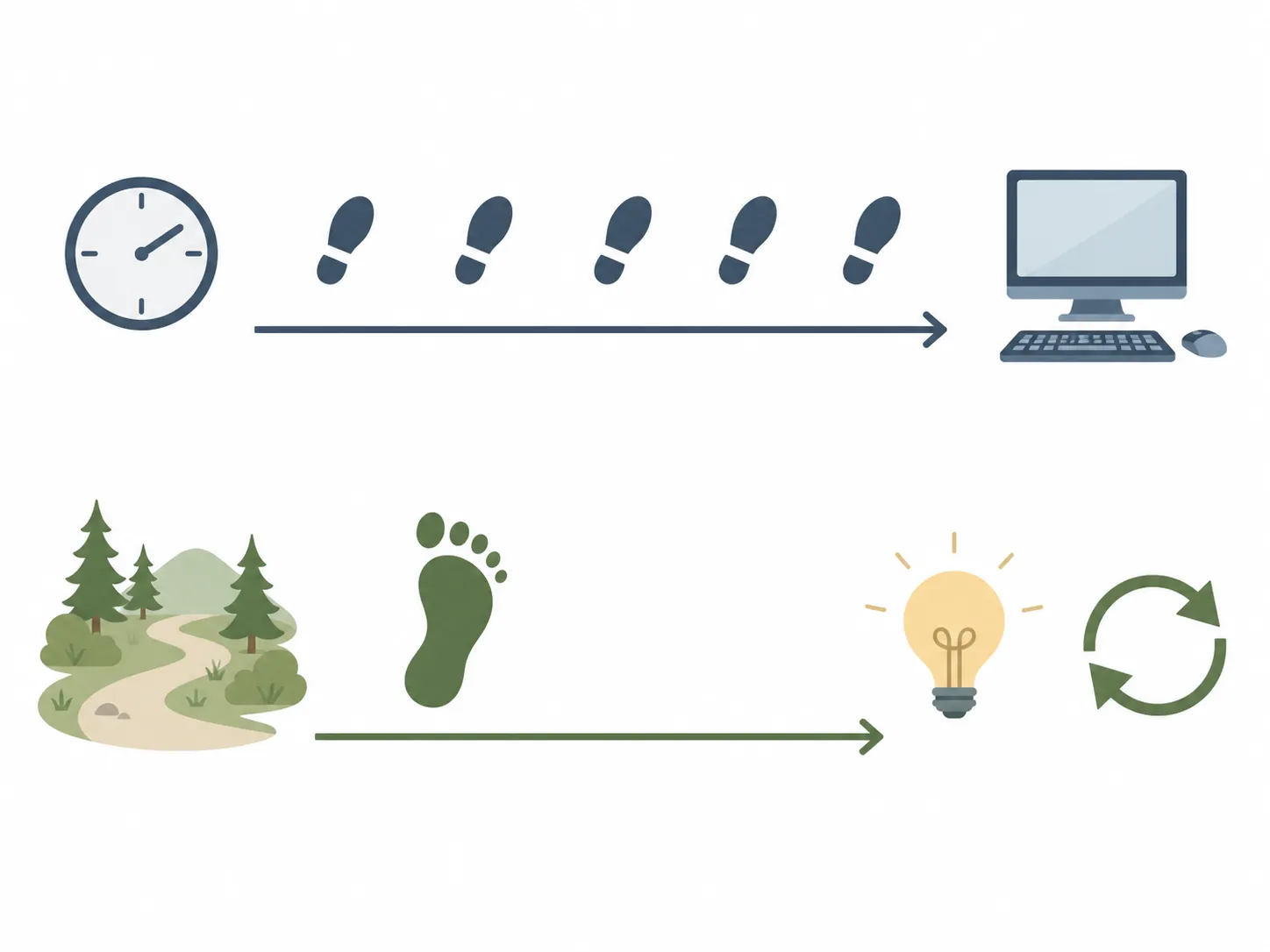
For productivity and focus, short walks are usually better inside an ongoing attention block; one longer walk is usually better when the job changes to idea generation, incubation, or recovery between hard blocks. That is a synthesis across adjacent evidence, not the result of one perfect “short walks vs long walk” productivity trial.
Why short, frequent breaks win inside a focus block
The most useful study for a student in a long seminar, or a worker trying to hold a writing or coding block together, is not a general exercise study. It is the 2025 classroom study by Sharpe and colleagues because it preserves the shape of the problem: people had to stay engaged across a 90-minute learning session, and the researchers compared many tiny breaks against one longer midpoint break.
In that study, 253 undergraduates attended 90-minute seminars. One condition used 90-second micro-breaks every 10 minutes; the comparison condition used one 10-minute break at minute 45. The distributed-break group produced better and more consistent quiz performance: 65.13% versus 56.44%. The single longer break helped immediately afterward, but that benefit was lost quickly. [1]
There are two reasons to be careful and still take the result seriously. First, the breaks were not specifically walking breaks; they were short unstructured breaks. Second, quiz performance in undergraduate seminars is not the same thing as finishing a legal memo or debugging a stubborn test failure. Even with those limits, the comparison is unusually relevant because the question is not whether exercise is good in general. The question is what kind of interruption helps a person return to the same cognitive task without losing the session.
The mechanism makes the finding less surprising. In Ariga and Lleras’s 2011 attention experiment, two brief diversions during a 50-minute task eliminated the usual performance decline. Their interpretation was not that attention is a tank that simply empties and refills. It was that people habituate to a task goal; a brief deactivation and reactivation can make the goal salient again. [2]
A short walk can serve that function well because it is a clean state change: stand up, move, stop staring at the same document, return. It also has a lower re-entry cost than a long walk. If the next sentence is already half-formed, or the next problem step is waiting on the page, the break should refresh the task without replacing it.
The practical office version is the five-minute hourly walk. In 2026, Diaz and colleagues reported on about 11,000 U.S. employees and found that five-minute hourly walks gave the biggest feasible self-reported improvement in productivity, mood, and alertness. Half-hourly walks were more beneficial, but also more disruptive. [3]
That workplace result should not carry more weight than it can bear. It was short-term, relied on self-reports, used self-selected break intervals, and came from a sample described as mostly white, female, and healthy. It is still useful for one thing: translating the micro-break idea into a dose that an actual desk worker might attempt without turning the calendar into confetti.
A longer walk has a different job: making room for ideas
Longer walks look worse only if the outcome is “maintain the same attention-heavy task with minimal re-entry friction.” Change the outcome, and they become much more attractive. If the task is to generate options, loosen a stuck draft, find alternate explanations, or let a problem incubate, the Stanford walking study is the better anchor.
Oppezzo and Schwartz studied 176 participants and found that walking for 5–16 minutes increased divergent creative output by about 60% on average. The effect did not vanish the moment participants sat down; there was a residual creative boost afterward. [4]
That matters because divergent ideation is not the same job as sustained attention. When a paragraph is stuck because the claim is wrong, a longer walk can be useful precisely because it interrupts the document’s grip. When a meeting needs three viable options instead of one defended position, a walk that lets the mind range a little is doing the job it is good at.
The clean way to use this is to give the walk a question before leaving: “Find three ways to frame the argument,” “List possible causes,” “Name better examples,” or “Decide what I am avoiding.” Do not turn the walk into a message-checking corridor. The point is not step count; it is a temporary change in cognitive mode.

When the workday needs recovery, not stimulation
Some breaks are not there to preserve the current block or generate ideas. They are there because the previous block took something out of you: a dense seminar, a hard proof, an emotionally loaded meeting, a long code review, a stretch of decision-heavy work. For that job, the better evidence points away from tiny resets and toward a more substantial recovery interval.
In a 2024 randomized controlled trial from the University of Utah, McDonnell and Strayer assigned 92 participants to a 40-minute nature walk or a 40-minute urban walk, matching the walks on distance, pace, and heart rate. The nature walk measurably rested executive attention, reflected in lower frontal midline theta in resting EEG, and boosted positive affect. [5]
That is not evidence that every worker needs 40 minutes in a park before answering email. It is evidence that the setting and duration of a walk can matter when the target outcome is restoration. If the next block asks for control, patience, or careful judgment, a longer walk in a less demanding environment has a more plausible job than another quick lap around the office.
Cal Newport’s “deep breaks” idea fits here as a practitioner heuristic, not as experimental evidence: a serious break should reduce attention residue, avoid shallow digital activity, and give the mind a real separation from the demanding work. [8] It is a useful rule of thumb when the problem is not momentary sleepiness but accumulated cognitive residue.
What the evidence does not prove
- There is no single definitive study that directly compares several short walking breaks with one long walking break for real-world productivity and focus. The matrix is a labeled synthesis across micro-break, walking, creativity, and restoration studies.
- The 2025 classroom study is highly relevant to sustained attention, but its micro-breaks were 90-second unstructured breaks, not prescribed walking breaks, and the sample was undergraduates in seminars. [1]
- The 2026 workplace walking evidence is useful for feasibility, mood, alertness, and self-reported productivity, but it was short-term and self-reported rather than an objective measure of output quality. [3]
- The Stanford walking study is strongest for divergent creative output, not for every kind of thinking. A walk that helps with idea generation may not be the right interruption during copyediting, proof-checking, or a fragile coding trace. [4]
- The nature-walk trial supports restoration between demanding sessions, especially in a nature context, but it studied 40-minute walks and resting brain activity, not five-minute office laps. [5]
- The broader micro-break literature is not a blank check. A 2022 meta-analysis of 22 samples and 2,335 participants found reliable improvements in vigor and fatigue for breaks of 10 minutes or less, but the overall performance effect was not significant; the authors also suggested that highly depleting tasks may require breaks longer than 10 minutes. [6]
The longevity headline is answering a different question
The “longer walks are better” headline belongs in a different decision file. The 2025 del Pozo Cruz study covered more than 33,000 adults over roughly eight years and addressed cardiometabolic and mortality outcomes, not acute focus or the quality of the next work block. It was also observational, so reverse causation is part of the interpretation problem. [7]
That does not make the health question unimportant. It just makes it the wrong evidence for deciding whether to take three short walks during a study session or one long walk at lunch. A mortality-risk study and a focus-break decision are not measuring the same outcome.
A walk prescription that does not create re-entry friction
- During a lecture, writing block, coding block, or study session: use short, frequent active breaks. The break should be short enough that the next action is still obvious when you sit back down.
- During a normal desk day: try a five-minute walk about once an hour before the afternoon turns into static, not after attention has already collapsed.
- When you are stuck or need options: take the longer walk and carry a question, not a queue of messages.
- Between two demanding sessions: use a longer walk for recovery, and choose a lower-stimulation or nature-rich route when available.
- After unusually depleting work: do not force a sub-10-minute break to do a recovery job it may not be able to do.
If the goal is to protect attention across a live work block, schedule short, frequent walks or active breaks. If the goal is to generate ideas, incubate a problem, or recover before the next hard block, take the longer walk. The better walk is the one matched to the cognitive job waiting when you sit back down.
References
- Sustaining student concentration: the effectiveness of micro-breaks in a classroom setting, Frontiers in Psychology, 2025
- Brief and rare mental “breaks” keep you focused: deactivation and reactivation of task goals preempt vigilance decrements, PubMed, 2011
- A 5-Minute Walk Every Hour May Offset the Effects of Sitting All Day, Health.com, 2026
- Stanford study finds walking improves creativity, Stanford Report, 2014
- The influence of a walk in nature on human resting brain activity, Scientific Reports, 2024
- Give me a break! A systematic review and meta-analysis on the efficacy of micro-breaks for increasing well-being and performance, PLOS ONE, 2022
- Longer Walks May Help You Live Longer, New Study Finds, Health.com, 2025
- On Deep Breaks, Cal Newport