
Pocket is no longer an option to choose against Readwise Reader. Mozilla announced Pocket’s shutdown on May 22, 2025, ended the service on July 8, 2025, and said user data would be deleted by November 12, 2025.[1] So the practical question in mid-2026 is not whether Readwise Reader is better than Pocket in the abstract. It is whether Reader is worth rebuilding a research reading system around after Pocket stopped being the quiet holding room for articles, reports, essays, and half-processed sources.
For research use, the short answer is: Readwise Reader is the strongest feature-for-feature Pocket replacement, but only if the heavier machinery will actually enter your workflow. It handles PDFs, EPUBs, newsletters, YouTube transcripts, web articles, document highlighting, Ghostreader AI, and automated export of highlights into tools such as Obsidian, Notion, Roam Research, Logseq, and Evernote.[2] That is far beyond Pocket’s old save-search-tag model. It is also more expensive, more involved to maintain, and still not a citation manager.
| If your old Pocket use looked like this | Best replacement direction |
|---|---|
| Saved journal-adjacent articles, PDFs, newsletters, and reports, then needed highlighted passages later | Readwise Reader is the strongest fit |
| Mainly kept a simple article queue and occasionally searched it | Instapaper or another lighter read-later app may be enough |
| Listened to saved articles more than you annotated them | Matter may be worth comparing, especially if you live on iOS |
| Care most about avoiding another hosted-service shutdown | Wallabag deserves attention because it is self-hosted and open source |
| Expected Pocket to behave like Zotero, Mendeley, or Paperpile | No read-later app fully solves that; use a reference manager separately |
Pricing matters enough to put near the top. As last verified in July 2026, Readwise Reader costs $9.99 per month when billed annually, or $119.88 per year.[3] Pocket Premium had cost $4.99 per month or $44.99 per year, which makes full-price Reader roughly 2.7 times more expensive.[4] Readwise also offers a 50% academic discount that brings the annual cost to $59.94, but the discount is handled by emailing Readwise and is not available through iOS App Store subscriptions.[4] That manual step is not a philosophical problem; it is just the kind of small administrative friction graduate students already have too much of.
Pocket’s Research Value Was Modest, But Real
Pocket was never a full research environment. Its appeal was that it stayed out of the way. You saved an article, added tags if you were disciplined, searched later if you remembered enough of the wording, and exported when the service or your patience forced the issue. Pocket Premium added full-text search and suggested tags, but it did not turn saved reading into a live annotation pipeline.[4]
That simplicity worked better than it should have for early-stage collecting. A researcher could save a policy report from a newsletter, a methods essay from a colleague, a magazine feature that might become a teaching example, and a web version of a working paper without deciding immediately where each belonged. Pocket absorbed indecision.
The problem arrived later, when “saved” needed to become “used.” A tag helped only if it had been applied consistently. A search helped only if the remembered phrase matched the text. A saved page helped only if the passage you needed had not become another unmarked paragraph in a long queue. Pocket was good at postponing the decision; research writing eventually asks for the decision back, with interest.
What Changes When Reader Replaces the Save-Search-Tag Model
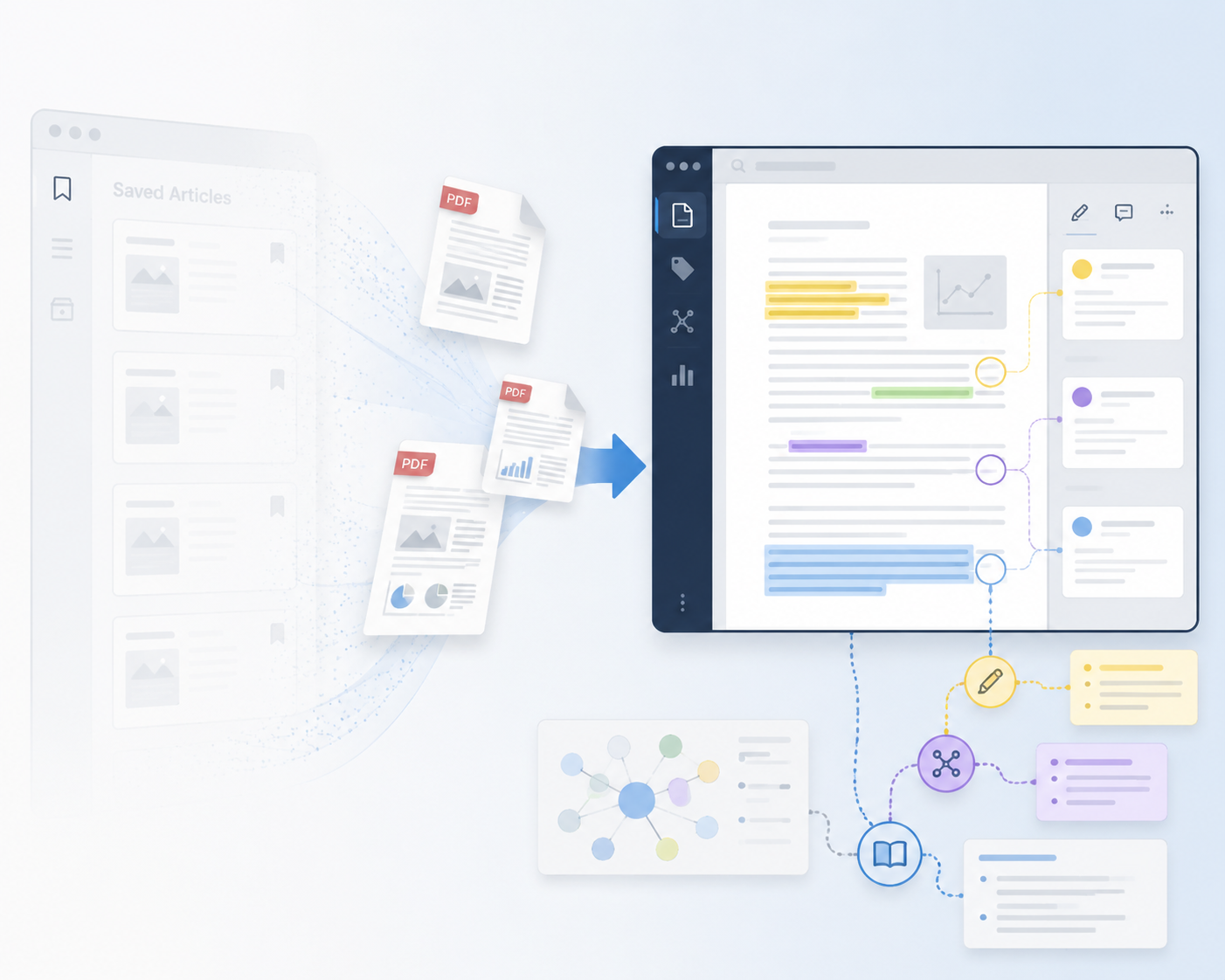
Readwise Reader changes the unit of work. Pocket treated most things as saved items. Reader treats them as reading objects that can be highlighted, annotated, filtered, summarized, questioned, and pushed into a note system. That distinction is not cosmetic for research. It changes where the intellectual work can happen.
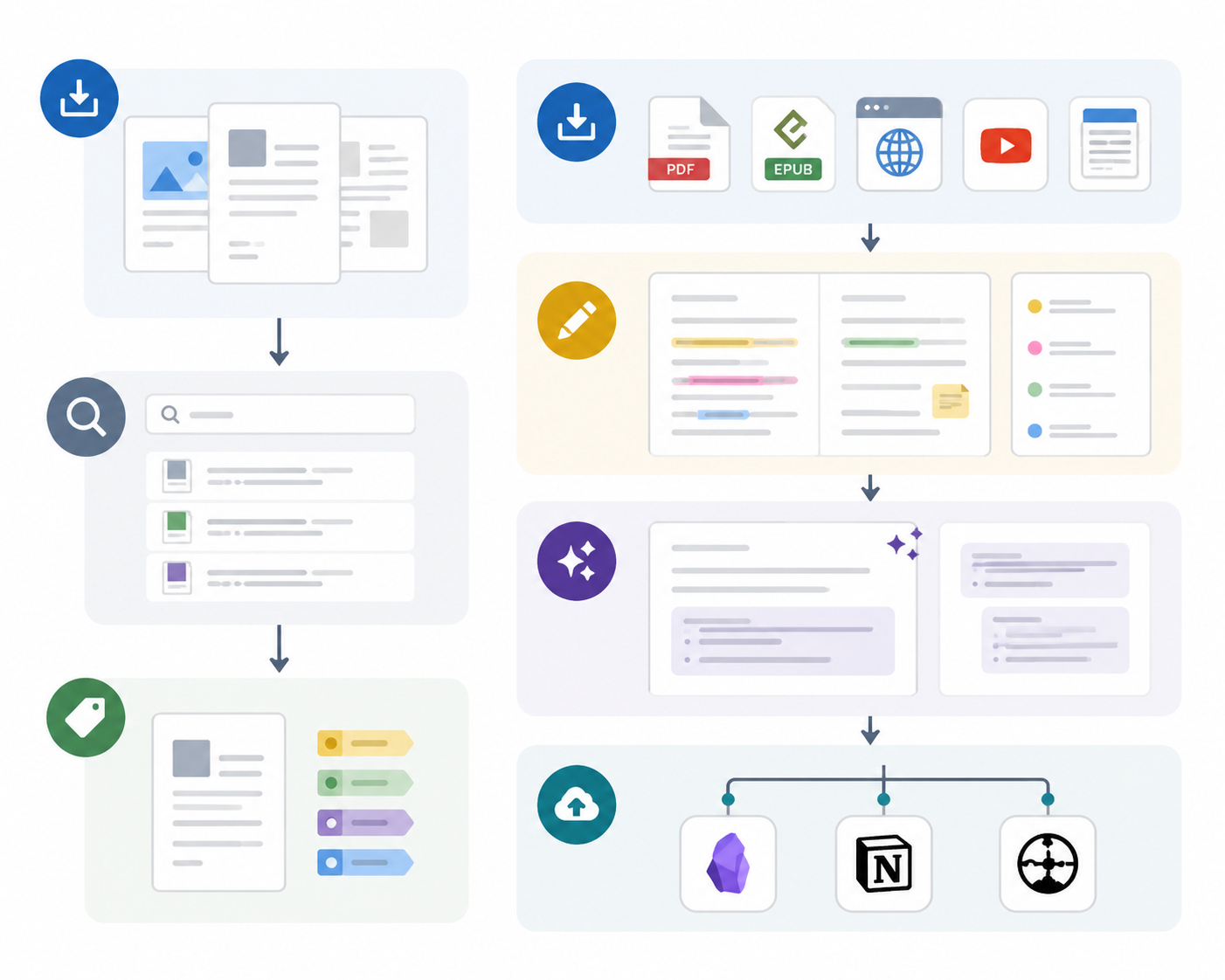
The first gain is format coverage. Reader supports web articles, PDFs, EPUBs, email newsletters through a dedicated address, and YouTube transcripts with inline highlighting.[2] Pocket could collect plenty of web material, but it was not built around native scholarly-PDF handling. For a researcher, that matters because the awkward items are often the important ones: a PDF report, a book chapter excerpt, a long institutional document, a webinar transcript, a newsletter essay with a useful claim buried halfway down.
The second gain is that highlighting becomes a durable object rather than a private gesture inside a reading session. Reader can synchronize highlights into Obsidian, Notion, Roam Research, Logseq, and Evernote.[2] If your writing process already lives in one of those tools, this removes a tedious middle step: copying the passage, pasting it into notes, adding the source title, and hoping future-you recognizes why it mattered.
This is where Reader’s advantage over Pocket is most defensible. A saved article is potential energy. A highlighted passage exported into the place where you outline, draft, or synthesize literature is closer to usable work. The difference shows up six weeks later, when you are trying to recover the sentence that clarified a policy distinction or the paragraph that gave you language for a theoretical contrast.
PDFs Are the Deciding Feature for Many Researchers
If most of your Pocket archive was web journalism, blog posts, and newsletters, Reader’s PDF support may feel like a nice extra. If your work regularly involves reports, white papers, syllabi, public consultation documents, preprints, or article PDFs, it becomes a different category of tool. Reader supports full highlighting on PDFs, while Pocket was never designed as a serious PDF annotation workspace.[2][4]
That does not make Reader a substitute for a reference manager. It does mean a researcher can keep more of the reading act in one place: save the PDF, mark the passage, add a note, and later send that highlight into a PKM system. The useful comparison is not “Reader versus Zotero.” It is “Reader versus the old habit of saving a PDF somewhere, reading it somewhere else, and manually reconstructing the useful parts later.”
Ghostreader Helps Most When the Question Is Narrow
Ghostreader is Reader’s built-in AI layer. Readwise describes it as able to summarize documents, define terms, and answer questions against saved content.[5] That is a meaningful difference from Pocket, which did not offer an equivalent AI assistant for interrogating saved documents.[4]
The temptation is to treat that as automatic productivity. It is not. A summary can help triage a long document; it does not decide whether the document is credible, relevant, or worth citing. A definition can help when a term is blocking comprehension; it does not replace reading the surrounding argument. Q&A against a saved document is most useful when the question is narrow: “Where does this report discuss implementation barriers?” is a better use case than “What should I think about this field?”
Used this way, Ghostreader can reduce the distance between collecting and assessing. Used lazily, it can make the unread pile look processed while leaving the actual judgment untouched. That distinction is especially important for research, where a plausible summary is not the same as a usable source.
Migration: Pocket HTML Gets You In, But It Does Not Clean the Archive
The migration path is at least straightforward at the file level. Pocket supported HTML export, and Reader can import Pocket’s HTML export directly.[6] For former Pocket users who exported before deletion, that means the old archive does not have to be rebuilt link by link.
What the import cannot do is decide what still matters. It will not know which tags were serious and which were wishful. It will not separate the article you saved for a dissertation chapter from the article you saved because a newsletter made it sound urgent on a tired Friday. It will not turn a neglected backlog into a clean research corpus.
A sane migration starts smaller than the exported file. Bring the archive in if you have it, but rebuild active use around current projects: one dissertation chapter, one grant proposal, one literature review, one client research stream. Reader is powerful enough to hold an enormous inbox. That is not the same as being obligated to refill it.
- Import the Pocket HTML export if you have it, but do not treat every imported item as active research material.
- Create a small set of project tags or filtered views before adding new sources.
- Test PDF highlighting and PKM sync on one real project before committing the whole archive.
- Keep citation records in Zotero, Paperpile, Mendeley, or another reference manager rather than trying to force Reader into that role.
The Price Is Justified Only If Reader Replaces Several Small Workarounds
At $119.88 per year, Readwise Reader is not a casual Pocket replacement.[3] It has to replace more than the old save button. The full price becomes defensible when it removes several recurring chores: saving PDFs separately, highlighting in one app, copying quotations into notes, sending newsletters into a messy inbox, searching old articles without remembering where they went, and manually moving reading notes into the system where writing happens.
The academic discount changes the equation. At $59.94 per year, Reader is still more expensive than Pocket Premium’s old $44.99 annual price, but the difference is no longer the same kind of decision.[4] For a graduate student or university researcher who actively uses PDFs, highlights, and Obsidian or Notion sync, the discounted price is easier to defend than the full consumer price.
The threshold is not whether Reader has enough features. It does. The threshold is whether those features replace behavior you already perform. If you do not annotate PDFs, do not review highlights, do not maintain a PKM system, and do not revisit saved material during writing, Reader may simply give you a more expensive unread queue.
| Reader feature | Research value | When it earns its keep |
|---|---|---|
| PDF and EPUB highlighting | Keeps non-web reading inside the same annotation system | You regularly mark up reports, papers, chapters, or long documents |
| Ghostreader AI | Helps summarize, define, and query saved material | You use it for triage and narrow document questions, not as a substitute for source evaluation |
| PKM highlight sync | Moves marked passages into writing and note systems | Your actual synthesis work happens in Obsidian, Notion, Roam, Logseq, or Evernote |
| Newsletter ingestion | Turns research newsletters into annotatable sources instead of inbox clutter | Newsletters are part of your source discovery process |
| Spaced repetition through Readwise | Can resurface highlights over time | You review highlights deliberately rather than accumulating them |
Where Reader Still Falls Short for Research
Reader’s largest research limitation is citation management. Its product materials emphasize reading, highlighting, document handling, AI assistance, and sync, but not BibTeX export, CSL export, Zotero integration, Paperpile integration, Mendeley integration, collaborative annotation, or shared reference libraries.[2] That absence is not a minor missing button. It defines the boundary of the tool.
For academic writing, the citation record still needs to live somewhere else. Reader can help you understand and retrieve a passage. It should not be the place you rely on for formatted references, publication metadata, deduplication, group libraries, or manuscript citation workflows. A clean setup lets Reader handle reading and annotation while Zotero or another reference manager handles bibliographic authority.
There is also a collaboration gap. Reader is built for an individual reading pipeline, not for a research team maintaining a shared annotated library. That may be fine for a doctoral chapter, independent research memo, or solo essay. It is less satisfying for lab groups, co-authored systematic reviews, or teams that need shared decisions about what counts as included, excluded, coded, or cited.
Alternatives Are Boundary Markers, Not Equivalent Replacements
Instapaper, Matter, and Wallabag are worth considering, but they answer different anxieties. Instapaper offers unlimited saves on its free tier and Kindle delivery, but does not match Reader on PDFs, AI, or PKM export.[7] That makes it more sensible for people who want a calm article queue than for people rebuilding a research annotation system.
Matter is stronger if listening is central. Readless describes it as having the best text-to-speech among the compared read-later tools, with Premium at $60 per year, but also notes that it is iOS-only.[7] That is a real constraint if your research reading moves between a university desktop, an Android phone, a tablet, and a browser.
Wallabag matters for a different reason: control. It is self-hosted and open source.[7] After Omnivore shut down in November 2024 and Pocket shut down in July 2025, two read-later services disappeared within roughly 14 months.[1][6] For researchers who now see platform stability as part of the feature set, Wallabag’s appeal is not polish. It is ownership.
A Practical Decision Rule
Choose Readwise Reader if your research process depends on annotated PDFs, long-form document review, AI-assisted triage, newsletter capture, and automatic movement of highlights into a PKM tool. It is the most convincing Pocket successor when the goal is not merely to save reading, but to get marked material back into the place where analysis and writing happen.
Choose a lighter or cheaper replacement if Pocket was mostly a queue for articles you might read later. Reader’s strengths are real, but they do not rescue a workflow that stops at saving. If the old problem was an unread backlog, a more capable inbox may only make the backlog look professionally organized.
Keep Reader in its lane. It can be an excellent reading and annotation system. It can be a strong bridge into Obsidian, Notion, Roam, Logseq, or Evernote. It is not a reference manager, not a shared research library, and not a guarantee that saved sources will become used sources. For researchers replacing Pocket, that boundary is not a flaw to ignore; it is the condition for using the tool well.
References
- Mozilla is shutting down read-it-later app Pocket, TechCrunch, May 22, 2025.
- Readwise Reader product page, Readwise.
- Readwise Pricing page, Readwise.
- Readwise Reader Pricing 2026, Readless.
- How to Actually Use What You Read with Readwise, Readwise Blog.
- Pocket Alternatives (2026), SupaSidebar.
- Best Read Later Apps in 2026, Readless.