
Status as of August 26, 2026
Permanent daylight saving time is not yet federal law. The U.S. House passed H.R. 139, the Sunshine Protection Act, by a 308–117 vote on July 14, 2026, but the Senate companion, S. 29, remained uncertain, with 18 cosponsors and at least one pledged hold from Sen. Tom Cotton reported at the time of coverage.[1][2] Nineteen states were described as ready to enact permanent daylight saving time if federal law allows it, while Arizona and Hawaii remained the standing exceptions that do not observe daylight saving time.[1][2][3]
For work schedules, that makes permanent daylight saving time a watch item with real planning consequences. It would end the twice-a-year clock change, which is where many payroll, night-shift, and compliance problems live. It would not end the one-hour problem. It would move that problem into winter mornings, where the cost lands hardest on employees who leave before 8 a.m. and on operations that depend on usable morning light.
The clock-change problem that permanent DST would remove
The cleanest scheduling gain is also the most concrete: the skipped and repeated hour disappears. Today, an overnight shift that runs from 11 p.m. to 7:30 a.m. does not always represent the same number of paid hours. On the spring-forward Sunday, that shift can contain 7 hours of work; on the fall-back Sunday, it can contain 9 hours. Under the FLSA, pay follows the hours actually worked, not the wall-clock label on the shift.[4][5]
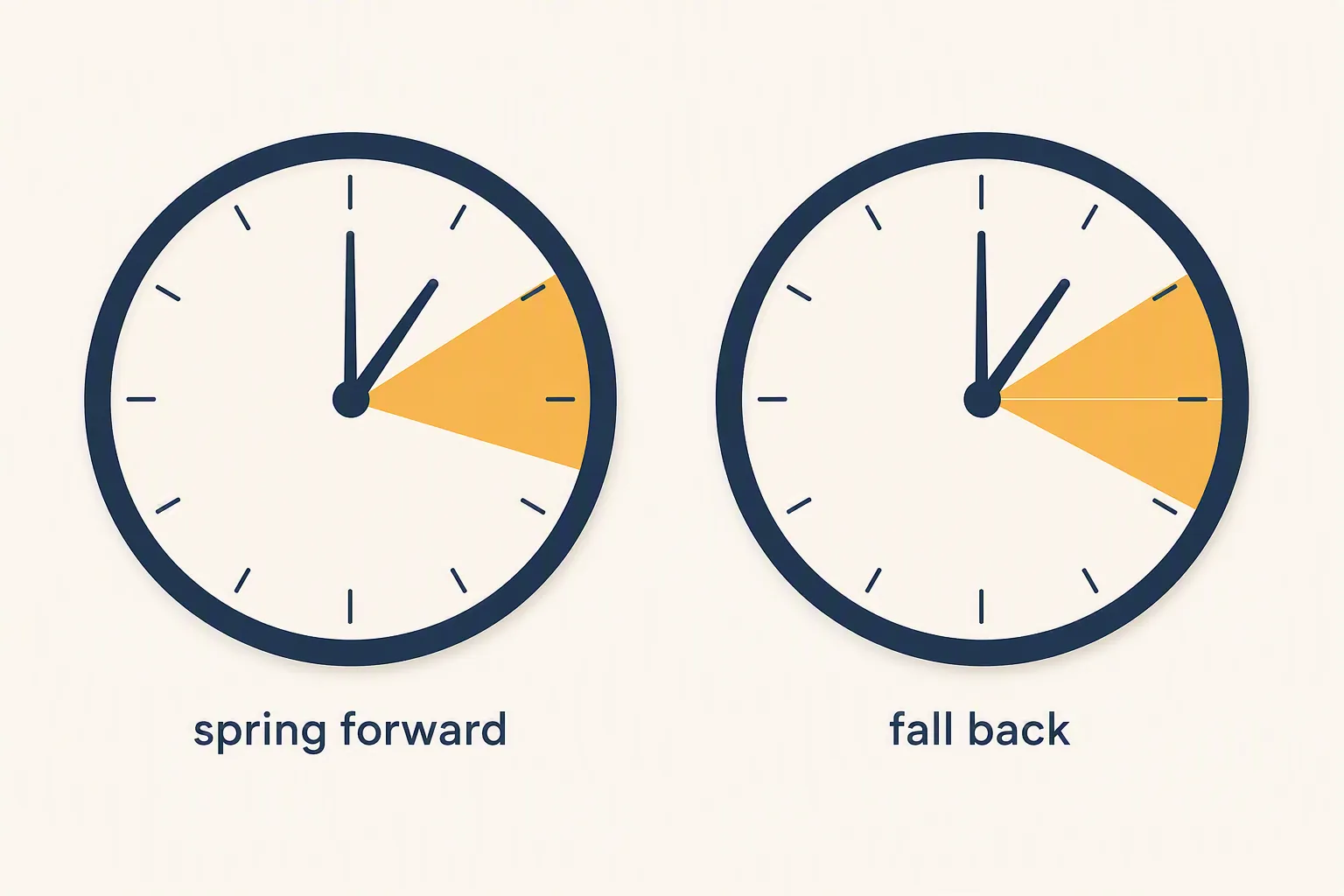
That is the part of the permanent daylight saving time argument that payroll departments do not need dressed up. The repeated fall hour means extra pay exposure, overtime calculations where applicable, timekeeping exceptions, supervisor explanations, and sometimes correction runs after employees reasonably ask why the hours on the check do not match the shift they remember working. Spring creates the inverse problem: employees may be scheduled across a shift that looks normal on the roster but contains one fewer compensable hour.
Federal law is only the base layer. State rules can make the same clock event more expensive or more complicated, and employer guidance in California treats graveyard-shift daylight saving transitions as a wage-and-hour issue that must be reconciled under state requirements as well.[6] A year-round clock removes that recurring exception from the calendar. It does not remove overtime rules, missed punches, meal-period problems, or bad scheduling practices; it removes one avoidable source of confusion that arrives on a weekend and becomes payroll’s problem on Monday.
The transition costs are real, but not universal
The spring change has more than an administrative footprint. Barnes and Wagner’s mining-industry study, covering 1983–2006 data as reported by the American Psychological Association, found 3.6 additional mining injuries on the Monday after the spring daylight saving switch and a 68% increase in lost workdays associated with those injuries. The same report described American Time Use Survey data from 2004–2006 showing workers slept about 40 minutes less on the Sunday night after the spring change.[7]
Those numbers should not be inflated into a claim that every workplace sees the same injury pattern. Mining is not a call center, and a Monday-after signal is not the same thing as a year-round safety model. Still, for employers with physical work, early report times, mobile crews, heavy equipment, or safety-sensitive tasks, it is enough to treat the spring change as a real scheduling hazard rather than a harmless inconvenience.
Chmura’s 2024 model, with a stated margin of error, estimated the annual U.S. cost of the spring time change at roughly $672 million across metropolitan statistical areas.[8] That is a modeled economic estimate, not a payroll ledger any single employer can copy into a budget. Its usefulness is directional: the spring change produces measurable friction across labor, output, and timing-sensitive activity. Permanent daylight saving time would remove that spring disruption and the fall payroll oddity at the same time.
The winter-morning cost is where the decision splits
The scheduling trade is not “two bad weekends versus nothing.” It is “two bad weekends versus darker winter mornings.” For employers, the second side matters because work does not begin at the same hour for everyone.
The United States Studies Centre modeled sunrise effects under permanent daylight saving time and found that 87% of the urban U.S. population would experience winter sunrises after 8 a.m., compared with 3% under the current arrangement. It also found that 44% of 2,585 contiguous-U.S. urban areas would see winter sunrise after 8:30 a.m. The same analysis reported that 58.8% of U.S. workers leave for work before 8 a.m., including 26% who leave between 7 and 8 a.m.[9]

That is the center of the work-schedule question. If most employees start at 9 a.m. from a laptop, the winter sunrise shift may be a nuisance or a commute preference. If crews assemble at 6:30, trucks roll at 7, or employees are already on a road, dock, jobsite, production floor, or school route before 8, the same policy creates a recurring operating condition. The hour no longer appears twice a year in the timekeeping system. It appears every winter morning in start-time decisions, lighting needs, commute exposure, and supervisor judgment calls about whether work can safely begin.
The 1974 test is a warning about operations, not nostalgia
The United States has already tried a version of this. During the 1974 permanent daylight saving time experiment, January sunrises approached 9 a.m. in Detroit, Indianapolis, Minneapolis, and Seattle. Public support reportedly fell from 79% to 42% within two months, schools in at least 18 states shifted start times, and the Department of Transportation’s interim report found effects “so small that they could not in general be reliably separated.” The National Bureau of Standards found no significant energy savings.[10]
For employers, the useful lesson is not that 1974 mechanically predicts 2027 or 2028. Work patterns, remote work, systems, and commuting have changed. The lesson is that winter morning pain becomes operational quickly. School start-time changes are schedule changes. Darker commutes become staffing conversations. Energy claims may not help the person who has to decide whether a crew can start on time in January.
How the pros and cons change by workforce type
| Workforce segment | Likely schedule gain | Likely schedule cost | Not for you if |
|---|---|---|---|
| Hourly overnight and rotating shifts | No skipped or repeated DST hour to reconcile; fewer special payroll rules around the clock-change weekends | One-time systems and policy updates if federal law changes | Your main problem is not the DST hour but inconsistent punches, overtime design, or state-law complexity |
| Early-start field, logistics, construction, utilities, maintenance, and road crews | No transition-week fatigue and no biannual clock confusion | More winter starts, staging, travel, and pre-task work occur before sunrise | Your crews already start after daylight or can shift winter start times without service loss |
| Sunrise-dependent or outdoor work | Simpler annual calendar | Morning work windows may shrink or require added lighting, sequencing changes, or later starts | Work can be performed safely and productively in darkness with existing controls |
| Stable daytime office staff | Fewer calendar disruptions and less confusion around the Monday after the change | Limited direct scheduling cost unless commute timing or dependent schedules matter | Employees are already distributed across time zones where offset changes drive the bigger issue |
| Remote and distributed teams | More predictable U.S. clock rules if all relevant states align | Cross-border offset mismatches may still occur if other countries keep seasonal changes | Your coordination problems come from asynchronous work design rather than clock policy |
| Payroll, HRIS, scheduling, and compliance teams | A recurring exception disappears from timekeeping, pay review, and supervisor training | Any federal change still requires configuration, testing, employee communication, and audit controls | Your vendor stack cannot confirm how it will handle the legal effective date |
Hourly and night-shift teams
This is where permanent daylight saving time has the clearest administrative upside. Payroll no longer needs a special rule for the repeated fall hour or the missing spring hour. Supervisors no longer need to explain why two employees on apparently identical overnight shifts have different paid hours because one shift crossed the time change and the other did not. Timekeeping systems no longer need that semiannual exception tested, documented, and audited.
The gain is especially practical for workplaces that run 24/7: hospitals, distribution centers, hotels, public safety operations, manufacturing plants, transit, security, and care facilities. Permanent DST does not make these schedules easy. It removes a known defect in the calendar that turns one hour into pay questions, overtime checks, and annoyed messages before the day shift arrives.
Early-start and sunrise-dependent teams
This is where the policy can stop looking like simplification. If a crew currently leaves the yard at 7 a.m., permanent DST does not just give them more evening light. In winter, it can move more of the commute, staging, inspection, setup, and first productive hour into darkness. That matters differently by job: a warehouse picker under fixed lighting is not in the same position as a road crew, utility crew, construction crew, delivery driver, or outdoor maintenance team.
The practical options are not elegant. Keep the same start time and absorb the darker conditions. Add lighting, controls, or supervision. Push winter starts later and accept downstream effects on service windows, customer appointments, overtime, traffic, or project sequencing. Split tasks so indoor, paperwork, loading, inspection, or safety meetings happen first. Each choice has an owner and a cost.
Salaried office staff
For stable daytime office staff, the direct schedule case for permanent DST is simpler. The Monday-after grogginess, calendar confusion, and school or commute adjustments may ease when the clock no longer changes. But salaried office schedules are often flexible enough that the policy does less work than advocates or critics imply. A team that already starts between 8:30 and 10, works indoors, and can shift meetings by agreement is not absorbing the same winter-morning cost as a crew that has to be on site before sunrise.
Remote and distributed teams
Remote teams benefit only if the clock rule reduces coordination noise. If U.S. employees stop changing clocks but colleagues, customers, or vendors in other countries continue to observe seasonal time changes, meeting offsets can still move. The work here is not philosophical; it is calendar hygiene. Recurring meetings, service-level windows, support handoffs, payroll cutoffs, batch jobs, and on-call rotations need to be checked against every jurisdiction that matters to the workflow.
The hidden migration risk is systems, not clocks on the wall
Even if permanent daylight saving time reduces recurring schedule exceptions, the switch itself is a systems change. Airlines for America told WTTW that crew scheduling, reservation systems, and payroll IT would need significant lead time before any daylight saving time change.[1] That warning is easy to understand outside aviation too. Time rules sit inside payroll engines, HRIS platforms, scheduling tools, calendar integrations, access-control logs, dispatch systems, reporting warehouses, and vendor interfaces.
Employers should not wait for the effective date to discover which system treats daylight saving time as a configurable rule and which one has assumptions buried in code. The same applies to collective bargaining language, attendance policies, shift differentials, paid meal periods, overtime triggers, call-in pay, and customer-facing hours. If the legal rule changes, the clock is only the visible part.
What schedule and payroll owners should verify before taking a position
A useful employer position starts with the workforce map, not with a national preference poll. Before supporting, opposing, or planning around permanent daylight saving time, separate the affected groups by start time, pay basis, work location, and dependence on morning light.
- Count employees who report, travel, or begin paid preparatory work before 8 a.m. in winter.
- Identify crews whose first hour depends on daylight, outdoor visibility, road conditions, customer access, or safety-sensitive setup.
- List every hourly, overnight, rotating, or 24/7 schedule that currently crosses the spring or fall clock-change hour.
- Ask payroll and HRIS vendors how they would handle a federal permanent-DST effective date, historical records, repeated-hour cleanup, and time-zone tables.
- Check whether state wage-and-hour rules, union agreements, attendance policies, or shift differentials would need revised examples.
- Review recurring meetings, on-call rotations, dispatch windows, and customer-support coverage for cross-border offset changes.
- Decide whether winter start times would stay fixed, move later, or be sequenced differently for darkness-sensitive work.
CDC/NIOSH guidance around daylight saving transitions focuses on practical adaptation measures such as adjusting sleep schedules, being alert to fatigue, and taking care during commutes and safety-sensitive work.[11] Under permanent DST, those measures still matter during any legal transition, but the larger employer question becomes winter routine: what controls are needed when darkness is no longer a two-Monday disruption but a condition attached to the early shift?
The employer-facing decision rule
Permanent daylight saving time is usually better for employers whose main exposure is the clock-change event itself: hourly overnight work, payroll reconciliation, 24/7 scheduling, stable daytime office work, and teams that value one consistent U.S. clock rule. It is usually harder for employers whose workday starts before 8 a.m. and whose first tasks depend on winter morning light.
The right answer is therefore not permanent daylight saving time in the abstract. It is permanent daylight saving time for this workforce, in these locations, with these start times, and with these systems. Last verified: August 26, 2026.
References
- What Impact Would a Switch to Permanent Daylight Saving Time Have? — WTTW, July 27, 2026.
- Daylight saving time permanent House vote — KGW.
- Buchanan’s Bill to Make Daylight Saving Time Permanent Advances to House Floor — Congressman Vern Buchanan, May 21, 2026.
- Hours Worked: Daylight Savings Time — U.S. Department of Labor elaws.
- 1 More Hour of Sleep, but 4 More Wage and Hour Problems as Daylight Saving Time Ends — Ogletree Deakins.
- Graveyard Shift Workers & Daylight Savings — California Employers Association, October 29, 2025.
- Daylight Saving Time Changes May Lead to More Workplace Injuries, Study Says — American Psychological Association, September 2009.
- The Cost of Daylight Saving Time — Chmura, 2024.
- Daylight savers or night wasters? The case against permanent daylight saving time in the United States — United States Studies Centre.
- The US Tried Permanent Daylight Saving Time in the ’70s. People Hated It — History.com.
- Daylight Savings Time — CDC/NIOSH, 2016.