
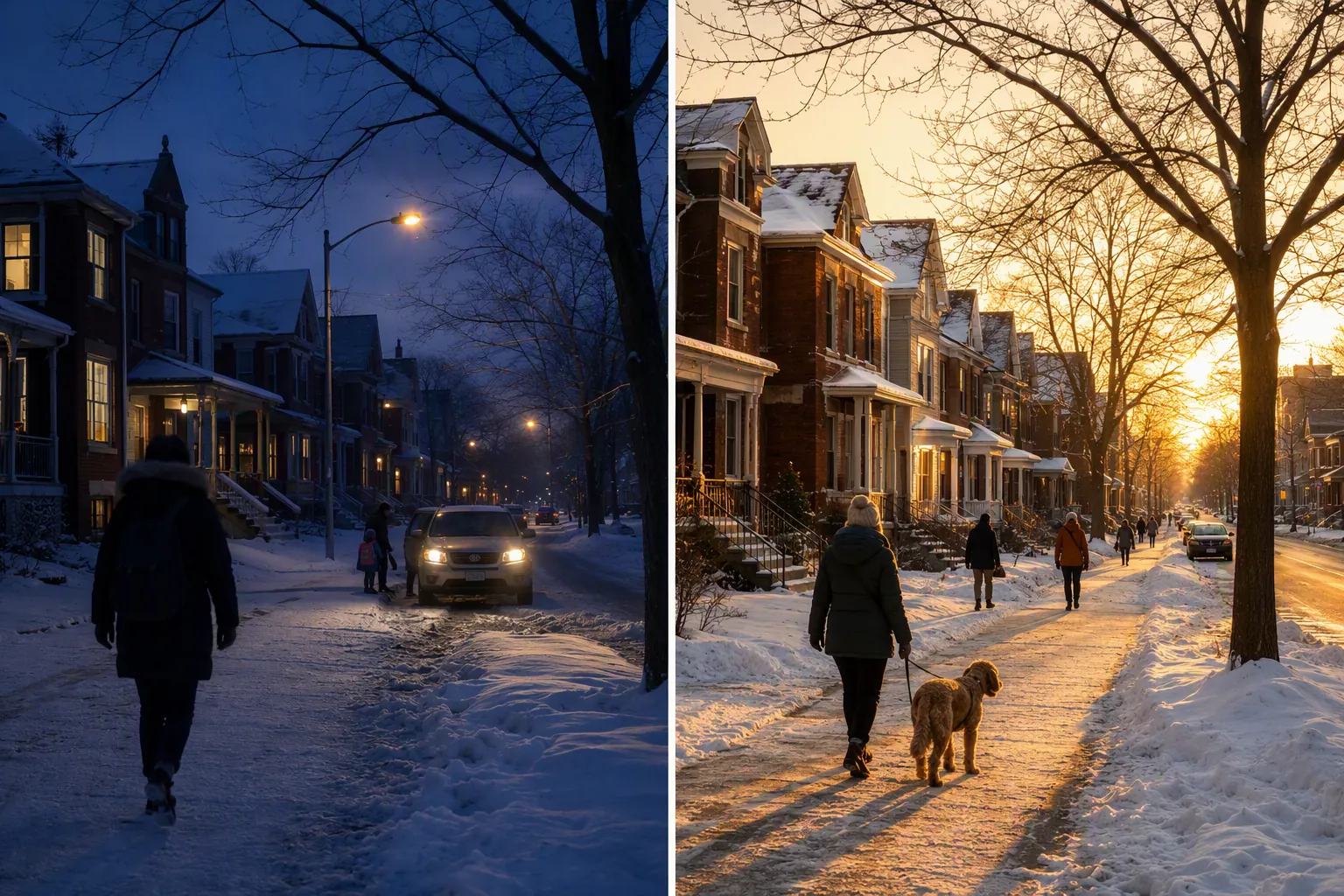
Permanent daylight saving time would not create more winter daylight. It would move the daylight later on the clock. The practical trade is simple enough to test against a real weekday: a winter sunset that now arrives before dinner would land an hour later, while a winter sunrise that now barely reaches the school run would also land an hour later.
That is why the promised benefit depends less on the phrase “permanent daylight saving time” than on your first required appointment. If your day starts after 9 a.m., the darker morning may be mostly background noise. If someone in your household has to be outside before 7:30 a.m., the same policy can feel less like an evening bonus and more like a winter-morning bill that comes due every weekday.
The policy status matters, but the clock matters more
The federal policy is no longer just an annual complaint about changing clocks. The House passed the Sunshine Protection Act on July 14, 2026, by a 308–117 vote, sending the bill to the Senate. The version described in The Hill’s July 2026 coverage includes an opt-out mechanism before the change takes effect, and 19 states are already positioned for permanent daylight saving time if federal law allows it. [1]
That tells you whether a switch is politically plausible. It does not tell you whether the switch helps your Tuesday. For that, start with the one-hour winter conversion.
| What you see now in winter | Under permanent daylight saving time | What changes in daily life |
|---|---|---|
| A 7:15 a.m. sunrise | An 8:15 a.m. sunrise | More school drop-offs, bus stops, early commutes, and job starts happen before sunrise. |
| A 7:45 a.m. sunrise | An 8:45 a.m. sunrise | The morning cost reaches well into a normal office-arrival window. |
| An 8:05 a.m. sunrise | A 9:05 a.m. sunrise | Northern and western-edge locations can push winter sunrise past 9 a.m. |
| A 4:20 p.m. sunset | A 5:20 p.m. sunset | Errands, walking, pickup, and some outdoor work after 5 p.m. become more usable. |
| A 4:45 p.m. sunset | A 5:45 p.m. sunset | More of the post-work window happens in daylight, especially for people ending around 5 p.m. |
The examples above are not city claims; they are the arithmetic of the policy. Permanent daylight saving time keeps the later clock setting through winter, so both sunrise and sunset move one hour later than they would under standard time. The benefit is the evening hour. The cost is the morning hour.
First locate your state, then locate yourself inside the time zone
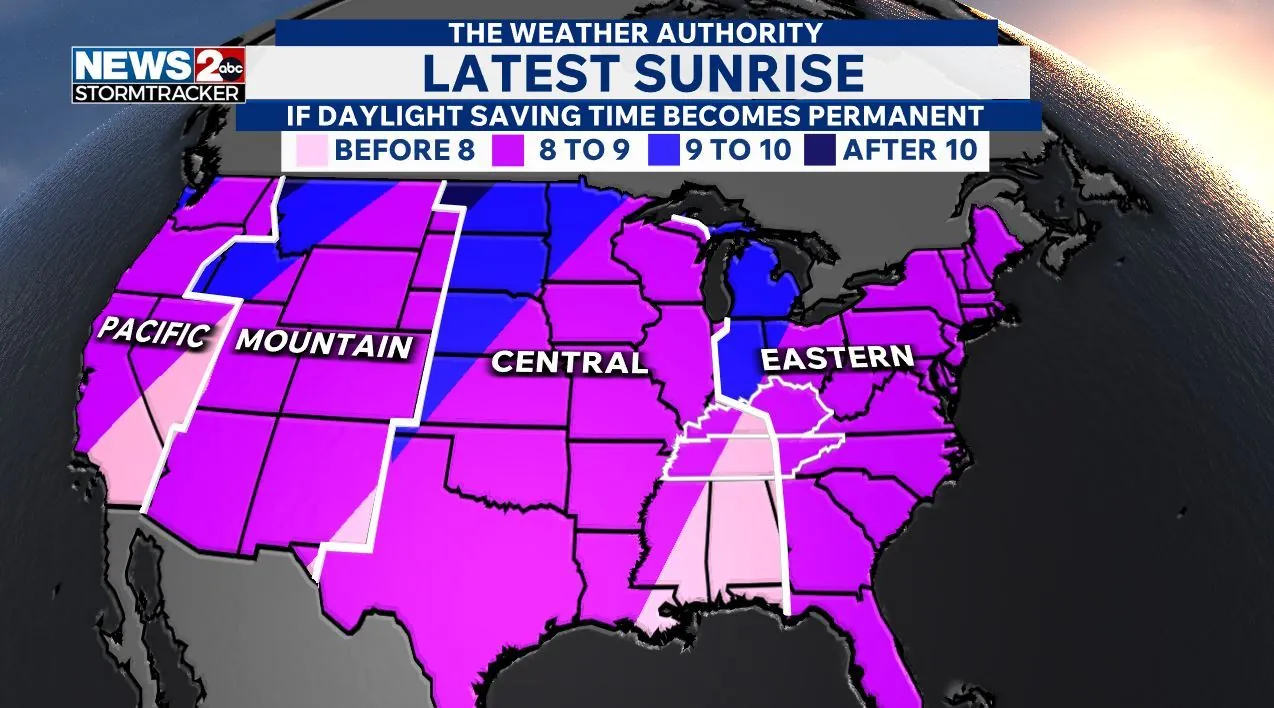
State status is the first filter because some states have already acted and others would be reacting to a federal change. The Hill’s map shows how permanent daylight saving time would affect each state and helps readers place their own state in the policy picture. [1]
| Your state’s position | What it means for your schedule planning | What to check next |
|---|---|---|
| One of the 19 states already positioned for permanent daylight saving time | Your state is not starting from zero. If federal law clears the path and your state does not opt out, the winter-clock change is more than theoretical. | Check winter sunrise first, especially if school, commute, or shift work starts before 8 a.m. |
| A state without a locked-in permanent-DST position | Your daily schedule could still change under federal action, but the state’s route may differ depending on the final law and opt-out decisions. | Watch both federal action and state-level follow-up. |
| A state considering or using an opt-out path | The practical result may differ from neighboring states, which matters for cross-border commuters and regional employers. | Check nearby states if you work, shop, attend school, or travel across a state line. |
The second filter is geography inside the time zone. A state on the western side of a time zone tends to feel later sunrises more sharply than a state or city on the eastern side. Latitude also matters: the farther north you are, the more compressed winter daylight becomes, so shifting that daylight later can move sunrise past 9 a.m. in the northernmost cities. [1]
The winter-light table to build for your own city
For a useful local answer, do not start with an average national sunrise. Pick your city’s darkest part of the year, then add one hour to the standard-time sunrise and sunset. That gives you the permanent-DST version of the day. The table below is the schedule test to run for your own location.
| Your city’s winter standard-time sunrise | Permanent-DST sunrise | Morning meaning |
|---|---|---|
| Before 7:00 a.m. | Before 8:00 a.m. | The morning cost exists, but many 8 a.m. starts still see daylight nearby. |
| 7:00–7:29 a.m. | 8:00–8:29 a.m. | The school and commute window starts to absorb the change. |
| 7:30–7:59 a.m. | 8:30–8:59 a.m. | A large share of ordinary morning movement happens before sunrise. |
| 8:00–8:29 a.m. | 9:00–9:29 a.m. | The trade becomes hard for early starters, especially children and workers who cannot shift later. |
| 8:30 a.m. or later | 9:30 a.m. or later | The morning is the main issue, not a side effect. |
| Your city’s winter standard-time sunset | Permanent-DST sunset | Evening meaning |
|---|---|---|
| Before 4:15 p.m. | Before 5:15 p.m. | The gain may still leave only a short after-work window, but it can move errands and short walks into daylight. |
| 4:15–4:44 p.m. | 5:15–5:44 p.m. | This is where the policy’s evening benefit is most visible for many 5 p.m. schedules. |
| 4:45–5:14 p.m. | 5:45–6:14 p.m. | The after-work gain is more comfortable, especially for households that need daylight for pickup, exercise, or outdoor chores. |
| After 5:15 p.m. | After 6:15 p.m. | The evening benefit is real, but the morning trade still has to be checked against start time. |
This is where broad claims about “more daylight” get too loose. A 5:20 p.m. winter sunset can be genuinely useful. It can mean a parent is not loading groceries in the dark, a runner can use a neighborhood route without a headlamp, and a small business has a more inviting hour after work. But that same shift can put a child at a bus stop before sunrise or move an outdoor crew’s first hour into darker conditions.

If your day starts before 7 a.m.
Permanent daylight saving time is usually a tough bargain for this schedule. If you leave home before 7 a.m., the evening benefit may arrive long after the morning cost has already shaped your day. You are more likely to drive, wait, load equipment, open a worksite, or begin a shift in darkness.
The question is not whether you might enjoy a brighter late afternoon. Many early starters would. The question is whether that later light compensates for making the first required trip of the day darker during the shortest weeks of the year. For school transportation, construction, delivery, health care, manufacturing, and other fixed-start work, flexibility is limited. The clock changes; the start time often does not.
If your household has an 8 a.m. start
The 8 a.m. household is the pressure point in this debate. School doors, office arrivals, daycare drop-offs, and medical appointments often cluster around this hour. Under permanent daylight saving time, many winter sunrises would move past 8 a.m., and the northernmost cities can see sunrise pushed past 9 a.m. [1]
That does not make the evening benefit imaginary. It does mean the benefit and cost land on different people at different times. A parent may appreciate daylight at 5:30 p.m. for pickup and errands, while the same child waited in the dark that morning. A commuter may like a brighter trip home, while the trip in required more headlights, more alertness, and more tolerance for low winter visibility.
For this group, the useful test is blunt: would your household be willing to trade a darker arrival window for a lighter after-work window? If the answer depends on school start times, bus routes, or a spouse’s shift, then the state-level benefit is not one household benefit. It is several schedules colliding.
If your day starts after 9 a.m.
This is where permanent daylight saving time can look much better. A later-starting remote worker, a retiree, a college student with later classes, or a household without early school transportation may miss much of the morning penalty. The sunlight that moves into the late afternoon can become the more usable part of the day.
The benefit is especially clear when winter errands usually compete with darkness. A 5:30 p.m. sunset changes the feel of a grocery run, dog walk, playground stop, neighborhood walk, or quick outdoor repair. It also gives some local businesses a more active-looking hour after the standard workday.
This schedule type should still check local sunrise, not because the morning cost disappears, but because it may land outside the person’s required travel window. That is a different trade from the one faced by a household that has to be on the road before 8 a.m.
If your main concern is after-work daylight
The strongest daily-schedule case for permanent daylight saving time is the winter evening. Moving sunset from before 5 p.m. to after 5 p.m. is not a small aesthetic change for people whose free time begins when work ends. It can turn a closed-in winter weekday into one with a usable outdoor margin.
That margin matters for ordinary life: walking to transit in visible light, picking up a child without the day feeling over, doing an errand before dinner, exercising outside, or keeping a neighborhood business district active after office hours. The gain is easiest to defend when the people receiving it are not the same people paying the steepest morning cost.
The harder cases are mixed households. One adult may have a flexible remote morning and value the evening hour. Another may leave for a fixed shift before sunrise. A teenager may walk to school in the dark. In those homes, “more evening daylight” is true but incomplete.
How to judge the benefit in your state
Use the state question as a routing tool, not as the final answer. A state that has already positioned itself for permanent daylight saving time may be more likely to move quickly if federal law clears the way. But the daily effect still depends on whether your part of the state is north or south, east or west inside the time zone, and whether your required day starts before the sun does.
- If your winter sunrise would move later than your required departure time, count that as a real cost, not a minor inconvenience.
- If your winter sunset would move past 5 p.m. and your obligations end around then, count the evening benefit as real.
- If your state sits near the western edge of a time zone, pay extra attention to sunrise.
- If your household crosses state lines for work or school, check whether neighboring states might follow a different path.
- If your schedule is flexible after 9 a.m., the same policy may feel much more favorable than it does for an early-shift worker or a school household.
Permanent daylight saving time can make winter afternoons more usable. It can also make winter mornings noticeably harder. The useful answer is the local one: add an hour to your darkest-season sunrise and sunset, then compare those times with when your household actually has to be outside.
References
- Permanent daylight saving time state map, The Hill, July 2026.