

Last verified: August 25, 2026. In this article, “coding notes” means the working Markdown developers keep in Obsidian, Notion, Logseq, or a repository: half-finished snippets, command cheatsheets, pasted stack traces, bug logs, architecture notes, refactor plans, and explanations written for a future version of yourself. It does not mean benchmark annotations.
The naming matters. The rigorous head-to-head evidence available here is GLM-5.3 versus GPT-5.6 Sol, not GLM-5.3 versus an undifferentiated “GPT-5.” The GPT-5 family also includes GPT-5, GPT-5.3 Codex, GPT-5.5, and other variants. On the evidence that can actually be checked, GPT-5.6 Sol is the better first-shot model. GLM-5.3 becomes the more compelling choice when retries are acceptable and cost per task matters.
The tested comparison is narrower than the headline
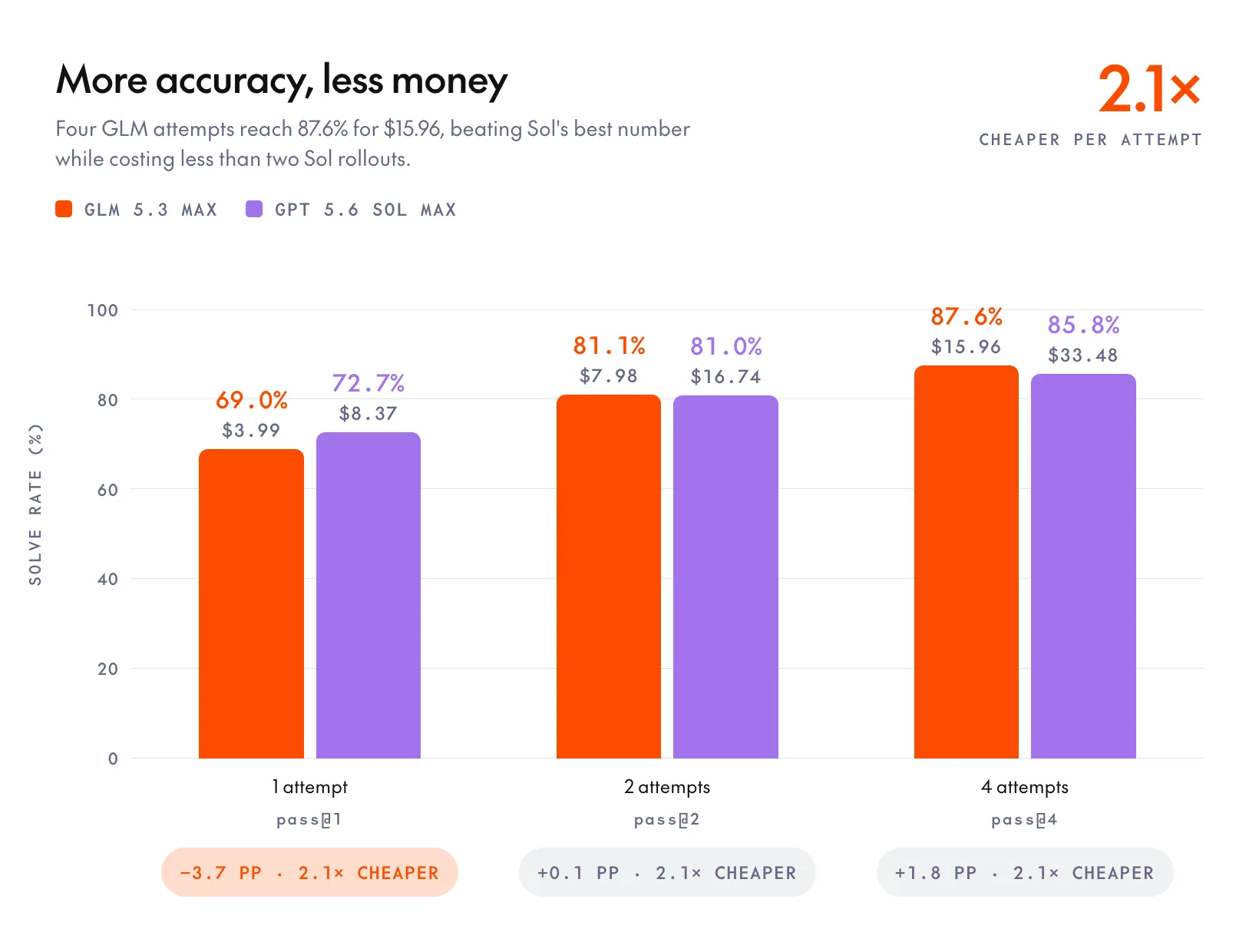
Together.ai's DeepSWE v1.1 comparison is the load-bearing evidence: 113 software-engineering tasks, four trials per task, and 904 total rollouts. It reports pass@1, pass@2, and pass@4, so it measures both the first answer and what happens when the workflow gets additional attempts.[1]
| Metric | GLM-5.3 | GPT-5.6 Sol |
|---|---|---|
| Pass@1 | 69.0% | 72.7% |
| Pass@2 | 81.1% | 81.0% |
| Pass@4 | 87.6% | 85.8% |
| Cost per rollout | $3.99 | $8.37 |
| Solves per $100 | About 17 | About 9 |
| Average rollout time | About 35 minutes | About 19 minutes |
| Average steps per rollout | 124 | 61 |
The first attempt belongs to Sol: 72.7% pass@1 versus 69.0% for GLM-5.3. That is the result to care about when you are in a live debugging session, pasting the response directly into a note, or asking for an explanation while the surrounding context is still fresh. A wrong first interpretation can become a misleading premise for everything written below it.
The retry picture changes quickly. GLM-5.3 reaches 81.1% at pass@2 against Sol's 81.0%, then leads at pass@4, 87.6% to 85.8%.[1] That does not make GLM-5.3 the stronger single response. It makes it unusually plausible for an iterative notes workflow in which the first draft is reviewed, tested, and regenerated before it is treated as knowledge.
The failure pattern is more useful than the leaderboard gap. Among its failures, GLM-5.3 broke existing tests in 11% of cases, compared with 20% for GPT-5.6 Sol.[1] The comparison does not prove that every GLM-generated refactor is safer. It does show that, in this benchmark, the cheaper model produced fewer failures that actively damaged the existing test state. That matters when a refactor suggestion is being copied into a permanent engineering note and may later be mistaken for a validated change.
What this means inside coding notes
For snippet explanations, first-shot accuracy is usually the main constraint. A note that says a function “deduplicates requests” when it only deduplicates responses can mislead the next debugging session, even if the prose is clear. Sol's pass@1 lead makes it the safer default for explanations that will be read once and relied on immediately.
Repository-to-Markdown documentation has a different failure surface. The model has to decide which files matter, preserve relationships between components, and avoid turning an incomplete repository reading into authoritative architecture. Either model can produce attractive Markdown; the practical question is whether the output is inspected against the repository before it becomes the index that future work depends on. The benchmark supports retrying GLM-5.3 when that review loop is available, but it does not establish that either model can document an arbitrary repository without supervision.
Bug-log drafting rewards a model that separates observed symptoms from inferred causes. A useful entry records what failed, where it failed, what was tried, and what remains unknown. The DeepSWE data says more about coding-task outcomes than about the factual discipline of prose bug reports, so this is an application-level judgment rather than a benchmark result. The safest workflow is to have the model draft the entry, retain the relevant log or command output, and mark hypotheses as hypotheses.
In-note refactors are where the failure data becomes operational. A suggested change can sound internally consistent while silently breaking an existing test or changing an interface that the note failed to mention. Sol is the better choice when the first proposal must be close to usable. GLM-5.3 is attractive when every proposed refactor goes through tests and the model can retry after seeing the failure.
Cost changes the routing decision
GLM-5.3 cost $3.99 per DeepSWE rollout versus $8.37 for GPT-5.6 Sol, making it about 2.1 times cheaper in that comparison. Together.ai reports roughly 17 GLM-5.3 solves per $100 of rollout budget versus 9 Sol solves.[1] The important unit is not the token price on a model page. It is the cost of getting a note or code change to a state you are willing to keep.
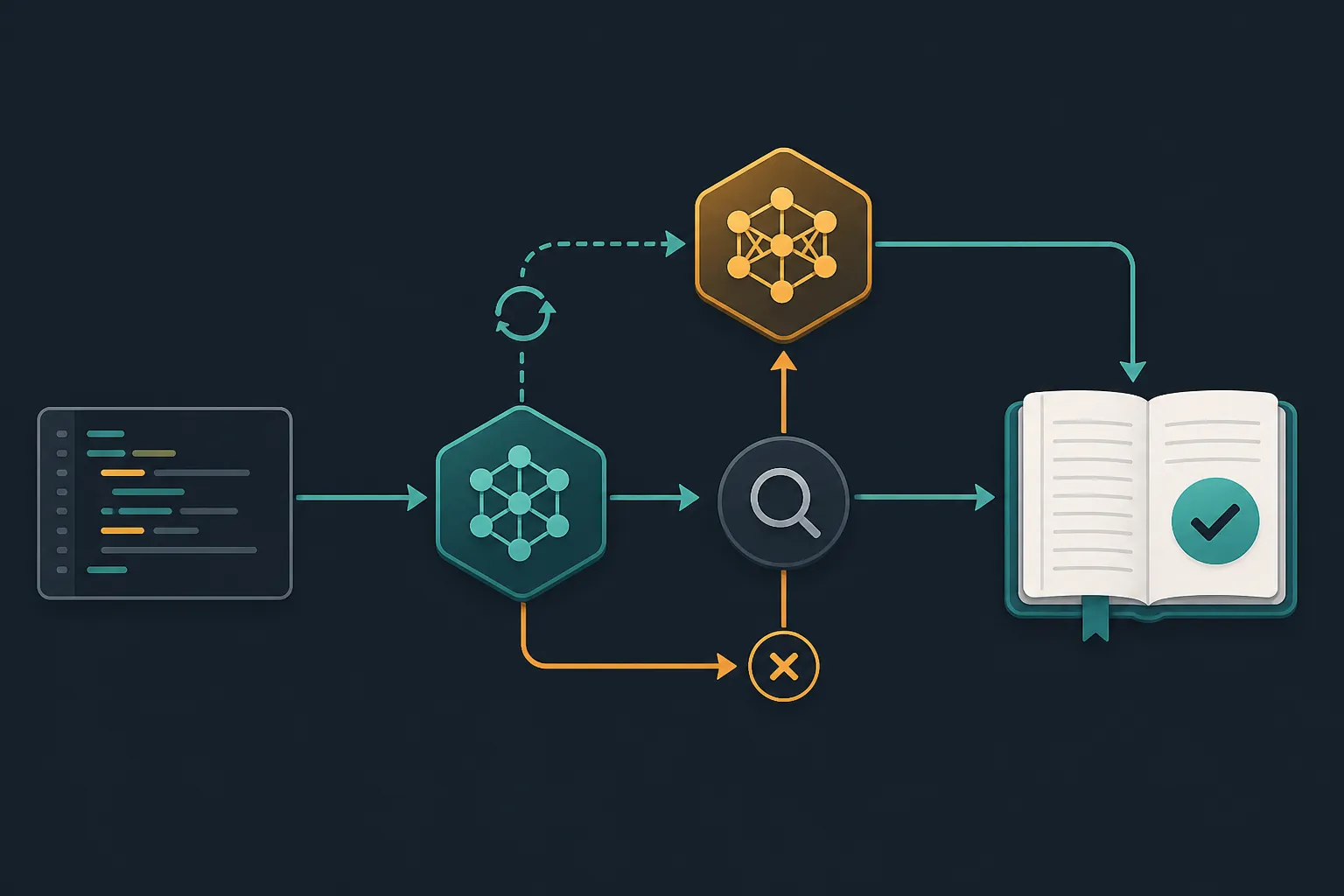
The strongest practical result is the cascade: use GLM-5.3 first, then escalate unresolved work to Sol. Together.ai reports that this route solves 85.9% of tasks at $6.61 each, outperforming Sol alone on its reported cost-and-success tradeoff.[1] For notes, escalation can mean sending only the failed task, the test output, and the original context to Sol rather than paying for the premium model on every explanation or draft.
Current access makes the comparison less clean than the rollout prices suggest. Z.ai's GLM Coding Plan is available from an $18-per-month Lite tier and can be used through tools including Claude Code, Cline, OpenCode, and Codex. Reported higher-tier prices differ by source: AI Pricing Guru lists $72 and $160, while Emergent.sh lists $80 and $168. The $18 floor is consistent; the higher tiers should be checked against the provider before purchase. GLM-5.3 is also listed by OpenRouter at $1.40 per million input tokens and $4.40 per million output tokens, versus $2 and $10 for GPT-5.6 Sol.[6][7]
Latency is a workflow constraint, not the verdict
Sol completed an average DeepSWE rollout in about 19 minutes and 61 steps, while GLM-5.3 took about 35 minutes and 124 steps. GLM-5.3 also used an 80K output-token limit compared with Sol's 60K in the comparison.[1] A longer run is tolerable for an overnight repository pass or a queued documentation job. It is much less tolerable when someone is trying to understand a stack trace before changing the next line of code.
That is why “cheaper” does not automatically mean “better for notes.” If waiting causes you to abandon the model and write the note yourself, the nominal discount has no practical value. GLM-5.3 fits best where the task can run asynchronously or where a second attempt is already part of the process.
What the surrounding benchmark evidence can and cannot say
Plain GPT-5 is a separate comparison point. OpenAI reported 74.9% on SWE-bench Verified using a fixed 477-example subset evaluated on its internal infrastructure, with a footnote describing the evaluation caveat, and Vellum reports an 88% GPT-5 result on Aider Polyglot.[2][3] Those figures are useful context for the family, but they should not be substituted for the GLM-5.3 versus GPT-5.6 Sol result.
Z.ai launched GLM-5.3 on August 14, 2026, describing it as a post-training update on the same 743-billion-parameter mixture-of-experts base as GLM-5.2.[4][5] Its launch table includes stronger Code Bench results, but those scores are vendor-reported, and the model weights were not public as of August 25. The weights were expected roughly two weeks after launch, which means independent reproduction was still pending.
There are useful independent signals, but they remain fragments rather than a replacement for the head-to-head. Artificial Analysis lists GLM-5.2 Max at 53 against an estimated 46 for GPT-5.3 Codex xhigh; a reported GLM-5.3 score near 60 circulated separately. MindStudio's KingBench 3 result gives GLM-5.3 73 out of 80, or 91.25%, against Fable 5's 82.5%, but that is a single vendor-adjacent data point.[8][9] None of these results tells us how a model will explain your repository or maintain the factual boundary of your bug log.
The practical pick
- Choose GPT-5.6 Sol when the first answer is expensive to get wrong, the work is live, or the note will immediately guide a teammate or a code change.
- Choose GLM-5.3 when the task can be retried, tests or human review sit between the output and the permanent note, and cost per completed task matters.
- Use a GLM-first, Sol-escalation route for mixed workloads: explanations and drafts start cheaply, while failed refactors and ambiguous repository conclusions receive a second model's review.
As of August 25, 2026, the evidence supports switching the routing strategy more confidently than switching to a universal winner. Recheck the pass@1 and retry results when GLM-5.3 weights become available, and recheck standalone API pricing once Z.ai publishes it. Those two changes could alter reproducibility and the cost-per-task calculation. Until then, GPT-5.6 Sol is the first-shot choice; GLM-5.3 is the budget-conscious retry choice.
References
- GLM-5.3 vs. GPT-5.6 Sol on DeepSWE: Cost, Coding, and Routing — Together.ai
- Introducing GPT-5 — OpenAI
- GPT-5 Benchmarks — Vellum
- GLM-5.3 — Z.ai
- GLM-5.3 Post-Training Coding — The New Stack
- Z.ai Subscription Pricing — AI Pricing Guru
- GLM-5.3 vs GPT-5.6 Sol pricing comparison — OpenRouter
- GLM-5.2 vs GPT-5.3 Codex — Artificial Analysis
- GLM-5.3 Benchmark Test Results — MindStudio