
The useful question in Garmin Cirqa vs WHOOP for focus and energy management is not which band looks cleaner on a wrist. It is what happens at 8am when the day is still movable. If the first serious writing block can go before lunch or after three meetings, the wearable has to do more than tell you whether last night was good. It has to help decide where the hard thinking belongs.
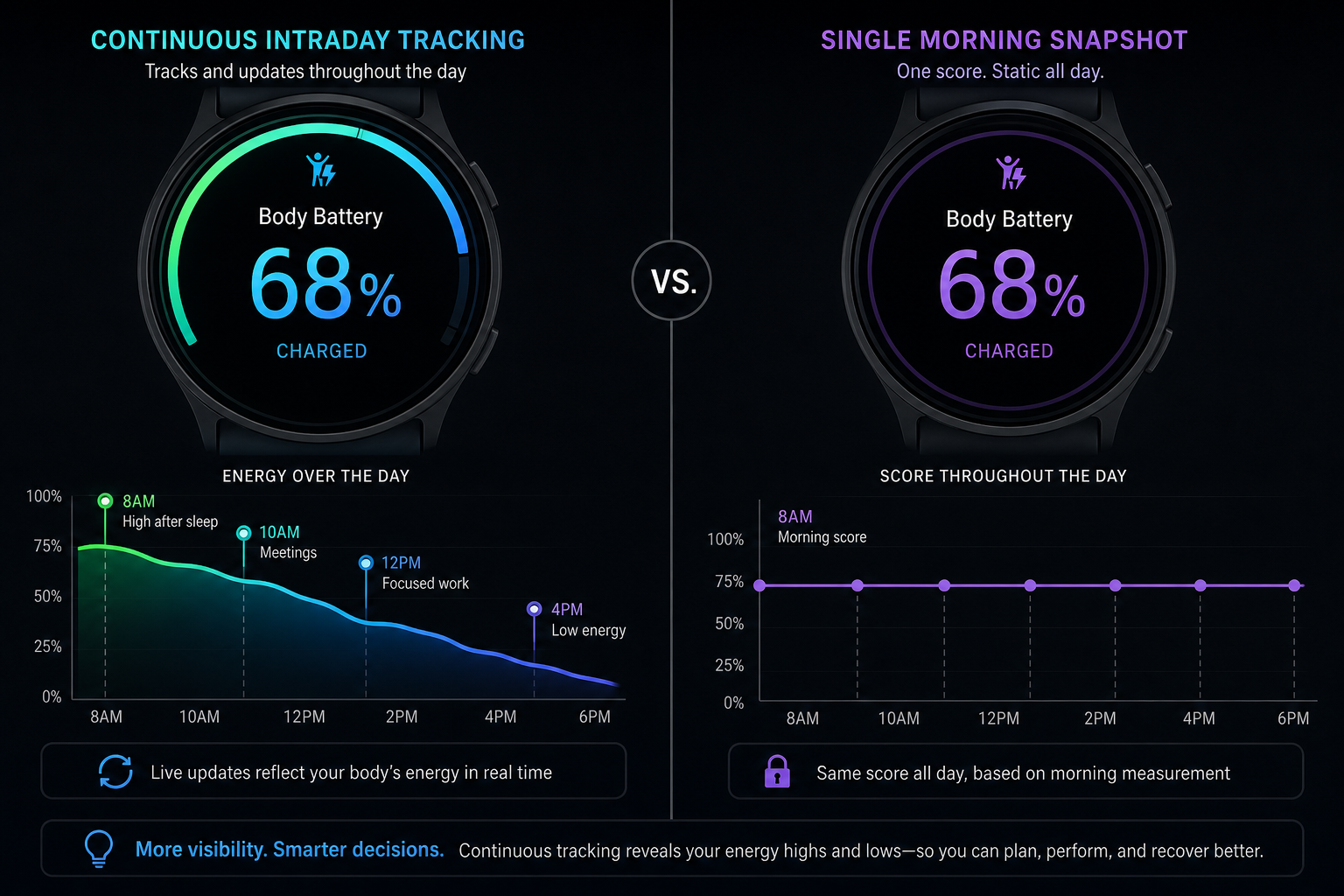
That is where the two systems separate. Garmin's Body Battery runs from 5 to 100 and updates continuously as the day unfolds, with waking values above 75 indicating solid recovery and values below 50 pointing to significant fatigue. WHOOP's Recovery score is calculated once each morning from heart rate variability, resting heart rate, and sleep, then stays static for the day. For planning deep work, that architectural difference matters more than most spec-sheet comparisons. [1][2]
The morning score is only the first decision
A morning readiness signal is still valuable. If WHOOP says recovery is poor, that is useful information before loading the day with a difficult negotiation, a strategy memo, and an interval workout. WHOOP is built around recovery, sleep, and strain; it is not pretending those things are irrelevant to productivity.
But a knowledge worker's day rarely fails only because the opening number was wrong. It fails because the calendar changes. A calm morning becomes two tense calls. A supposedly light admin hour turns into a sequence of decisions. The work that looked possible at breakfast may no longer be a good use of the afternoon.
At 8am, Garmin and WHOOP can both influence the first choice. A high Body Battery reading supports putting the most demanding cognitive work early: writing, analysis, product direction, technical review, or any task where sloppy attention creates downstream cost. A low Body Battery reading below 50 is a reason to be cautious about treating the morning as a blank slate. WHOOP's morning Recovery score can also warn against overcommitting. The difference is that Garmin keeps answering after the day starts. [1][2]
| Workday decision | Garmin Cirqa with Body Battery | WHOOP with Recovery and Strain |
|---|---|---|
| 8am: deep work or admin | Uses current Body Battery, including whether you woke above 75 or below 50 | Uses morning Recovery based on HRV, resting heart rate, and sleep |
| After meetings | Can show energy drain as the day progresses | Recovery score remains the same morning snapshot |
| Low-energy afternoon | Can confirm depletion and support moving work, walking, or resting | Can show daily strain, but not a refreshed cognitive-energy signal |
Why Body Battery fits intraday planning
Body Battery is useful for work planning because it treats energy as something that changes while the work is happening. Garmin says the metric combines signals including heart rate variability, stress, activity, and rest to estimate available energy across the day. The number is not a direct measurement of intelligence, creativity, or willpower. It is a rolling physiological estimate that can make a calendar decision less imaginary. [1]
The cognitive-work angle matters. Garmin's own materials state that sustained mental effort such as writing, coding, analysis, and difficult decisions can appear as stress in HRV tracking. Garmin also describes a pattern where a four-hour deep work block can drop Body Battery by 20 to 30 points. That should not be read as clinical proof that a strategy memo equals a workout. It is better treated as a documented Garmin/user-pattern illustration: focused mental effort can create enough physiological stress for the system to notice. [3]
That distinction is exactly why Cirqa is interesting for focus. The value is not that a band can declare, with perfect authority, that your brain has 37 percent left. The value is that it can show a trend while there is still time to change the day. If Body Battery is falling sharply before lunch, the cost of pretending the afternoon will be pristine becomes visible sooner.
The meeting block is where WHOOP goes quiet
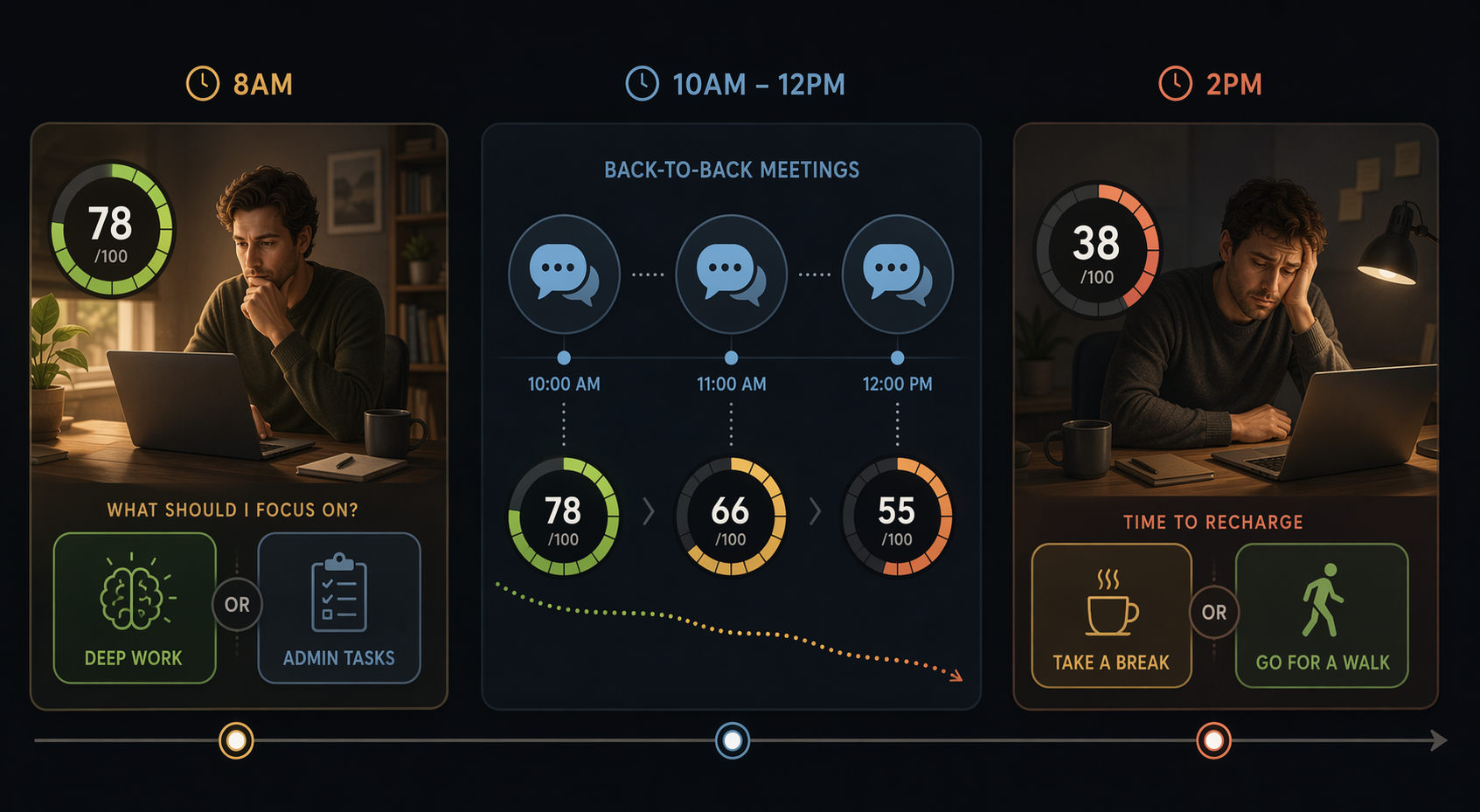
The cleanest comparison is a normal remote-work trap: two hours of back-to-back meetings between 10am and noon. No workout. No dramatic event. Just context switching, disagreement, performance pressure, and decisions that cannot all be postponed.
Garmin's advantage is that this block can change the signal. If the meetings register as stress and Body Battery drains, the person looking at the afternoon has new information. The 1pm writing block may still happen, but it may need a walk first, a narrower scope, or a move to tomorrow morning. This is not glamour. It is the dull, useful work of preventing a high-value task from being attempted with the wrong fuel.
WHOOP's Recovery score does not update after the morning calculation. WHOOP also provides a Strain score from 0 to 21, but that score tracks cumulative daily cardiovascular load and is designed around exercise and physical activity rather than cognitive energy management. After a tense meeting block, WHOOP may still be excellent at explaining the recovery context you brought into the day. It is less suited to answering what the day just did to you. [2]
This is the practical frustration with a static readiness model. The number can be accurate in the morning and still become less actionable by lunch. For athletic recovery, that may be acceptable: you are deciding whether to train hard, train easy, or rest. For knowledge work, the question repeats several times a day, and the consequences are subtle. You do not always fail by collapsing. You fail by spending two expensive hours producing a version of work that needs to be redone.
The afternoon dip needs a live signal, not a moral lecture
Afternoon depletion is where many productivity systems become too heroic. The calendar says finish the proposal. The body says sort email and avoid making commitments. A wearable cannot solve that conflict, but it can reduce the amount of self-deception involved.
If Body Battery is low in the afternoon, the useful response is often modest: take a walk, move the hardest paragraph to tomorrow, convert a deep-work block into review work, or protect a shorter sprint instead of pretending the original plan is still intact. Garmin does not need to be perfectly precise for that to be useful. It needs to be directionally responsive enough to make the cost of continuing visible.
WHOOP can still shape the broader pattern. If poor Recovery keeps appearing after late caffeine, alcohol, stress, or short sleep, WHOOP's behavior tagging and journaling approach can help connect habits with future recovery. That is a different timescale. It is valuable for changing the conditions that produce better workdays, but it does not replace live guidance during the workday itself. [4]
Where WHOOP is still the stronger system
WHOOP deserves credit for being more mature in the recovery-and-behavior ecosystem. Its product logic is clear: understand sleep, monitor recovery, manage strain, and learn which behaviors improve or hurt readiness. For someone whose productivity system starts with training load, sleep consistency, and behavior correlation, WHOOP can be the better fit.
That matters for founders, executives, consultants, and remote workers who train seriously or whose work capacity is tightly tied to sleep quality. If the main decision is whether to push a workout, reduce strain, or protect recovery after a bad night, WHOOP's structure makes sense. It is not useless for productivity. It is just optimized around a different control panel.
There is also an app-experience issue. Garmin Connect can feel dense, and not every user wants more health data packed into more menus. DC Rainmaker's early Cirqa hands-on noted that Garmin's journaling is customizable but not as deep out of the box as WHOOP's for behavior tracking. For users who will actually tag habits consistently, that difference can matter. [5]
Distraction-free design is a tie
Both devices avoid the main failure mode of productivity wearables: becoming another screen. Garmin announced Cirqa as a screen-free health and fitness tracker, and both Cirqa and WHOOP are positioned as distraction-free options rather than smartwatch replacements. Neither is there to deliver phone notifications during a writing block. [6]
That makes the comparison cleaner. If someone is choosing between these two, the decision is not really about watch faces, message previews, or app ecosystems in the smartwatch sense. It is about which invisible system earns its place by supporting better decisions.
For readers also weighing Garmin against a different screen-free tracker, the separate Garmin Cirqa and Fitbit Air comparison is the better place for that branch of the decision.
Price changes the productivity math
Cirqa's price is unusually relevant because this is not only a wellness purchase. It is a work-planning tool. Garmin Cirqa is listed at $199.99 as a one-time purchase with no mandatory subscription, while WHOOP's plans are listed at $199 per year for WHOOP One, $239 per year for WHOOP Peak, and $359 per year for WHOOP Life. On simple subscription math, Cirqa costs less than a year of even WHOOP's lowest annual plan. [5][7]
That does not automatically make Garmin the better value for every person. If WHOOP changes sleep behavior, prevents overtraining, and creates a stronger recovery routine, the subscription can be justified. But for the narrower use case of timing deep work and managing cognitive energy across the day, paying annually for a system that does not update its core recovery score during the workday is harder to defend.
The caveat: Cirqa is still new
There is one important reason not to overstate the Garmin case. Cirqa was announced on July 21, 2026, with availability listed for July 24, 2026, so long-term independent accuracy reviews are not yet available. DC Rainmaker's first look was preliminary and noted bugs around auto-detection and Training Readiness UI. That does not invalidate Body Battery as a concept, but it does mean early buyers are accepting some first-generation uncertainty around this specific screen-free device. [5]
The safest claim is therefore narrow: Garmin Cirqa appears better aligned with intraday focus and energy management because Body Battery updates continuously and is designed to reflect stress, rest, and activity through the day. It is not yet proven that Cirqa is more accurate than WHOOP across every physiological signal, every user, or every work pattern.
Which one should you choose for focus?
Choose Garmin Cirqa if the main job is protecting deep work from the reality of the day. Its Body Battery model is better suited to decisions like moving a writing block, taking a recovery walk before analysis, or recognizing that a meeting-heavy morning has already spent the energy you planned to use later.
- Choose Garmin Cirqa if you want a live energy signal for scheduling writing, coding, analysis, planning, or decision-heavy work.
- Choose Garmin Cirqa if you dislike mandatory subscriptions and want the lower-cost option for this specific productivity use case.
- Choose WHOOP if sleep optimization, exercise strain, recovery coaching, and behavior correlation matter more than midday calendar adjustment.
- Choose WHOOP if you already think in training-load terms and want productivity to sit inside that broader recovery system.
For focus and cognitive energy management, Garmin Cirqa is the more actionable tool because its central metric keeps changing while the workday changes. WHOOP remains the stronger fit for people who want a recovery ecosystem built around sleep, strain, and habits. The deciding question is whether the wearable needs to improve tomorrow's recovery pattern or help you move today's hardest work before the useful energy is gone.
References
- Body Battery Energy Monitoring — Garmin
- How It Works — WHOOP
- 5 reasons your Body Battery says you're running low — Garmin Blog
- Time Management for Entrepreneurs: How to Maximize Your Productivity — WHOOP Locker
- Garmin Cirqa: Everything You Need To Know — DC Rainmaker
- Meet Cirqa smart band, the screen-free health and fitness tracker from Garmin — Garmin Press Release
- Garmin Cirqa Is Here: 10 Top Facts About Garmin's Screen-Free Tracker — Forbes, July 21, 2026