
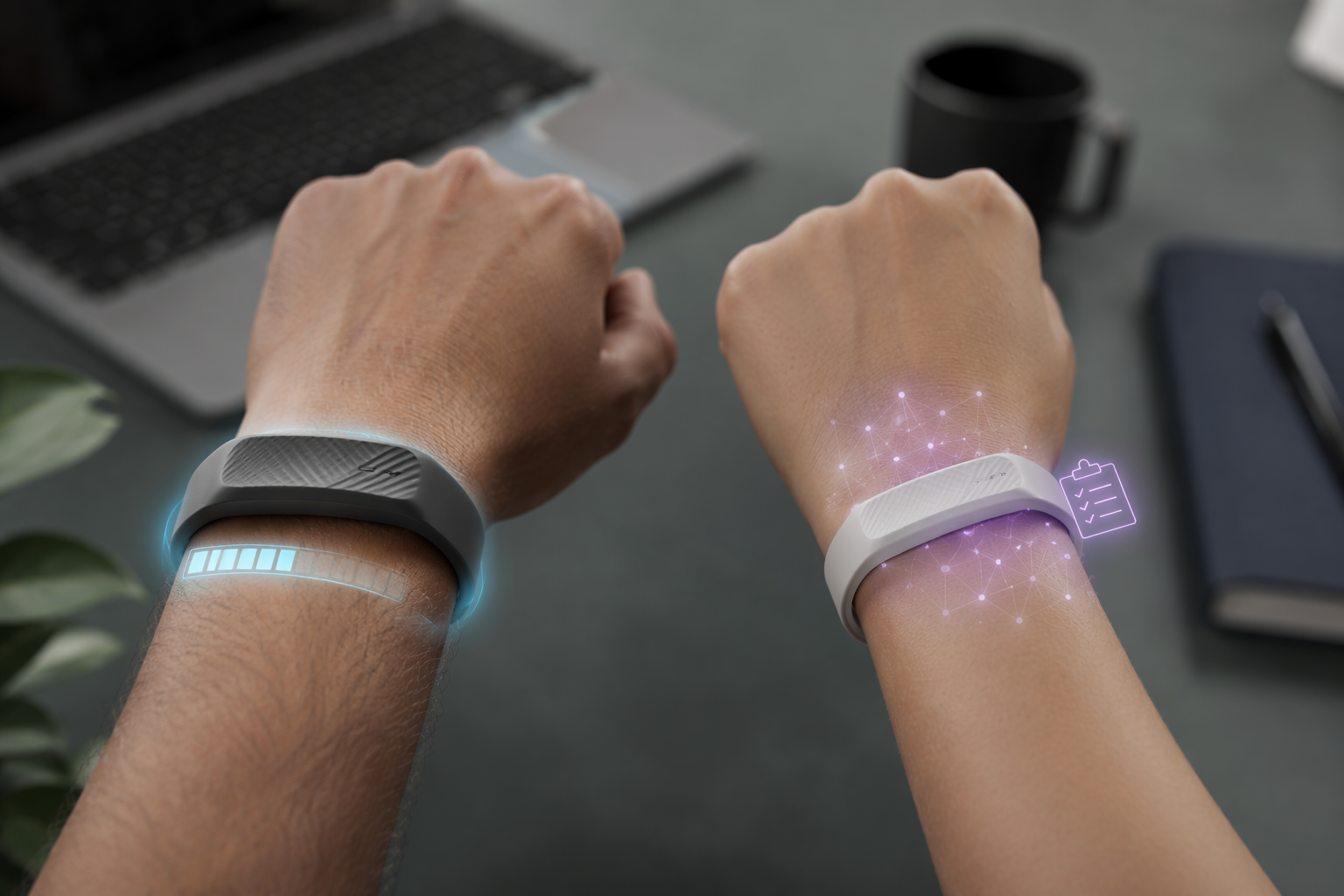
Last verified: July 22, 2026. If your main reason for looking at Garmin Cirqa vs Fitbit Air for productivity and focus is that your smartwatch became a second phone, the most important spec is already shared: neither device has a wrist screen. No tiny inbox. No glanceable weather tile. No app grid pretending to be harmless.
The real choice is what kind of help you want after the screen is gone. Choose Garmin Cirqa if you want passive awareness of when your body may be better prepared for deep work. Choose Fitbit Air if you want an AI coach to reduce small planning and logging decisions during the day.
| Decision point | Garmin Cirqa | Fitbit Air |
|---|---|---|
| Best for | People who want distraction-free energy awareness and prefer to make their own scheduling decisions. | People who want AI help deciding, logging, summarizing, and adjusting small health-related actions. |
| Price and subscription | $199.99; focus-relevant metrics including Body Battery, HRV Status, Training Readiness, and stress tracking are listed as available without a required subscription in Garmin Connect.[1] | $99.99; the differentiating AI Coach features are largely tied to Google Health Premium at $9.99/month.[2] |
| Battery and charging friction | Up to 10 days of battery life, with a 90-minute full charge.[3] | 7-day battery life, with a 5-minute quick-charge feature.[2] |
| Weight | 14.8g.[1] | 5.2g module; Engadget said it came very close to being comfortable enough to sleep with.[2] |
| Screen and notification behavior | No screen, no on-wrist metrics, maps, or notifications; status depends on LED, vibration, and the phone.[1] | Screenless band; framed by outside commentary as a focus tool partly because it avoids the distraction pattern of conventional smartwatches.[4] |
| Main focus mechanism | Body Battery, HRV, stress, sleep, and Training Readiness give a passive view of recovery and strain. | Gemini AI Coach summarizes readiness and handles some logging and adjustment tasks. |
| Biggest caveat | Cirqa was announced July 21, 2026, with orders opening July 24, 2026; there are no independent third-party accuracy tests yet.[1] | The AI Coach has produced false activity records in review testing, including a 52-minute elliptical session the reviewer did not do.[2] |
The shared win: fewer wrist interruptions
For knowledge work, removing a screen is not a minimalist flourish. It changes the device’s job. A screenless band can collect sleep, recovery, stress, and activity signals without inviting you to check one more surface every time your attention wavers.
That matters more than most wearable comparisons admit. A watch can be excellent at health tracking and still be a poor focus tool if it keeps asking to be consulted. Cirqa and Air both start from a better premise: the wearable should gather context quietly, then let the phone or an app handle interpretation when you choose to look.
This is also why traditional Fitbit models with displays are not the clean comparison here. Charge-style and Inspire-style trackers may be useful devices, but they preserve the glance habit. The Air is the relevant Fitbit because it removes the very interface that often fragments attention.
Garmin Cirqa: better if you want to protect deep-work windows
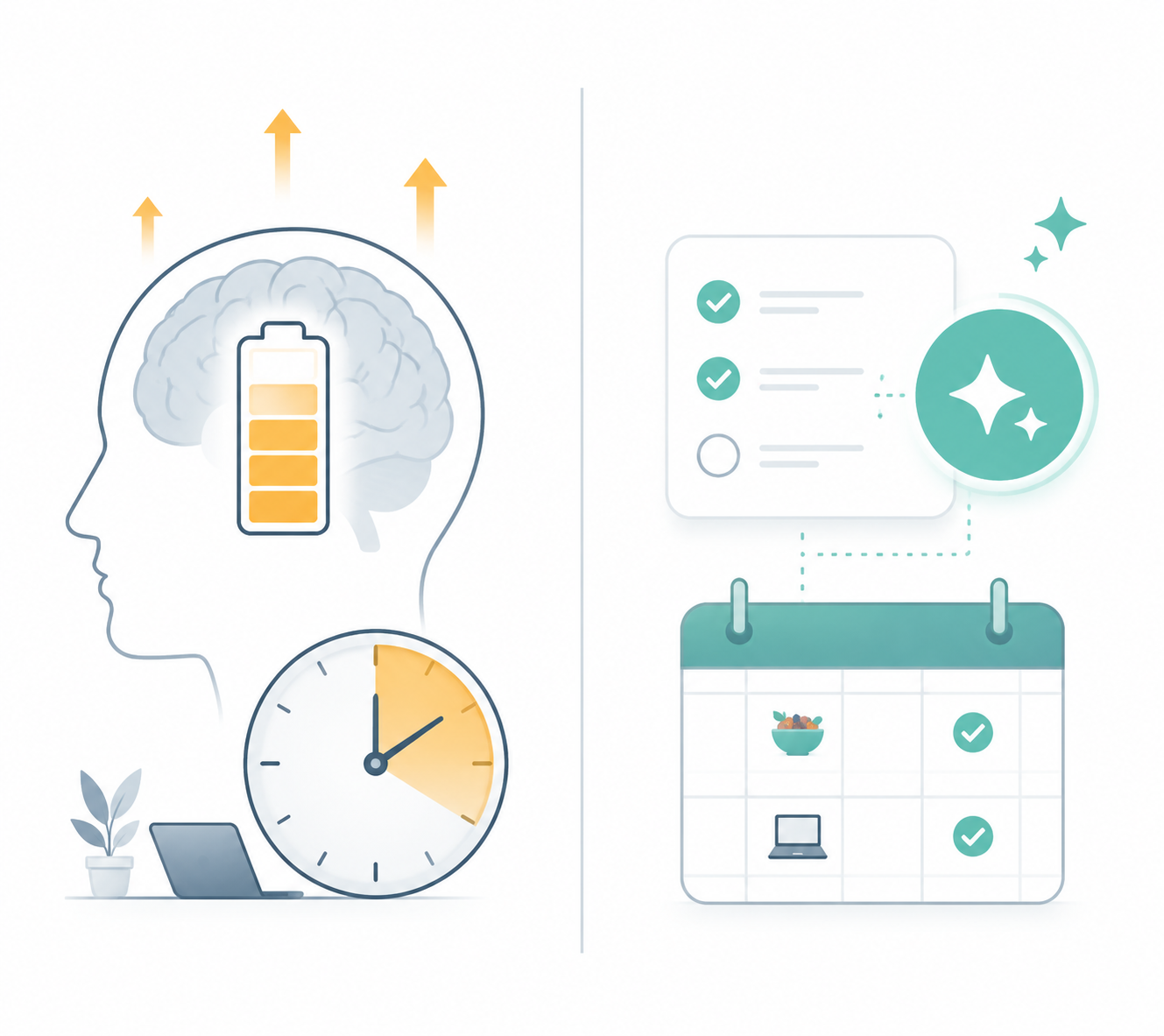
Cirqa’s productivity argument runs through Garmin’s recovery language, especially Body Battery. Garmin describes Body Battery as a way to estimate your energy reserves using inputs such as heart rate variability, stress, activity, and sleep. In Garmin’s own framing, “when you are well-rested and your Body Battery is charged, you’re liable to notice you’re also at the peak of your mental powers.”[5]
That sentence is useful, but it should be kept in its proper container. It is Garmin’s manufacturer framing, not independent proof that a Body Battery score can predict writing quality, code review accuracy, exam performance, or executive judgment. Cirqa is also newly announced, so there is no independent testing yet of this particular band’s accuracy or how well its metrics transfer into workday decisions.
Still, the model is practical. A writer does not need a wearable to decide the perfect hour to write; she needs enough context to stop placing the hardest work after the worst night of sleep and the most stressful meeting block. An engineering lead may not need a device to prescribe the day; he may need a nudge that the morning is a better place for architecture review than status cleanup.
Cirqa’s strength is that it stays mostly out of the way. Body Battery can be checked in Garmin Connect. HRV Status and stress trends can add texture. Sleep data can explain why a day feels unusually brittle. Training Readiness is more athletic in origin, but for non-athletes it can still function as a broad recovery signal: not a command, not a diagnosis, just one more reason to avoid pretending every morning starts from zero.
Used well, Cirqa supports a self-directed work rhythm:
- Put demanding thinking, writing, planning, or technical problem-solving in higher-energy windows when your schedule allows.
- Move shallow work, email, admin, and recurring updates into lower-energy stretches.
- Use sleep and stress trends to explain rough days rather than moralize them.
- Check the data at chosen times instead of letting the device create new interruptions.
The last point is not cosmetic. Cirqa has no glanceable metrics, maps, or notifications on the wrist.[1] If you are trying to rebuild concentration after years of wrist pings, that absence is the feature.
Fitbit Air: better if planning is where your attention leaks
Fitbit Air approaches focus from the other side. Instead of mainly showing you patterns to interpret, it leans on Gemini AI Coach to reduce the number of small decisions you have to manage. That can matter on days when the problem is not knowing whether you are tired. The problem is that every next action has become another tab in your head.
The most convincing example is small: Engadget reports that a user can say, “log the same breakfast I had yesterday,” and the AI executes it.[2] That is not a grand productivity transformation. It is better than that: it removes a tiny administrative task that otherwise asks for attention, memory, and app navigation.
The Air’s coaching model can also summarize readiness and suggest actions. For a user who gets stuck converting health data into a plan, that may be more valuable than another recovery chart. Some people do not want to study their own energy patterns every morning. They want a system that says, in effect, here is what changed, here is what you might do next, and here is the log entry you probably forgot.
That said, AI coaching has a special failure mode. A bad step count is annoying. A hallucinated workout is different because it asks the user to supervise the assistant. Engadget reported that Fitbit Air’s AI hallucinated a 52-minute elliptical workout the reviewer never did.[2] Once that happens, the coach no longer just reduces cognitive load; it also creates a verification chore.
For some users, that trade is acceptable. If the AI saves ten small decisions and requires one correction, it may still be a net gain. For others, especially people who already distrust automated summaries, the possibility of invented activity records will make the system feel like another inbox: useful, but only after inspection.
Price is not just price when the useful feature is a subscription
At first glance, Fitbit Air is the cheaper experiment: $99.99 versus Cirqa’s $199.99.[1][2] But for productivity, the relevant question is not which band costs less on day one. It is whether the feature that made you choose the device remains available without turning into a monthly toll.
Cirqa’s focus-relevant toolkit is less glamorous but cleaner financially. Body Battery, HRV Status, Training Readiness, and stress tracking are listed as available through Garmin Connect without a required subscription.[1] If you are buying the band to observe energy and protect demanding work blocks, the ongoing cost story is simple.
Fitbit Air’s productivity edge is more dependent on Google Health Premium. The Air may be cheaper hardware, but the AI Coach features that distinguish it are largely behind the $9.99/month plan.[2] If you are comfortable paying for an assistant layer, that may be reasonable. If subscriptions make you ration which features you actually use, the lower upfront price can be misleading.
Battery and sleep comfort affect focus more than they look like they should
A focus wearable has to stay worn. If charging breaks the habit, the readiness data gets patchy. If the band is uncomfortable at night, sleep tracking becomes aspirational.
Cirqa has the better endurance claim: up to 10 days of battery life, with a 90-minute full charge.[3] That suits someone who wants a low-maintenance background sensor. You charge it less often, think about it less often, and are less likely to find it dead right after a poor night of sleep.
Fitbit Air counters with convenience rather than duration: 7-day battery life and a 5-minute quick-charge feature.[2] The quick charge matters for people who are already used to plugging in devices in short bursts. Its larger advantage may be comfort. At 5.2g, the Air module is far lighter than Cirqa’s 14.8g, and Engadget said it came very close to being comfortable enough to sleep with.[1][2]
For sleep-dependent readiness data, that is not a small detail. The most accurate recovery system is not very helpful if you take it off at night because it annoys you.
Not for you if
| Device | Not for you if |
|---|---|
| Garmin Cirqa | You want an assistant to tell you what to do next, summarize your day proactively, or handle logging tasks by voice. Cirqa is better as an awareness layer than a planning partner. |
| Garmin Cirqa | You need independent validation before buying. As of July 22, 2026, Cirqa has just been announced, with orders opening July 24, 2026, and no third-party accuracy testing yet.[1] |
| Fitbit Air | You do not want subscription dependence for the main productivity feature. The AI Coach is the reason to choose Air for focus, and that capability is largely tied to Google Health Premium.[2] |
| Fitbit Air | You will resent checking the coach’s work. Review testing has already shown hallucinated activity data, which undercuts trust for users who want the assistant to remove supervision rather than require it.[2] |
Which one is better for productivity and focus?
Garmin Cirqa is the stronger choice if your focus problem is timing. You want to know when you are likely better prepared for concentrated work, then make your own decision about the calendar. Its no-screen, no-notification design is strict in the right way, and its core focus-relevant metrics do not appear to depend on an ongoing subscription.
Fitbit Air is the better fit if your focus problem is decision friction. You want AI to handle small planning and logging tasks, summarize readiness, and reduce the number of moments where you have to open an app and manually manage yourself. The hardware is lighter, the quick charge is convenient, and the screenless design keeps it out of smartwatch territory.
The risk is different for each device. Cirqa may leave you with data you still have to interpret. Fitbit Air may give you recommendations you still have to verify. For a self-directed knowledge worker who mainly wants fewer interruptions and better energy awareness, Cirqa is the cleaner productivity tool. For someone who wants an assistant to take small decisions off the plate, Fitbit Air can be the better choice, provided the subscription and occasional AI errors do not become their own source of attention.
References
- CIRQA Smart Band, Garmin Wiki.
- Fitbit Air review: Google Health AI Coach testing, Engadget.
- Meet Cirqa Smart Band: Screen, AOL.
- 5 Reasons Google’s Screenless Fitbit Air Is The Ultimate Focus Tool, Lucy Paulise.
- Body Battery: How to Thrive, Garmin Blog.