
People use “ban” to mean very different things. A principal locking phones in pouches for Algebra II is not doing the same legal work as Congress ordering platforms to block access on school grounds. A state cell-phone policy can be a classroom-management rule. A federal social media restriction can become a speech regulation before anyone has finished the press conference.
That distinction matters because school device restrictions are spreading fast. By 2025, 34 states had school cell-phone restriction policies, which explains why lawmakers see a receptive policy climate for broader school-hour limits.[1] It does not prove those broader limits are constitutional. Popularity tells us that districts are tired of competing with screens. It does not answer whether Congress may require TikTok, Instagram, Snapchat, or other covered services to suppress access based on location, age, platform design, or a government-defined duty to prevent harm.
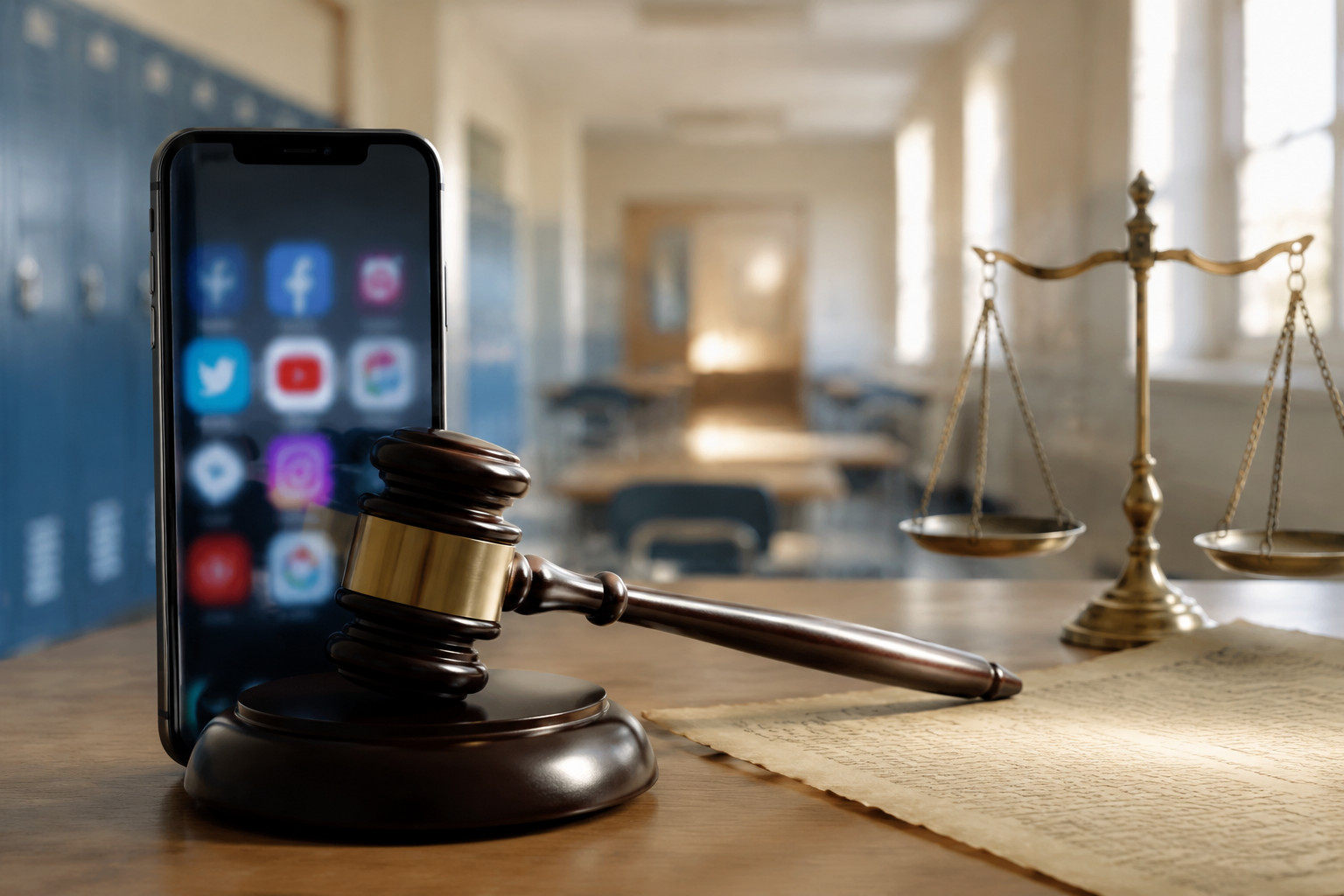
As of the latest available records in the materials reviewed for this article, the current Q3 2026 legislative status of HR 5173, S. 278, and S. 1748 could not be independently verified. The constitutional analysis below therefore rests on the bill descriptions and litigation sources available in those records, not on a claim that any one of the bills is procedurally poised for passage today.
Why HR 5173 Is the Hardest Bill to Wave Away
HR 5173, the No Social Media at School Act, has the cleanest administrative pitch of the federal proposals described in the available record. Introduced in October 2025 by Rep. Craig, it would require TikTok, Instagram, and Snapchat to geofence K-12 school grounds during school hours.[2] To a district administrator, that sounds much easier than asking teachers to police backpacks, lockers, bathrooms, and hallways. Put the burden on the platforms. Tie it to school time. Tie it to school property. Keep class moving.
Then the exemption list appears. The bill description identifies exceptions for weather alerts, Amber alerts, emergency responders, email, Wikipedia, e-commerce, videoconferencing, and gaming.[2] Those carveouts are not small drafting details. They are the place where a practical school-hours geofence begins to look like a government judgment about which online activities deserve access and which do not.
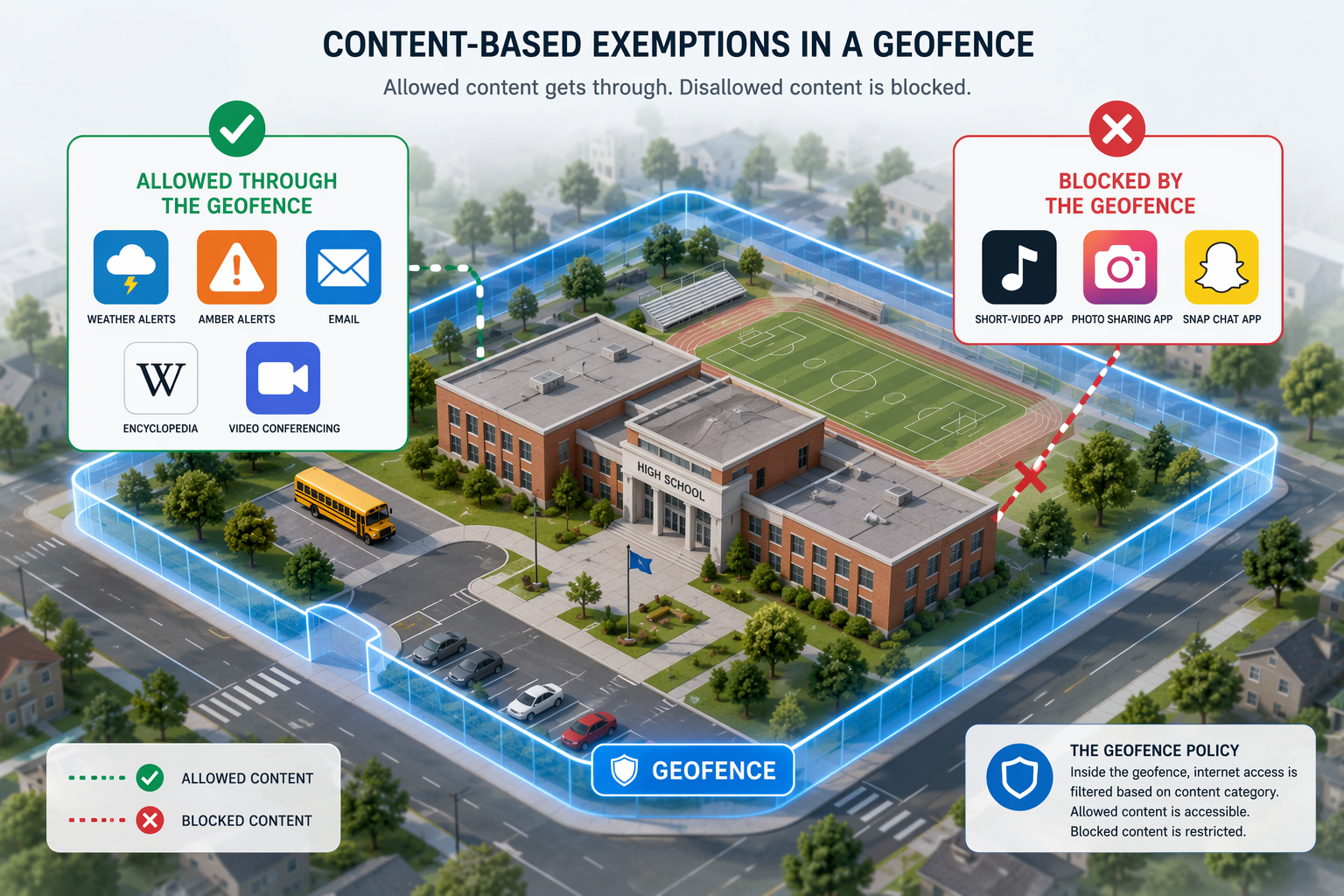
The reason this matters is not theoretical. In litigation over Georgia’s SB 351, the Northern District of Georgia treated the law’s content-based exemptions for professional networking and news platforms as its primary downfall, according to the Harvard Law Review’s February 2026 discussion of the case.[3] The government did not merely regulate a neutral delivery mechanism. It drew lines among services and uses, then asked the court to accept that the speech burden was still sufficiently neutral.
HR 5173 invites a similar question. If a student may use Wikipedia but not a social platform, email but not a direct message inside an app, videoconferencing but not a livestream feature, gaming but not a social feed attached to a game, the law has to explain why those distinctions track the government’s asserted school-focus interest rather than a preference among categories of online expression. The First Amendment problem is not that Congress cares about attention. It is that exemption architecture can reveal content discrimination even when the bill’s public explanation sounds like school administration.
School lawyers learn to distrust words like “access” when the implementation actually turns on function, content, platform identity, and permitted purpose. A geofence may describe where the restriction operates. It does not by itself make the restriction content neutral. The legal pressure point is what the law allows through the fence.
The Florida HB3 Caveat
There is a real caveat for anyone tempted to say state social media laws always fail. The Eleventh Circuit allowed enforcement of Florida’s HB3 in November 2025, and the research record describes that decision as a sign that feature-based regulation can survive intermediate scrutiny.[3] That does not rescue every school-hours geofence. Feature-based rules and geofencing rules travel different constitutional paths. A court’s willingness to uphold one design does not mean it will bless another law whose operative work is done by a platform list and a set of content-adjacent exemptions.
KOSA’s Problem Is Not the Same Problem
The Kids Online Safety Act, S. 1748, should not be treated as just another school ban. Its constitutional anxiety comes from a broader duty-of-care model rather than from a school geofence. The bill has had bipartisan momentum, and its child-safety premise is politically and morally powerful. No school attorney who has sat through a parent meeting after a student crisis should dismiss those concerns as invented.
The difficulty is how a duty to prevent harm to minors gets translated into platform behavior. The ACLU warned in December 2025 that KOSA would give the government power “to decide what content is dangerous to young people,” and specifically raised concerns about censorship affecting jokes, hyperbole, sex education, and suicide prevention resources.[4] That is a different First Amendment vulnerability from HR 5173’s exemption list. It is a chilling-effect problem: when liability risk turns on whether content may be considered harmful to minors, platforms have incentives to remove or demote lawful speech at the edges.
This is where child-safety drafting becomes hardest. A rule aimed at predatory design, compulsive use, or targeted amplification may be described as product regulation. A rule that pressures platforms to decide which conversations about sexuality, self-harm, humor, identity, or distress are too dangerous for minors moves closer to content governance. Courts do not need to believe every parade of horribles to take that risk seriously. They only need to see that protected expression may be burdened because platforms cannot confidently separate prohibited “harm” from lawful discussion.
KOSA therefore deserves more careful treatment than a slogan on either side. Its supporters can point to genuine safety concerns and a legislative record shaped by family advocacy. Its opponents can point to the familiar First Amendment hazard of government-backed standards that encourage private intermediaries to suppress speech before the government ever files an enforcement action. Both can be true at the same time.
S. 278 Runs Into the Definition Wall
S. 278 is easier to explain and, for that reason, easier to oversell. The available research describes it as combining under-13 account prohibitions with school-hour limits.[5] That sounds more direct than KOSA’s duty-of-care structure and less administratively elaborate than HR 5173’s school-ground geofencing.
But simple prohibitions still need a definition that can carry constitutional weight. “Social media” is not a self-executing category. A messaging app may host public channels. A game may include feeds, chats, creator tools, and livestreaming. A classroom platform may include profiles, comments, and sharing. A video site may be entertainment, research, political speech, or homework support depending on the use.
If the law defines covered services too broadly, it risks burdening large amounts of protected expression that are not closely tied to the school-focus interest. If it defines them too narrowly, it starts selecting disfavored platforms or features while leaving functionally similar channels untouched. Either route gives challengers something concrete to attack before a court ever reaches the emotional force of protecting younger children.
That is why definitional slippage is not a technicality. For districts, vague coverage means uncertain vendor obligations and uneven implementation. For students and families, it means speech access may turn on whether a platform falls inside a contested statutory box. For courts, it means the law may fail because Congress could not identify the regulated object with enough precision.
The Narrower Path: Paying Schools to Put Phones Away
The Focus on Learning Act, HR 1275 and S. 404, works differently. Rather than ordering platforms to block access or requiring users to lose access, it would use federal grants for lockable pouches and magnetized containers.[6] That distinction is doing nearly all of the constitutional work.
A grant program does not require Congress to decide whether Wikipedia is permissible but Instagram is not. It does not require a platform to classify jokes, suicide-prevention material, or sex education as risky content. It does not rise or fall on a universal definition of social media. It gives schools money to adopt physical device-management tools if they choose to do so.
That does not make it the strongest behavioral intervention. A pouch in a classroom may reduce visible phone use without touching every route a student has to a social platform. It may also depend heavily on local enforcement, staff buy-in, exceptions for medical or disability needs, and whether families accept the policy. But those are implementation questions of the sort school districts already handle. They are not the same as a federal mandate that burdens online expression by platform category, content-risk standard, or statutory definition.
That is the unsatisfying legal answer. The bill least exposed to First Amendment attack is probably the one that least resembles a federal social media ban. Incentives for phone-free school practices sit on firmer constitutional ground than platform-access mandates, but they do not let Congress claim it has directly barred students from social media during the school day.
References
- School cell-phone restriction policies, Campus Safety Magazine, 2025
- Congress Bill Spotlight: No Social Media at School Act, The Fulcrum
- Content Neutrality for Kids: Intermediate Scrutiny for Social Media Age-Verification Laws, Harvard Law Review, February 2026
- Lawmakers Renew Push to Regulate Kids' Speech Online Despite Speech Protections, ACLU, December 2025
- S. 278
- Focus on Learning Act, HR 1275 / S. 404