
The most useful argument for coloring at work is also the least glamorous one: if you are stuck, restless, and one tap away from a phone break that will leave you more scattered, a sheet of structured coloring can interrupt that loop without adding another screen, app, or ritual to maintain. The case for the benefits of coloring for focus and productivity is not that it makes people produce more by magic; it is that it can reduce the mental noise that gets in the way of returning to work.
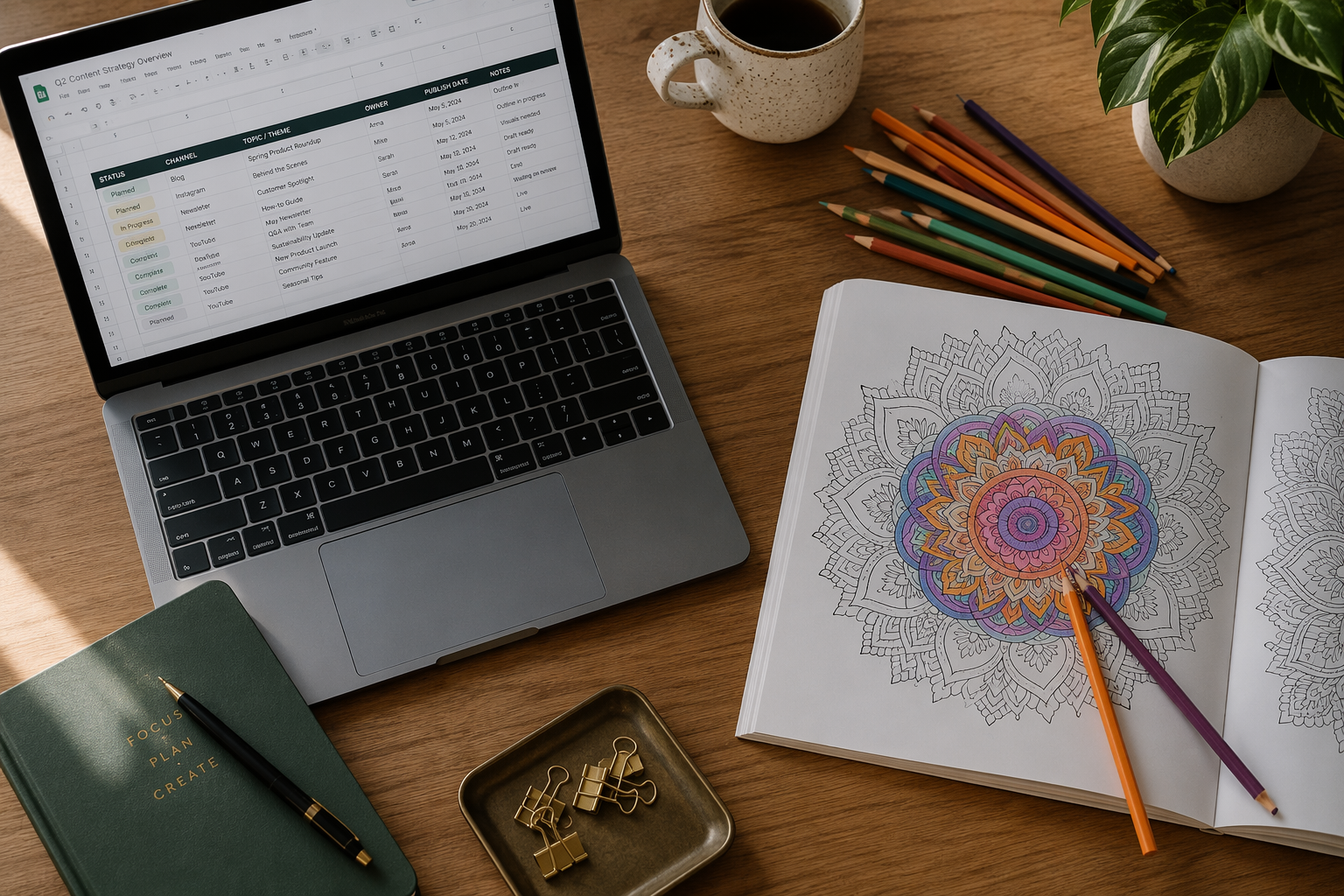
Why structured coloring works better than a random break
The research is fairly consistent on one point: not all coloring behaves the same way. In Curry and Kasser’s 2005 study, complex structured designs such as mandalas reduced anxiety more effectively than simple or unstructured coloring, which they linked to a challenge-skills balance that encouraged a meditative-like state [1]. Koo et al. found a similar pattern in a 2020 study of 120 older adults: 20 minutes of mandala coloring relieved anxiety more than free drawing or reading [2].
That distinction matters for knowledge workers because the point is not to “be creative” in the broad sense. The point is to give the brain a small, bounded task that occupies enough attention to interrupt rumination without demanding language, decisions, or a fresh stream of inputs. Mayo Clinic Health System says coloring activates the frontal lobe and reduces amygdala activity, while Cleveland Clinic’s Dr. Scott Bea describes it as requiring modest attention outside self-awareness [4][5]. In plain terms, it gives the mind something orderly to do while the noisy self-commentary quiets down.

That mechanism is also why coloring is a more plausible reset than passive scrolling. A phone break usually adds fresh fragments: headlines, messages, other people’s priorities, unfinished threads. Coloring still asks for attention, but in a narrow, low-stakes way. Johanna Basford’s description captures the contrast well: putting the phone down, noticing the physical materials, and feeling reset in a way that is the opposite of coming off a screen [3].
What the newer studies actually show
The strongest recent practical evidence comes from Palmer-Cooper and Woodford’s 2024 study at the University of Southampton. In a 140-participant trial, 10 minutes of self-guided coloring, done at least three times per week for two weeks, significantly improved stress, anxiety, depression, quality of life, and dispositional mindfulness; 71.3% of participants said they intended to continue [6]. That is a useful pattern for workers because it suggests coloring can matter at the scale of a short reset, not just a long art-session lifestyle habit.
Other studies point in the same direction. Flett et al. reported that daily 10-minute coloring for one week reduced depressive and anxiety symptoms in a sample of 115 women aged 18–36 [7]. Samuel et al. also reported benefits in patients with generalized anxiety disorder [8]. The common thread is not that coloring solves every attention problem, but that short, repeatable sessions can reduce the emotional load that makes concentration harder in the first place.
How to use it as a work reset
- Use a structured design, ideally a mandala or another page with clear boundaries and repeated detail.
- Set a timer for 10 to 15 minutes; the evidence cluster is strongest in that window [2][6][7].
- Keep it analog: paper, pencils, pens, and no browser tabs.
- Return to one defined task immediately afterward, rather than treating the break as a vague recharge ritual.
That last point is important. Coloring is best treated as a reset between work blocks, not as a productivity system of its own. The studies mostly measure anxiety, stress, mindfulness, attention, and related mental states, not finished reports, coding speed, or error rates [1][2][6][7]. So the honest claim is narrower: coloring can create better conditions for focus, and better focus conditions may support productivity, but direct output gains are still an inference rather than a proven workplace metric.
That narrower claim is still useful. If your default break is a phone check that leaves you jangly, or if meditation feels like one more thing you are failing to do correctly, a 10-minute coloring session is a low-friction alternative. It is also easier to keep when you are tired, because it does not ask for a new identity or a new app habit. It just asks you to fill in a shape.
What to expect, and what not to expect
Expect a shift in state more than a sudden leap in output. If the break does its job, you come back with less rumination, less self-interruption, and less urge to keep checking whatever was pulling you away from the task. You may also notice that the transition back into deep work feels less abrasive, because the mind has already spent a few minutes on something bounded and physical [3][4][5].
Do not expect it to replace therapy, medication, or treatment for diagnosed anxiety or depression. Do not expect every coloring page to work equally well. And do not expect a universal productivity cure. The point is simpler: when a workday starts to fray, structured coloring gives you a short, screen-free way to lower the mental static before you return to the page, the spreadsheet, or the code editor.
References
- The Effect of Complex and Simple Coloring Pages on Adult Anxiety Art Therapy 2005 [doi.org/10.1080/07421656.2005.10129441](https://doi.org/10.1080/07421656.2005.10129441)
- The Effectiveness of Mandala Coloring on Anxiety: A Randomized Controlled Trial Art Therapy 2020[doi.org/10.1080/07421656.2020.1776808](https://doi.org/10.1080/07421656.2020.1776808)
- New Research Shows A Few Minutes of Coloring Can Erase Your Stress TIME 2026-04-21 [time.com/article/2026/04/21/coloring-stress-relief-benefits/](https://time.com/article/2026/04/21/coloring-stress-relief-benefits/)
- 3 Reasons Adult Coloring Can Actually Relax Your Brain Cleveland Clinic [health.clevelandclinic.org/3-reasons-adult-coloring-can-actually-relax-brain](https://health.clevelandclinic.org/3-reasons-adult-coloring-can-actually-relax-brain)
- Coloring Is Good for Your Health Mayo Clinic Health System [mayoclinichealthsystem.org/hometown-health/speaking-of-health/coloring-is-good-for-your-health](https://mayoclinichealthsystem.org/hometown-health/speaking-of-health/coloring-is-good-for-your-health)
- The Effect of Adult Coloring on Mental Health and Mindfulness Journal of Creativity in Mental Health / Taylor & Francis 2024 [tandfonline.com/doi/full/10.1080/17533015.2024.2419921](https://tandfonline.com/doi/full/10.1080/17533015.2024.2419921)
- Colouring books for adults benefit mental health, study finds The Guardian 2017-11-09 [theguardian.com/society/2017/nov/09/colouring-books-for-adults-benefit-mental-health-study-new-zealand-anxiety-depression](https://www.theguardian.com/society/2017/nov/09/colouring-books-for-adults-benefit-mental-health-study-new-zealand-anxiety-depression)
- Coloring Therapy Effects on Generalized Anxiety Disorder Patients PMC [pmc.ncbi.nlm.nih.gov/articles/PMC9773305/](https://pmc.ncbi.nlm.nih.gov/articles/PMC9773305/)