
The first question is not how to fill out the form; it is whether each Colorado entity is covered and whether the filing structure has already been mapped. Colorado's new requirement applies to private-sector employers with 100 or more employees that do business in Colorado and were required to submit EEO-1 as of March 1, 2026, and each entity in a corporate group is assessed separately rather than through one consolidated report [1]. The filing window is tied to each entity's periodic report month, opening two months before and closing two months after that month, so there is no single statewide date to calendar and forget [2]. The March 1, 2026 form reference is frozen, and the July 1, 2027 effective date leaves only a narrow runway to sort out entity mapping, data ownership, and sign-off paths before filing starts [3].
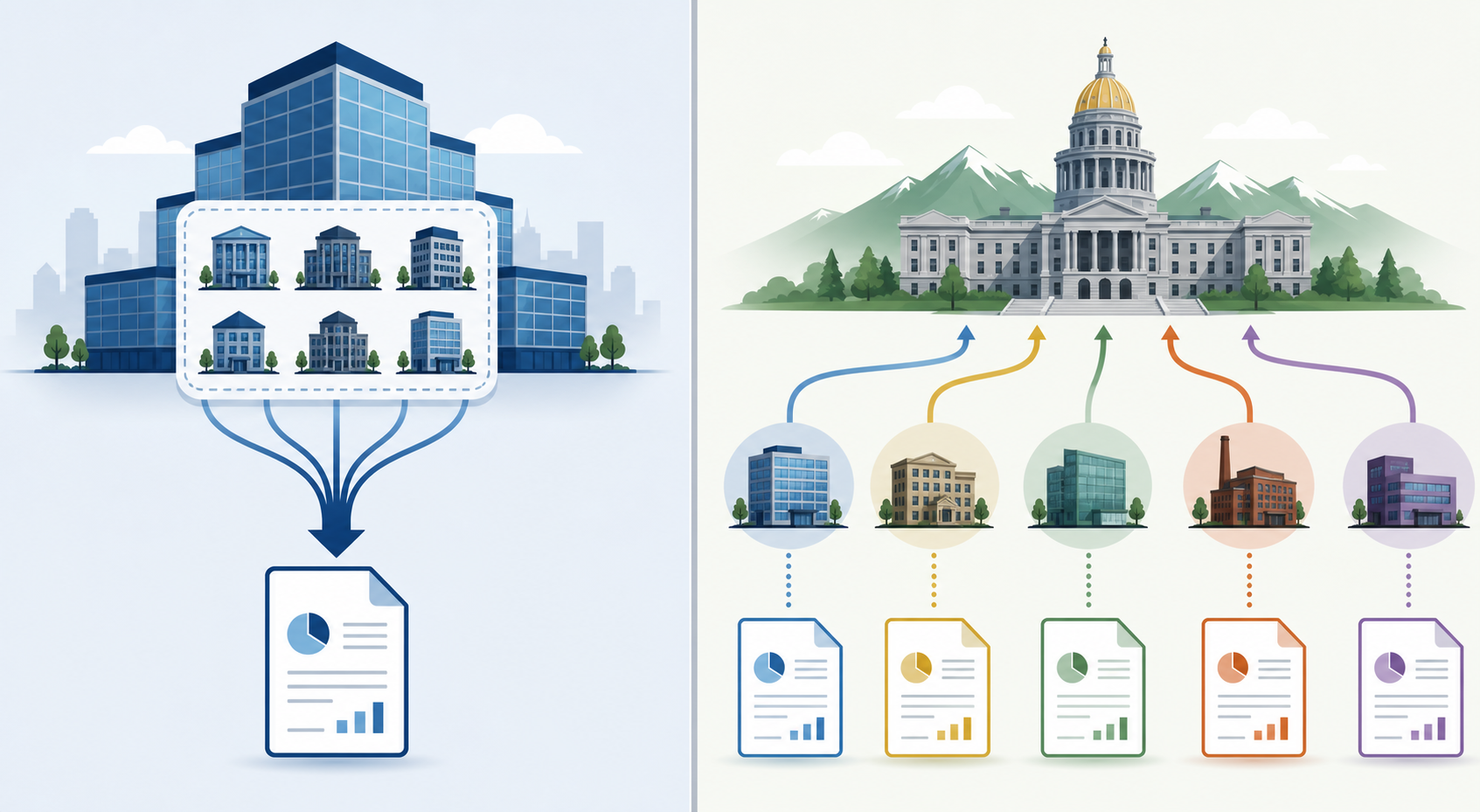
Confirm the covered entities first
If the entity list is wrong, every later step gets noisy. Start by assessing each legal entity on its own: employee count, Colorado business activity, and whether it was already subject to federal EEO-1 on March 1, 2026 [1]. Then decide who owns that entity's data pull, who reviews it, and who will submit it when the periodic report month arrives.
- Build a legal-entity map that matches payroll, HRIS, and corporate records.
- Flag entities near the 100-employee threshold now, before a growth spike or acquisition makes the answer messy.
- Note which subsidiaries, branches, or operating companies file separately; do not assume a parent company filing covers them all [1][2].
Lock the data set before the window opens
The real time sink is not the button click; it is getting numbers that hold together across systems. Pull the employee and demographic data needed for each entity, reconcile it to the entity map, and preserve the source extracts so the filing can be rebuilt if anyone later asks why a number changed. Because the statute freezes the EEO-1 form as it existed on March 1, 2026, archive that version now and map your job categories against it instead of waiting for the next federal refresh [3].
- Save the March 1, 2026 EEO-1 form version with your internal instructions and crosswalk [3].
- Reconcile headcount and demographic totals to the legal entity, not the parent.
- Keep the raw exports, review notes, and approval trail together.
- Resolve location, entity-code, and acquisition overlaps before the filing window opens.
Treat the filing as potentially public
The statute does not supply a confidentiality shelter, and the filing runs through the Secretary of State's business system, so the safe assumption is that the information may be accessible outside the company [5]. Illinois has already shown how a Secretary of State filing system can make EEO-1 demographic data public, which is enough of a warning that this should be reviewed as disclosure material, not just compliance paperwork [5].
- Review the filing packet as if a competitor, employee, or reporter could see it.
- Strip out anything that is not required to complete the report.
- Decide in advance who will answer if the filing is surfaced or questioned externally.
Do not wait on Washington
The federal rescission process is still only proposed. The EEOC voted 2-1 on July 21, 2026 to move toward rescinding federal EEO-1 reporting, and a public hearing is set for August 11, 2026, but that is not a completed rollback [4]. Colorado's obligation should therefore be treated as independent of the federal timeline, not as something that can sit idle until the EEOC finishes its rulemaking.
- Keep federal EEO-1 workflows alive until the federal requirement actually changes [4].
- Watch for Colorado Secretary of State implementing guidance; the filing mechanics and any confidentiality determinations are still unresolved.
- If you report in other states, compare the rules separately instead of forcing them into one template.
Know the operational consequence
If someone misses the filing, the consequence is not abstract. The Colorado Secretary of State says a missed periodic report can put the entity into delinquency status and out of good standing [6]. That consequence is enough to treat the filing as urgent.
References
- Colorado Mandates State EEO-1 Data Reports - Jackson Lewis
- Colorado Will Require State-Level EEO-1 Data Reporting - Fisher Phillips
- Colorado EEO-1 Workforce Data Requirement Begins July 1, 2027 - Sequoia
- EEOC to propose rule ending EEO-1 reporting - HR Dive
- Colorado Counters Potential Federal EEO-1 Discontinuation - Affirmity
- Periodic reports - Business FAQs - Colorado Secretary of State