
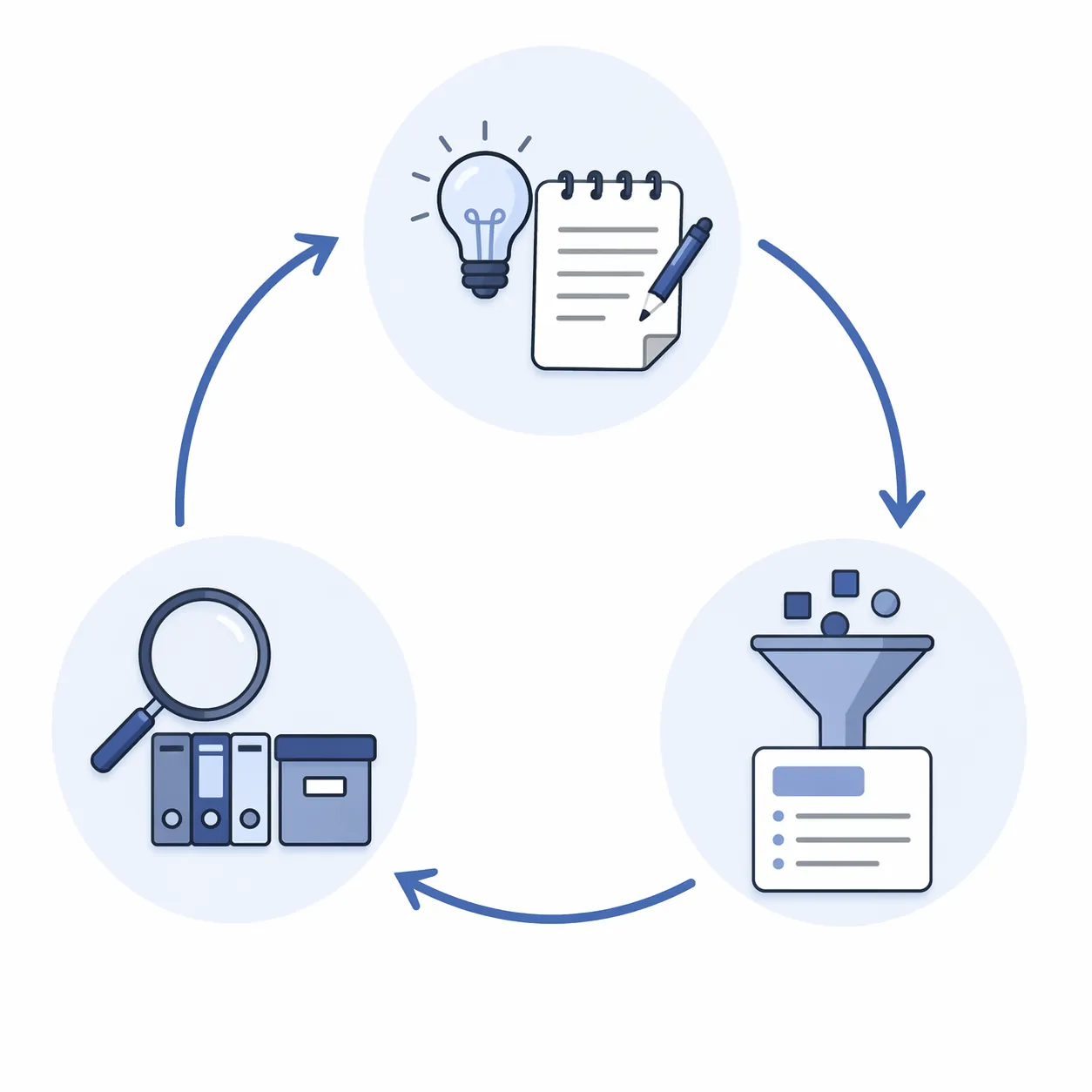
Claude Opus 5 and Fable 5 are not note-taking apps. They are models you might route into a notes workflow through Claude Projects, the API, Claude Code, or an integration that sits beside your notebook, document store, or PKM system. That distinction matters because the real question in claude opus 5 vs fable 5 for note-taking is not which model sounds more impressive. It is which one should touch which part of the daily loop: capture, synthesize, retrieve, repeat.
That loop is usually plain and repetitive. A morning brain dump needs cleanup. A meeting transcript needs decisions, owners, and open questions. An article clipping needs compression without losing the original argument. A project folder needs a sane answer to “what did we decide last month?” Most of that work is short-turn and cumulative. It happens too often to treat every request like a special research expedition.
Opus 5 arrived on July 24, 2026, so any verdict on it is necessarily early. CNBC reported Anthropic’s launch claims that Opus 5 rivals Fable 5, costs less, and outperforms Fable 5 on coding and knowledge-work evaluations, while Anthropic positioned it as a model “designed to be used every day.” Those are useful launch-day facts, not independent long-term evidence yet.[1]
| Daily note-taking question | Claude Opus 5 | Fable 5 |
|---|---|---|
| API price | $5 input / $25 output per million tokens[1] | $10 input / $50 output per million tokens[1][2] |
| Launch and evidence status | Launched July 24, 2026; current performance claims rely on Anthropic and CNBC reporting[1] | Older public material exists, but much comparison content is against Opus 4.8, not Opus 5[2][3] |
| Privacy posture for notes | Supports zero-data-retention configurations, according to available comparison material[3] | Requires 30-day data retention, according to available comparison material and Fable documentation context[2][3] |
| Best fit in the notes loop | Routine capture cleanup, article summaries, meeting synthesis, quick retrieval | Long research synthesis, multi-session continuity, expensive judgment |
Start With The Loop, Not The Leaderboard
Benchmarks can tell you whether a model is strong. They do not tell you whether you should spend premium tokens turning a rough standup note into three bullet points. Daily notes create a particular kind of pressure: the marginal task looks small, but the habit compounds. One meeting, one clipping, one end-of-day review, one project question, again tomorrow.
A practical Claude-assisted notes system usually has three jobs. Capture keeps messy material from disappearing. Synthesis turns that material into decisions, summaries, claims, questions, or next actions. Retrieval asks the model to find and restate what is already in the corpus without inventing a cleaner history than the notes actually support. Public Claude note-taking guides tend to describe this same capture-to-synthesis pattern, even when the surrounding tools differ.[4]
Once the workflow is framed that way, Opus 5 has the more natural default role. It is cheaper, it is reported to be strong at knowledge work, and it is explicitly being sold for everyday use.[1] Those are exactly the properties that matter when the model is sitting close to the intake pipe of your notes.
Where Opus 5 Fits In Daily Notes
For routine capture, the model’s job is not to be profound. It should preserve the raw meaning, remove friction, and leave a trail you can trust later. A useful request after a meeting might ask for decisions, unresolved questions, named owners, and dates mentioned in the notes. A useful request after a morning dump might ask for tasks, worries, ideas, and things that should not become tasks yet. These are bounded transformations.
This is where the price difference becomes more than a procurement detail. Opus 5 is priced at $5 per million input tokens and $25 per million output tokens, while Fable 5 is priced at $10 and $50 respectively.[1][2] For a once-a-quarter research synthesis, that gap may be tolerable. For daily note cleanup, it punishes the exact behavior that makes the system useful: using the model casually, often, and before the pile becomes unmanageable.
Article summarization is similar. Most clippings do not need an autonomous agent to reason across days. They need a compact note that says what the author argued, what evidence mattered, what is worth quoting later, and how the piece relates to one active project. A stronger model helps, but only up to the point where it reliably compresses without theatrical over-interpretation.
Meeting cleanup is even less romantic. The useful output is often a short record: what changed, who is blocked, what decision was made, and what needs a follow-up. If a model adds polished executive language but buries the one unresolved dependency, it has made the note worse. Opus 5’s reported knowledge-work strength matters here because the work is still judgmental, but it is judgment inside a tight frame.[1]
Retrieval is where overbuilt AI note systems often start to rot. The model should answer from the notes, state uncertainty when the notes are thin, and point back to the relevant source material when possible. That does not require the most expensive long-horizon model for every query. It requires disciplined routing, clean context, and instructions that make the model distinguish “the notes say” from “a plausible answer would be.”
The Privacy Difference Is Not Cosmetic
Personal notes are not the same category as public research prompts. A journal entry, a negotiation note, a health worry, a personnel concern, or an unfiltered project postmortem carries a different privacy expectation than “summarize this public article.” Available comparison material says Opus 5 supports zero-data-retention configurations, while Fable 5 requires 30-day data retention.[2][3]
That does not automatically make every Opus 5 integration private. The surrounding product, API configuration, workspace policy, and connector all matter. But at the model-policy layer, zero-data-retention support is directly relevant to note-taking in a way that a flashy autonomy story is not. If the notes include personal journaling or sensitive work material, this belongs near the top of the routing decision.
A Simple Routing Pattern For Ordinary Days
The cleanest daily setup is not “pick one model forever.” It is to let cheap, capable work happen by default and reserve premium reasoning for moments when the context is large enough, ambiguous enough, or consequential enough to deserve it. Claude model-selection guidance has described a similar pattern: start with a strong general model when unsure, and route more expensive capability only where the task justifies it.[5]
- Use Opus 5 for morning brain dumps, inbox notes, and quick cleanup where the main job is categorizing messy text.
- Use Opus 5 for meeting notes when you need decisions, owners, risks, and follow-ups extracted from a bounded transcript or rough note.
- Use Opus 5 for article clippings when you want the argument, evidence, useful quotes, and project relevance compressed into a durable note.
- Use Opus 5 for routine retrieval when the answer should come from a known folder, project, or date range.
- Escalate only when the model must reason across many sessions, many files, and unresolved project history.
That last line is the important one. Most daily notes do not fail because the model was not grand enough. They fail because capture is inconsistent, summaries erase useful uncertainty, or retrieval has no reliable source boundary. Paying double for every ordinary transformation does not fix those problems.
When Fable 5 Starts To Make Sense
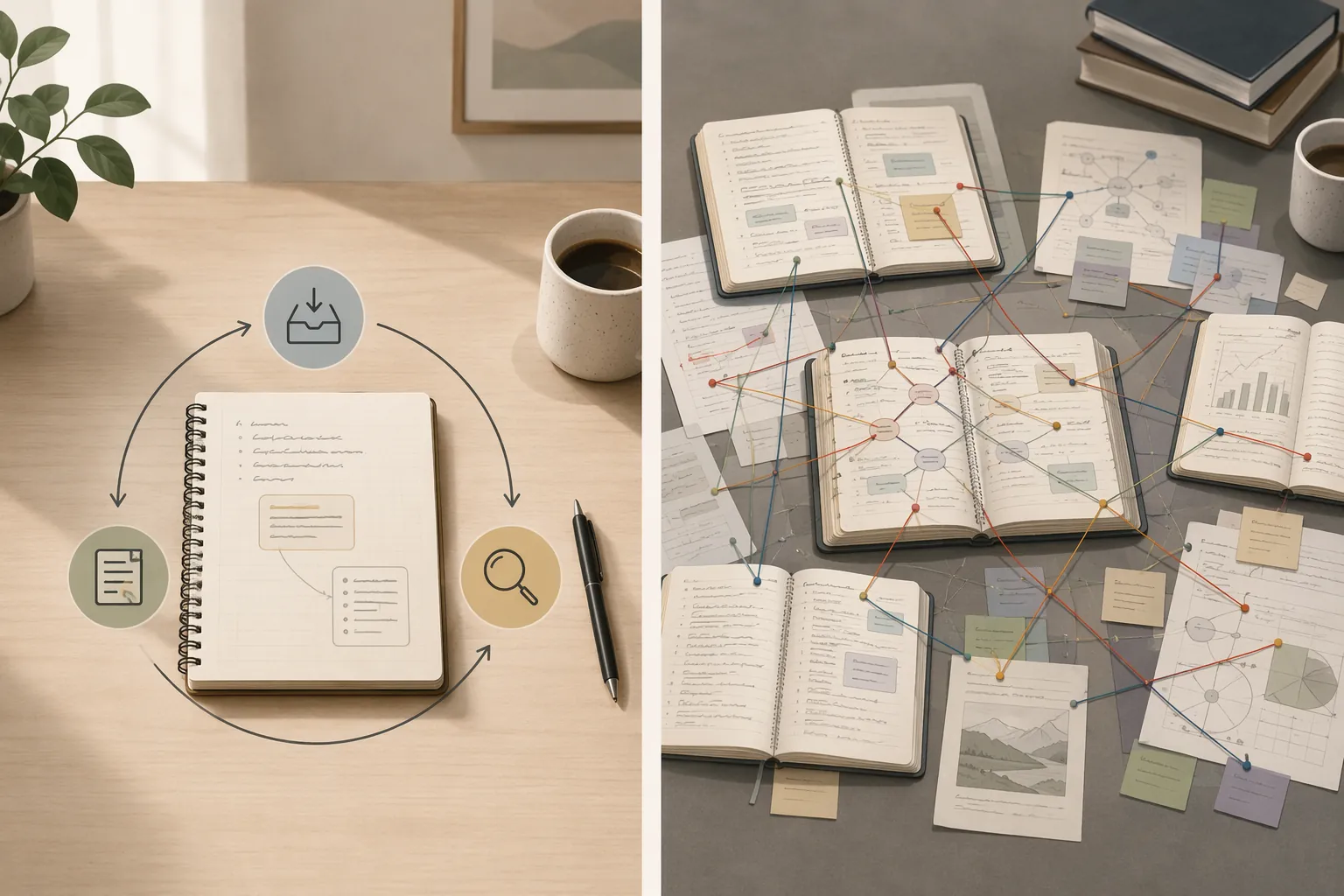
Fable 5 is not wasteful by definition. It becomes wasteful when it is used as a prestige default for small tasks. Its more credible place in a note-taking system is the layer where notes stop being daily residue and become a research corpus: multiple documents, competing claims, long-running questions, and decisions that depend on how the evidence has changed over time.
The strongest available evidence for that role does not come from user-reported note-taking case studies. It comes from broader testing around persistent file-based memory. TrueFoundry reported that Fable 5 showed a 3× improvement versus Opus 4.8 in Anthropic’s Slay the Spire testing when using persistent file-based memory across sessions.[3] That is not proof that Fable 5 is 3× better for your research notebook. It is evidence that the model’s architecture can matter when a task rewards continuity across sessions.
For note-taking, that boundary might look like a literature review that spans several weeks, a product strategy archive with unresolved tradeoffs, or a book project where the model must keep track of arguments, counterarguments, and source clusters. In that setting, the valuable behavior is not merely summarizing today’s document. It is noticing that today’s document changes how last week’s synthesis should be weighted.
Fable 5’s adaptive thinking and autonomous stamina are easier to justify when the model is asked to stay with a project rather than touch a note and leave. The cost then buys continuity, not ornament. It can read a prepared bundle, compare old and new notes, maintain a working memory through files, and produce a synthesis that would be tedious to manually assemble.
That is also why Fable 5 should be invoked deliberately. Give it the prepared corpus, the question, the constraints, and the level of confidence you need. Do not use it to summarize every clipping on the chance that one of them might later matter. If a project becomes important enough, promote the relevant notes into a research set and let Fable 5 work there.
Do Not Import Old Opus 4.8 Evidence Into An Opus 5 Verdict
A lot of existing comparison material was written before Opus 5 launched and compares Fable 5 with Opus 4.8. That material can still help explain Fable 5’s long-horizon behavior, especially the persistent-memory pattern, but it should not be used to claim that Fable 5 beats or loses to Opus 5 on a specific task.[3]
For Opus 5, the current evidence is thinner in a different way. The model is one day old as of July 25, 2026. CNBC’s report is useful because it gives launch timing, price, and Anthropic’s stated performance claims, but independent benchmarks and long-term daily-note user reports have not had time to appear.[1] Treat Opus 5 as the default that the present evidence supports, not as a settled law of note-taking.
The Access And Continuity Question
Daily note-taking is unusually sensitive to service continuity. A model used for rare synthesis can be unavailable for a while and merely delay a project. A model wired into daily capture can break the habit. Fable 5 had a temporary access suspension from June 12 to June 30, 2026, due to export-control issues, which is a real but hard-to-quantify reliability consideration for anyone depending on it as a daily layer.[2]
That fact should not be inflated into a prediction that Fable 5 will be unstable. It should simply push against using the more specialized, more expensive model as the only path through ordinary notes. A resilient system keeps raw notes readable, stores important source material outside the model, and treats any model as a processor rather than the place where the memory lives.
Decision Checkpoint
Use Claude Opus 5 as the default daily note-taking model if your work is mostly capture cleanup, article summarization, meeting synthesis, short project reviews, and targeted retrieval. Its half-price API cost, reported knowledge-work strength, everyday-use positioning, and zero-data-retention support line up with the boring repeated work that makes a notes system useful.[1][3]
Reserve Fable 5 for expensive judgment: multi-day research synthesis, autonomous review of a prepared corpus, and projects where persistent memory across files and sessions can actually repay the 2× price. The case for Fable 5 is strongest when the task needs continuity, not when the note merely needs cleanup.[2][3]
The routing rule is simple enough to keep: Opus 5 for the daily loop; Fable 5 for the research layer. If your notes are mostly daily capture and short synthesis, choose Opus 5 now and re-check independent benchmarks later. If your notes have become a multi-session research corpus that needs sustained autonomous continuity, pay for Fable 5 at that layer only.
References
- Anthropic's Claude Opus 5 AI model rivals Fable 5 and is cheaper, CNBC, July 24, 2026
- Claude Fable 5 and Claude Mythos 5, Anthropic
- Claude Fable 5 vs Opus 4.8: Benchmarks, Pricing & When to Use Each, TrueFoundry
- Using Claude for note-taking and personal knowledge management, AI Codex
- Which Claude Model Should You Use in 2026?, ClaudeWorld