
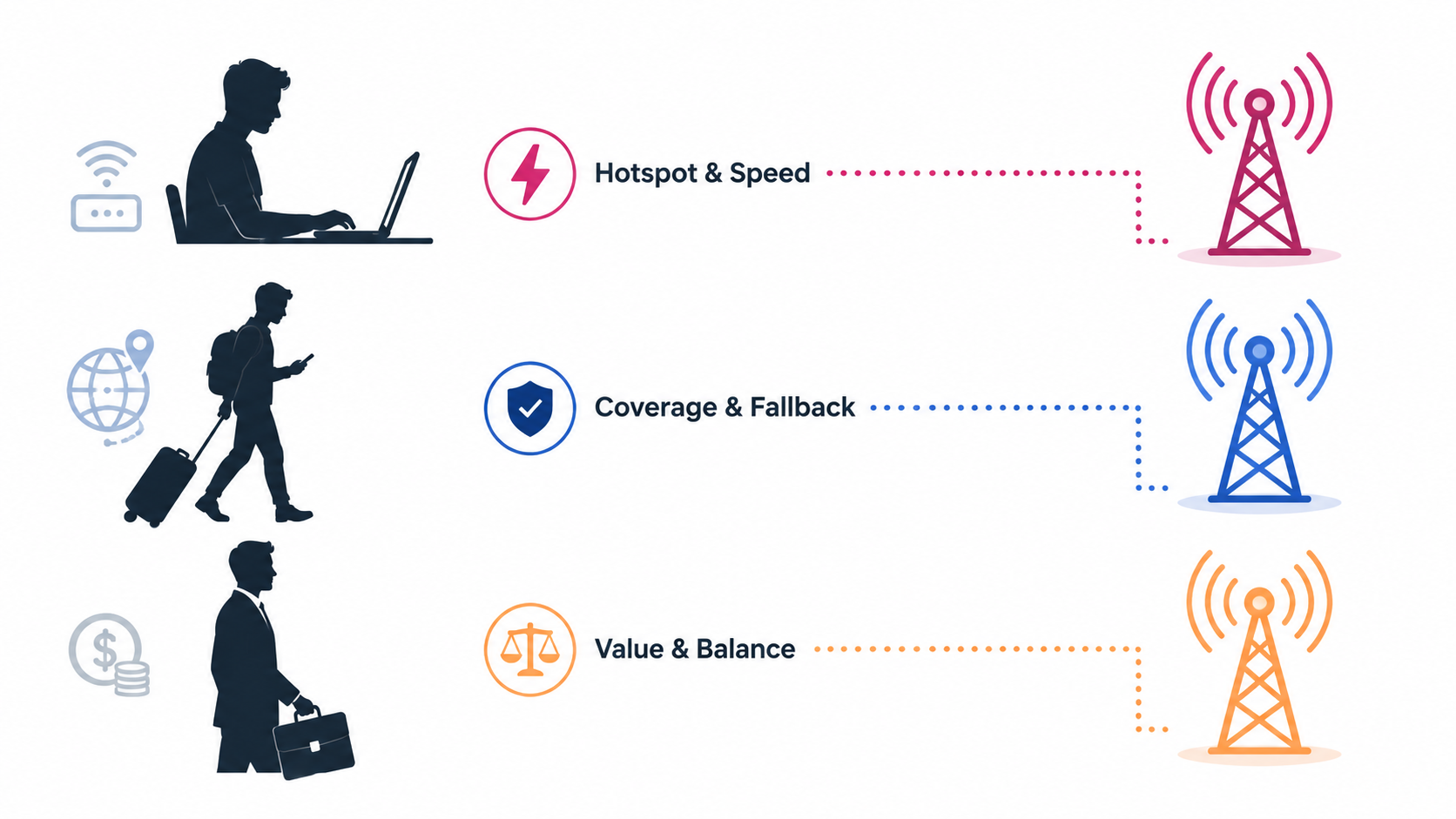
If your phone is also your backup office, the best US 5G carrier for productivity in 2026 is not one universal winner. Choose T-Mobile if your bottleneck is laptop tethering, big file work, and video-heavy days. Choose Verizon if your work takes you through airports, client sites, highways, and places where LTE fallback still decides whether the day holds together. Choose AT&T if you want the most sensible value balance: solid priority data, enough hotspot for regular use, broad performance recognition, and a lower monthly price than the comparable big-three plans.
That answer starts with speed, but it does not end there. T-Mobile’s median 5G download speed is the eye-catching number here: 309 Mbps in Ookla-based reporting for 2026, and its 5G footprint is listed at 332 million people covered.[1][2] For real work, though, the more practical question is what happens after the first speed test: whether the signal survives indoors, whether upload speeds keep a video call stable, whether LTE is still available when 5G is not, and whether your laptop runs out of hotspot data halfway through the week.
| Best fit | Carrier and plan | Productivity reason | Key speed or coverage point | Hotspot data | Monthly price |
|---|---|---|---|---|---|
| Heavy hotspot and video work | T-Mobile Experience More | Fastest median 5G download speed and the strongest hotspot allowance in the main comparison | 309 Mbps median 5G download; 332M-person 5G footprint | 60 GB premium hotspot | About $85/mo |
| Frequent travel and LTE fallback | Verizon Unlimited Plus | Stronger fallback case when 5G is weak or unavailable outside dense metro areas | 71% LTE land-area coverage vs. T-Mobile’s 63% | About 30 GB hotspot | About $80/mo |
| Best value-for-coverage balance | AT&T Unlimited Extra EL | Lower price with priority data, hotspot, security features, and national performance recognition | RootMetrics ranked AT&T #1 for National Overall Performance in H2 2025 | 30 GB hotspot | About $76/mo with auto-pay |
Why the fastest 5G carrier is not automatically the best work carrier
A fast download speed is useful. It shortens software updates, cloud-file syncs, browser-heavy research, and the miserable wait after someone sends a large deck five minutes before a meeting. T-Mobile’s 309 Mbps median 5G download result gives it a real advantage for that kind of work.[1] If your workday regularly includes pulling large files from cloud storage or running a laptop from your phone, that speed can turn dead time into usable time.
But productivity does not experience a network as one number. A video call depends more on stable upload, latency, congestion, and indoor signal than on peak download. A travel day depends on whether the phone falls back to a usable LTE connection after leaving strong 5G coverage. A tethered laptop depends on hotspot allowance, not just the phone’s own unlimited-data label.
The testing sources do not measure the same thing, either. Ookla speed data is useful for broad, crowdsourced experience; RootMetrics drive testing is useful for more controlled network comparisons; plan-comparison tables are useful only if the plan terms are current. If those sources disagree, that is not automatically a contradiction. They are often looking at different slices of the same practical question: will this carrier keep you working where you actually are?
Can you stay connected where the work actually happens?
T-Mobile has the broadest 5G population footprint in the material used for this comparison, with 332 million people covered.[2] That matters if your work is concentrated in cities, suburbs, airports, hotels, coworking spaces, and client offices where its mid-band 5G is strong. In those places, T-Mobile is the easiest carrier to recommend for people who want their phone to behave less like an emergency backup and more like a regular connection.
Verizon’s case is different. Its advantage is not that it beats T-Mobile’s 5G footprint in this data set; it does not. The useful Verizon number is LTE land-area coverage: 71% of the U.S. versus T-Mobile’s 63%, based on FCC data cited in a 2026 carrier comparison.[3] That is the kind of statistic that looks boring until you are between appointments, outside a metro area, watching a 5G icon disappear, and still needing enough signal to send files, load maps, join a call, or hotspot long enough to handle a client question.

AT&T sits between those two stories. It is not the speed headline in this comparison, but RootMetrics ranked AT&T #1 for National Overall Performance in H2 2025, while Verizon won five of eight RootMetrics headline awards, including Best Overall Performance and Best 5G Performance.[4] That split is a useful warning against lazy carrier crowns. Depending on the test design and category weighting, both Verizon and AT&T can look like the more reliable national performer while T-Mobile still owns the speed-and-5G-footprint story.
The practical coverage call
- Pick T-Mobile if you mostly work in 5G-covered cities and suburbs and want the strongest combination of speed and hotspot capacity.
- Pick Verizon if you travel often through less predictable coverage areas and want stronger LTE fallback as a workday safety net.
- Pick AT&T if you want broad, credible national performance without paying the highest comparable monthly price.
Hotspot data is the productivity feature most people underestimate
For a phone-only user, the difference between 30 GB and 60 GB of hotspot data may look like a plan-table detail. For a laptop-tethering worker, it changes the week. A laptop burns through data differently from a phone: browser tabs refresh in the background, cloud folders sync, operating systems update, video calls run in higher-resolution layouts, and collaboration tools keep polling while you work.
This is where T-Mobile separates itself most clearly. T-Mobile Experience More includes 60 GB of premium hotspot data, while Experience Beyond offers 250 GB.[5] AT&T Unlimited Extra EL includes 30 GB of hotspot data, and Verizon’s comparable tier is also around 30 GB in the cited plan comparisons.[5][6] That gap is not cosmetic. It decides whether a worker can treat mobile tethering as a normal part of the week or as an emergency ration.
A realistic heavy-use week might include several video meetings from a hotel, one client-site afternoon on a guest network that blocks half the tools you need, a cloud backup you forgot was running, and a travel day where airport Wi-Fi is technically available but too unstable to trust. Under that pattern, T-Mobile’s 60 GB tier gives more room before you have to start policing every tab. The 250 GB tier is the only big-three option in this comparison that starts to resemble a serious replacement for unreliable temporary Wi-Fi, although it still depends on local signal and plan terms.
That does not make Verizon or AT&T poor choices for hotspot use. A 30 GB allowance can be enough for a professional who mostly uses office or home Wi-Fi and needs tethering for occasional gaps. It is less comfortable for someone whose phone is expected to keep a laptop online across a full travel week. The decision is not whether 30 GB is good or bad in isolation; it is whether your actual work pattern treats hotspot as backup or infrastructure.
Upload stability matters when your face is on the call
Download speed gets the marketing banners. Upload speed gets the blame when your video freezes, your audio clips, or your shared screen lags just enough to make a conversation feel unprofessional. In the cited 5G speed comparison, Verizon’s median upload speed was 13.06 Mbps and T-Mobile’s was 13.57 Mbps, close enough to call effectively tied for most practical purposes. AT&T trailed at 8.98 Mbps.[5]
That does not mean every T-Mobile or Verizon video call will beat every AT&T call. Local congestion, building materials, device modem quality, and time of day can overwhelm national averages. The narrower conclusion is still useful: for video-call-heavy workers choosing only from these national figures, T-Mobile and Verizon have the stronger upload-speed case, while AT&T’s value argument rests more on price, priority data, and overall coverage balance than on upload leadership.
There is also a difference between a call that starts and a call that stays usable. If you work from a fixed location most days, run your own test where you actually sit: home office, client conference room, warehouse floor, clinic break room, campus parking lot. If you travel, the better question is not whether one carrier can produce a great speed test somewhere; it is whether the plan gives you enough good-enough connections across the messy route.
Pricing only makes sense after you know what the extra dollars buy
Among the three productivity plans compared here, AT&T Unlimited Extra EL is the value anchor at about $76 per month with auto-pay. It includes 75 GB of priority data and 30 GB of hotspot data.[5] That combination is enough for many professionals who need dependable mobile data but do not live on hotspot all week.
T-Mobile Experience More is about $85 per month, and the reason to pay the premium is specific: faster median 5G downloads, larger 5G population coverage, and 60 GB of premium hotspot data.[1][2][5] If hotspot capacity saves even a few hours of after-hours cleanup in a month, that price difference can be easy to justify. If you rarely tether, the extra hotspot allowance may sit unused.
Verizon Unlimited Plus is about $80 per month in the cited plan comparisons.[6] Its price makes the most sense for workers who value fallback coverage more than maximum hotspot allowance. If your work route includes rural clients, regional travel, job sites, or long highway stretches, paying for a stronger LTE fallback story can be more rational than chasing the fastest 5G median download number.
AT&T also has a security angle that matters more for some workers than others. ActiveArmor is part of AT&T’s pitch for users who want extra protection against spam, fraud, and device-level threats. That does not turn a carrier plan into a complete security program, but for enterprise remote workers and solo professionals handling client communications, it is a relevant part of the value calculation.
Where budget carriers fit, and where they do not
Mint Mobile, Visible, and US Mobile deserve a look if your ceiling is well below the big-three postpaid prices. The cited research points to Mint Mobile at $30 per month on T-Mobile’s network, Visible at $25 per month on Verizon’s network, and US Mobile at $25 per month with access to multiple network options. Consumer Reports also ranked US Mobile #1 in its 2025 carrier ratings, as reported by The Hill.[7]
The caution is that cheaper access to a network is not always the same as the same work experience on that network. MVNO performance can be affected by plan terms, prioritization, hotspot limits, and local congestion. In one city or neighborhood, an MVNO plan may be perfectly adequate for professional use. In another, it may be the plan that slows down exactly when everyone else nearby is also on the network.
For a light mobile worker, the savings can be worth that uncertainty. For someone whose billable day depends on tethering a laptop from hotels, client parking lots, and borrowed rooms, the cheaper plan has to be tested under real work conditions before it replaces a postpaid productivity plan.
Decision map for the best US 5G carrier for productivity in 2026
Use the carrier that protects the part of your workday most likely to fail. For many remote workers, that is not the same as picking the carrier with the flashiest single metric.
- Choose T-Mobile if hotspot capacity and 5G speed are your bottleneck. It has the strongest case for laptop tethering, cloud-heavy work, and video-heavy days, especially with 60 GB on Experience More or 250 GB on Experience Beyond.
- Choose Verizon if travel coverage and LTE fallback protect your workday. Its LTE land-area advantage matters when the work happens away from dense 5G coverage.
- Choose AT&T if you want the strongest all-around value under the stated budget. Unlimited Extra EL gives you 75 GB of priority data, 30 GB of hotspot, a lower monthly price, and credible national performance.
- Consider an MVNO only if you can test it where you actually work. The savings are real, but so is the uncertainty around prioritization and congestion.
Before switching, check current plan terms, hotspot rules, device compatibility, and local coverage at the places where you actually open your laptop. A carrier wins this comparison only if it keeps your real workday from collapsing, not because it wins a chart in the abstract.
References
- 5G Speeds in 2026, Reviews.org
- T-Mobile Vs Verizon, July 2026, US Mobile
- Verizon Wireless vs. T-Mobile: 2026 Carrier Comparison, HighSpeedInternet.com
- New report card for Big Three, Tom's Guide
- Which Network Has the Fastest 5G Speeds?, WhistleOut
- The 5 Best Cell Phone Plans of 2026, Wirecutter
- America's favorite cell carriers for 2026, The Hill