
The best foldable phone for productivity in 2026 depends less on which one looks most advanced and more on which kind of work you are trying to finish when a laptop is not open. If the phone has to become a desktop-like hub, the Samsung Galaxy Z Fold 7 is the cleanest fit. If it has to survive field days and still last, the Google Pixel 10 Pro Fold is the safer work companion. If battery life and pen-supported work matter most, Motorola’s Razr Fold has the strongest case. If price and charging speed are the pressure points, the OnePlus Open 2 belongs on the shortlist where it is actually available.
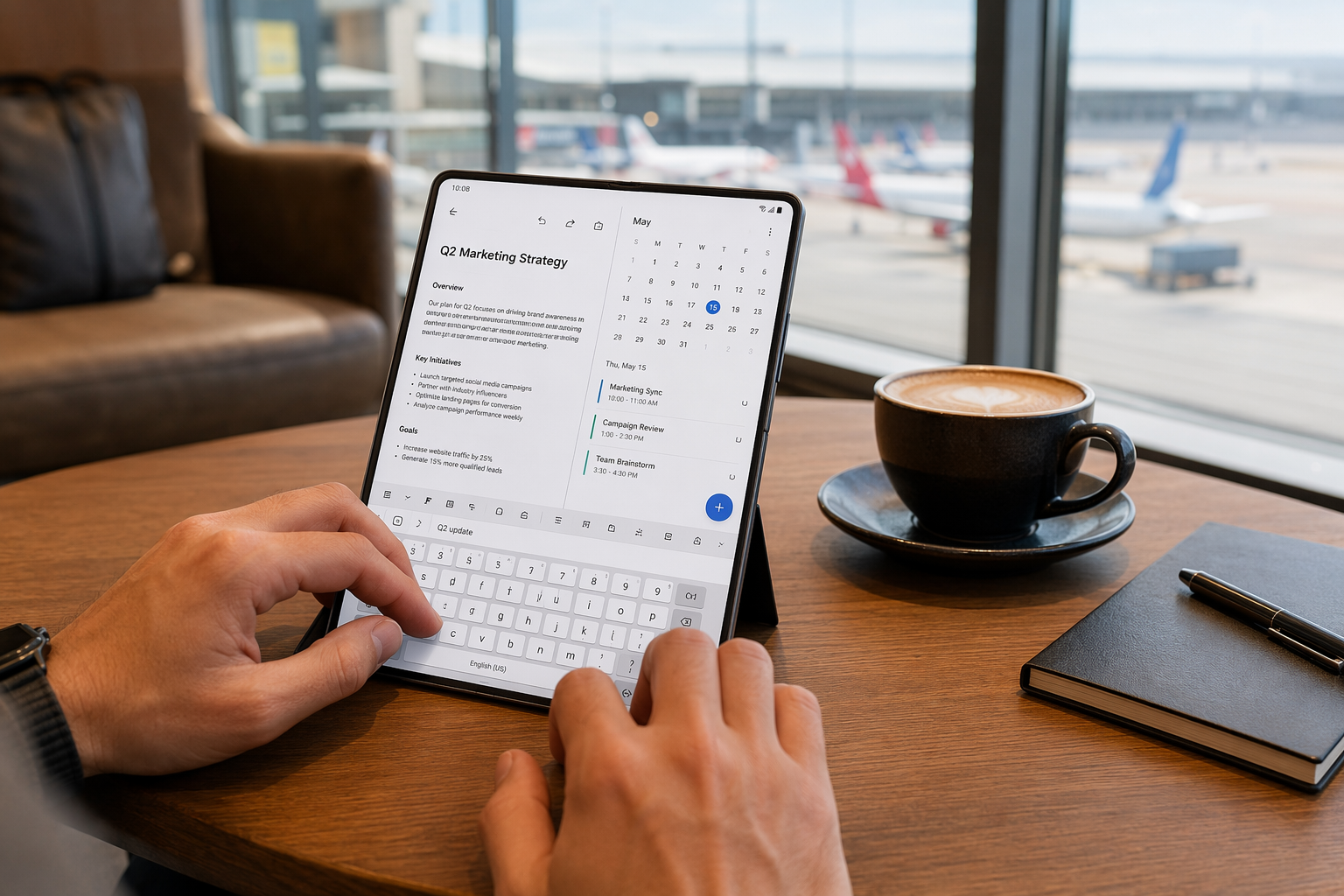
Quick Verdict: Match the Foldable to the Work
| Phone | Best for | Work strengths | Main compromise | Mid-2026 price |
|---|---|---|---|---|
| Samsung Galaxy Z Fold 7 | Desktop-style multitasking and DeX | 8in inner screen, 6.5in cover screen, 215g body, DeX on external monitors, 200MP camera, roughly 13h in PCMag testing [1][2] | No S Pen digitizer this generation; 4400mAh battery is the weakest here [2] | $1,999 [1] |
| Google Pixel 10 Pro Fold | Durable field use and AI-assisted mobile work | 8in inner screen, 6.4in cover screen, IP68 dust and water resistance, Tensor G5 transcription and translation features, about 24h in Wirecutter testing and 13h42min in PCMag testing [1][3][4] | 258g weight and less ambitious large-screen multitasking than Samsung or OnePlus [1] | About $1,500 [3] |
| Motorola Razr Fold | Longest runtime and pen-supported work | 8.1in inner screen, 6.6in cover screen, 6000mAh battery, up to 37h in Wirecutter testing, about 21h in PCMag testing, Moto Pen Ultra support, floating windows, laptop mode [1][3][5] | IP48 rating and limited long-term durability evidence because it is Motorola’s first book-style foldable in mid-2026 [5][6] | $1,899 [5] |
| OnePlus Open 2 | Value, fast charging, and expandable workspace where sold | Open Canvas workspace, $1,599 price, 120W charging, about 50% in roughly 17 minutes in TrustedReviews testing [6][7] | Limited Western availability and shorter software-support confidence than the strongest mainstream rivals [7][8] | $1,599 [7] |
That $1,500 to $1,999 spread is the first reality check. Foldables can be rational work tools, but they are still premium tools. If that range makes the whole category feel wrong for your budget, the better comparison is Best budget smartphone for productivity in 2026, not another foldable spec sheet.
What Productivity Actually Means on a Foldable
For work, a foldable earns its keep in the middle layer between phone tasks and laptop tasks. It is not just answering messages. It is reading a contract while checking comments, copying figures from a deck into an email, marking up a screenshot before a call, watching a transcript while drafting follow-up notes, or connecting to a monitor because the hotel desk has one and your laptop is still in a bag.
That is why the deciding factors are not identical to a normal flagship-phone comparison. Camera quality matters if you scan receipts, capture whiteboards, or document site visits, but Samsung’s 200MP camera does not automatically make the Z Fold 7 the best work phone. Hinge feel and thinness matter mostly when they affect fatigue, pocketability, and whether you will actually unfold the device in public. The bigger questions are simpler: how many work surfaces does the software give you, how long does the battery hold up, what happens if the phone gets wet or dusty, and whether the input method fits the work.
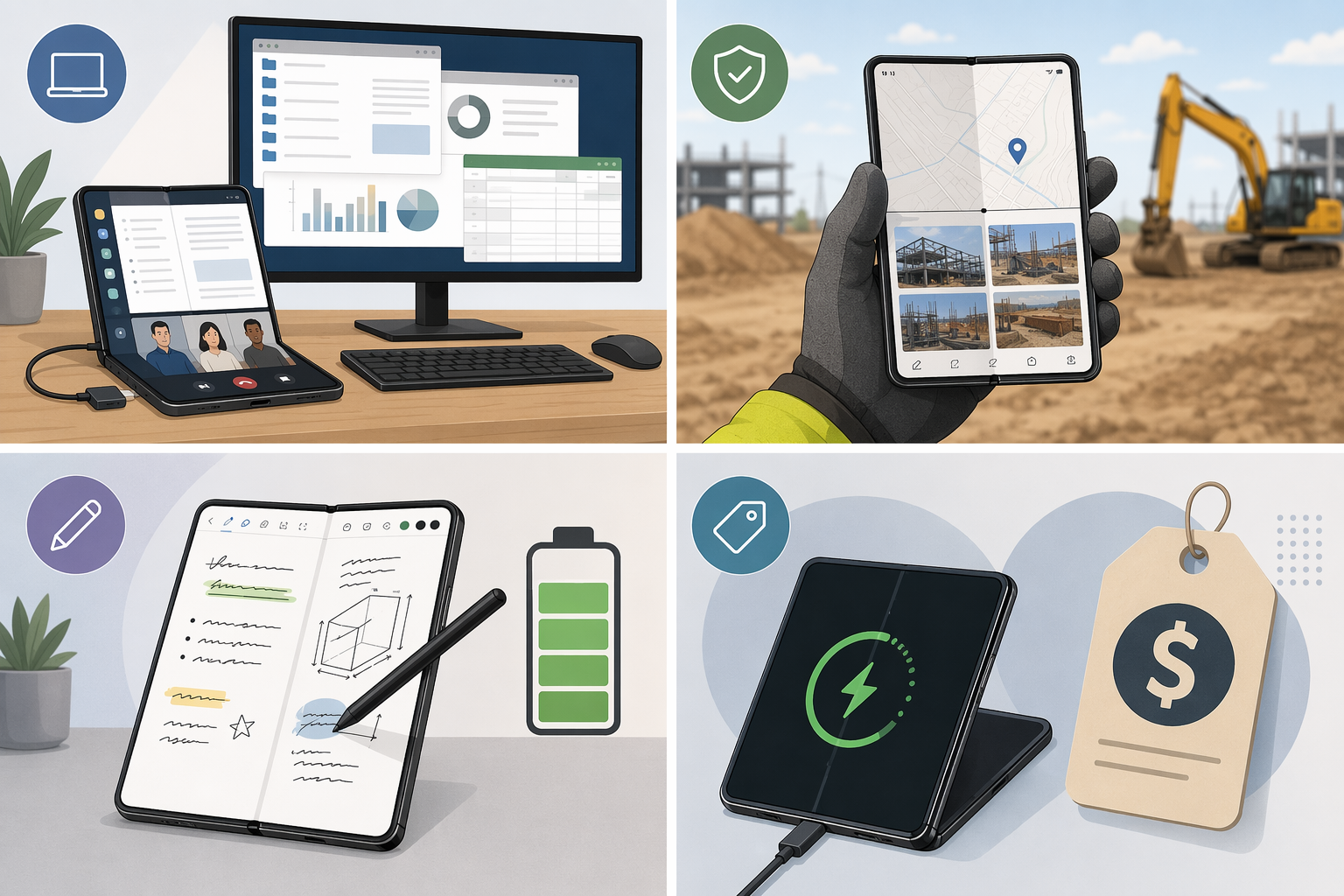
The Workflow Differences Matter More Than the Screen Size
Samsung Galaxy Z Fold 7: the closest thing to a pocket desktop
The Galaxy Z Fold 7 is the pick when the foldable is expected to become a workstation. Samsung’s advantage is not merely the 8in inner display or the 6.5in cover screen; it is the way DeX turns the phone into a desktop-style environment on an external monitor [1][2]. That changes the shape of a travel day. With a keyboard, mouse, and hotel or office monitor, the phone can move beyond split-screen triage into a layout that feels closer to a lightweight computer.
This matters for document-heavy work. Comparing a brief and a spreadsheet, keeping Slack or Teams visible while editing a note, or opening a browser research window beside a draft all fit Samsung’s strengths. At 215g and 4.2mm thin when open, it also avoids the heavy-tablet feel that makes some foldables tiring during one-handed checks [2].
The catch is sharp for a productivity buyer: the Z Fold 7 removed the digitizer, so it no longer supports S Pen input [2]. That is not a small footnote if your previous Fold workflow involved annotating PDFs, signing documents, sketching layouts, or marking up screenshots. Samsung still has the best desktop-style story here, but it is no longer the safest default for people who treat pen input as part of the workday.
Google Pixel 10 Pro Fold: better for the person moving through rougher days
The Pixel 10 Pro Fold is less convincing as a laptop replacement, but more reassuring as the phone you take into unpredictable work. Its IP68 rating makes it the first foldable in this group with dust and water resistance at that level, which matters if the phone is used around job sites, travel, weather, bags, and outdoor calls rather than only desks and lounges [4].
Pixel’s productivity angle is also different. Tensor G5 features such as transcription and translation are more useful during calls, interviews, meetings, and quick note recovery than during spreadsheet juggling [4]. The phone is helping you capture and process work rather than giving you the most elaborate windowing system. That distinction matters: an AI transcript can save a meeting, but it does not replace Samsung DeX or OnePlus Open Canvas when you need three active work panes.
The 258g weight is the price of that sturdier field profile [1]. If you mostly work seated, the extra mass may fade into the background. If you are constantly opening the phone one-handed while boarding, walking, or inspecting something on-site, it is noticeable.
Motorola Razr Fold: the runtime-and-stylus workhorse
Motorola’s Razr Fold has the most unusual productivity argument in this group: it leans into battery, pen input, and flexible windowing instead of trying to look like the most established enterprise choice. Its 6000mAh battery is the largest among the main US-relevant picks here, and its test results stand out: Wirecutter measured up to 37 hours, while PCMag measured about 21 hours [1][3]. Those are different test contexts, but both point in the same direction: Motorola is the endurance pick.
The Moto Pen Ultra support gives it a practical advantage for people who still think with a pen. Marking up a document, circling a detail in an image, signing something quickly, or taking handwritten meeting notes is not a nostalgic feature set; it is often the fastest way to handle messy work on a small device [5]. Add freeform floating windows and a laptop mode that uses the bottom half as a keyboard, and Motorola becomes the foldable that most directly addresses the awkward hour when you need to do real work without a bag of accessories [5].
The restraint is durability confidence. The IP48 rating is weaker than Pixel’s IP68, especially on dust, and this is Motorola’s first book-style foldable in mid-2026, so long-term evidence is thinner than it is for Samsung’s mature Fold line [5][6]. That does not make it a bad buy. It does mean the person choosing it should be choosing the battery-and-pen workflow knowingly, not assuming it carries the same field-risk profile as the Pixel.
OnePlus Open 2: the value choice if its caveats fit your market
OnePlus Open 2 is the rational pick for a buyer who sees a foldable as a work surface but does not want to pay Samsung money. At $1,599, it undercuts the Z Fold 7 and Motorola Razr Fold, and its Open Canvas workspace remains one of the clearest large-screen multitasking ideas in the category [7][8]. Instead of treating split screen as a narrow two-app trick, Open Canvas is built around a more expandable workspace.
The other obvious work benefit is charging. TrustedReviews cites 120W charging and about 50% in roughly 17 minutes [6]. For a freelancer, consultant, or remote worker moving between appointments, that can matter more than a benchmark win. A short stop near an outlet becomes a meaningful recovery window.
The reason it is a contender rather than the default recommendation is availability and support confidence. The OnePlus Open 2 has limited Western availability, and the support picture is not as reassuring as the best mainstream alternatives [7][8]. If you can buy it cleanly in your region, get acceptable warranty coverage, and live with the software-support tradeoff, it is one of the strongest value plays in the productivity foldable space.
Battery Life: Directional Evidence, Not a Single Scoreboard
Battery numbers are tempting because they make the decision look clean. The Z Fold 7 is around 13 hours in PCMag testing, the Pixel 10 Pro Fold is 13 hours and 42 minutes in PCMag testing and about 24 hours in Wirecutter testing, and the Motorola Razr Fold is about 21 hours in PCMag testing and up to 37 hours in Wirecutter testing [1][3]. Those figures should not be flattened into one universal ranking because PCMag and Wirecutter use different protocols.
The practical reading is still useful. Samsung is the weakest battery bet among the main picks. Pixel appears dependable enough for a full mobile workday, with the added confidence of its durability rating. Motorola is the long-runtime specialist. OnePlus changes the equation with 120W charging: it may not remove battery anxiety for everyone, but it makes a mid-day top-up unusually effective [6].
There is also a battery outlier worth mentioning without over-recommending it for US buyers. Honor Magic V6 has a 6660mAh battery and is a battery standout, but limited US availability keeps it from being a main recommendation in this comparison [1]. A phone that is hard to buy, service, or support is not a simple productivity answer.
Durability Can Overturn the Spec-Sheet Winner
For someone who works mostly at a desk, Samsung’s DeX advantage can outweigh its weaker battery and missing pen. For someone who takes calls outside, checks plans near equipment, travels in bad weather, or shares a device across messy work environments, Pixel’s IP68 rating becomes more than a line item [4]. It reduces the amount of mental care the phone demands.
Motorola sits in the middle in a more complicated way. Its IP48 rating gives some protection, but it is not the same reassurance as Pixel’s IP68 [5]. The phone’s battery and pen support are excellent productivity traits, yet the buyer should treat long-term durability as less proven. That is especially relevant for people who plan to keep a foldable for several years rather than trade it in after one upgrade cycle.
OnePlus has a different kind of durability issue: not necessarily the hinge in daily use, but the ownership environment. Limited availability can affect warranty paths, repair convenience, accessories, carrier support, and resale confidence [7]. Those are productivity issues too, because downtime is a cost.
Stylus, Desktop Mode, and Workspace: Choose the Tool You Will Actually Use
The stylus decision is unusually important in 2026 because Samsung changed the assumption. A buyer coming from an older Galaxy Z Fold may reasonably expect S Pen support and only discover late that the Z Fold 7 removed the digitizer [2]. If handwritten annotation is central to your work, Samsung’s DeX advantage does not solve that loss.
| If your work often involves... | Start with... |
|---|---|
| External monitors, keyboard and mouse, desktop-style app layouts | Galaxy Z Fold 7 |
| Calls, site visits, weather, dust exposure, and fast AI note capture | Pixel 10 Pro Fold |
| Handwritten notes, PDF markup, long days away from outlets | Motorola Razr Fold |
| Multi-app workspace on the phone screen plus very fast charging | OnePlus Open 2 |
This is where the best foldable phone for productivity in 2026 becomes a workflow question rather than a brand question. DeX is powerful if you use monitors. Stylus support is decisive if you annotate. Open Canvas is valuable if you live in multi-app comparison work. Pixel’s transcription and translation strengths matter most if meetings, calls, and field communication generate the work you need to capture [4][8].
Practical Shortlist
- Buy the Samsung Galaxy Z Fold 7 if your foldable needs to become a desktop-like work hub with DeX and strong large-screen multitasking, and you do not depend on S Pen input.
- Buy the Google Pixel 10 Pro Fold if field durability, IP68 protection, dependable battery behavior, and AI-assisted capture matter more than advanced multitasking.
- Buy the Motorola Razr Fold if long runtime, stylus support, floating windows, and laptop mode fit your work, and you are comfortable with IP48 and limited long-term durability evidence.
- Consider the OnePlus Open 2 if the $1,599 price, Open Canvas, and 120W charging solve your main problems, and its regional availability and support caveats do not create new ones.
The wrong way to buy one of these is to crown the most impressive foldable and hope it fits your work. The better way is to name the moment you are trying to improve: the monitor you want to plug into, the note you need to mark up, the site visit you do not want to baby a phone through, or the twenty-minute charging stop that has to carry the rest of the afternoon.
References
- The Best Folding Phones for 2026: Google, Motorola, Samsung, and More, PCMag
- The best foldable phones to buy in 2026, Android Central
- The 4 Best Foldable Phones of 2026, Wirecutter/NYT
- Get Ready to Hear a Lot More About Foldable Phones in 2026, CNET
- Best foldable phone in 2026 reviewed and rated, Stuff.tv
- Best Foldable Phones 2026, TrustedReviews
- Foldable Phone Showdown: Samsung Z Fold 7 vs OnePlus Open 2 vs Google Pixel Fold 2, CellMeYourPhone
- Top 5 Foldable Android Phones for Productivity in 2026, Vertu