
The impact of Amazon Nova’s discontinuation on note-taking tools is narrower than the headline first suggests. On July 28, 2026, Amazon updated its Bedrock model lifecycle page to move several Nova models into KTLO maintenance, with end-of-life dates now listed for Nova Premier and Nova Sonic on September 14, 2026, and Nova Canvas and Nova Reel on September 30, 2026.[1] The awkward part is the calendar: the Nova family launched at re:Invent in December 2024, so teams that built around those models are dealing with a lifecycle change less than two years later.[1]
That is a real discontinuation. It is not, however, evidence that the AI features in Notion, GoodNotes, Evernote, or Obsidian are about to disappear because Amazon turned something off. None of those major note-taking apps relies on Amazon Nova models, based on the available public materials. The useful question is not “Which note app is secretly broken today?” It is “If the model under my note app changes, who has to clean up the mess?”

The Shutdown Is Real, but the Blast Radius Is Small
AWS gives Bedrock models at least 12 months from launch to end of life, and the Nova timeline appears to meet that minimum. That does not make the disruption theoretical. A model can be officially supported long enough to satisfy a platform policy and still disappear quickly enough to create work for schools, app developers, and users who thought a feature had become part of the furniture.
The clearest affected example is Ativion StudentKeeper. It is not a general-purpose notes app; it is classroom-management EdTech with AI-powered teacher note-taking. AWS’s own case study says StudentKeeper uses Amazon Nova Pro and Nova Lite to help teachers capture and organize student observations.[2] That matters because it shows where discontinuation work lands: not in a press release, but in a classroom workflow where notes, summaries, and teacher review habits have already adapted to a tool.
For Ativion, the practical path is migration. AWS recommends that Nova 1 Pro users move to Nova 2 Lite, and says Nova 2 Lite surpasses Nova Premier in multi-step problem-solving while offering 7x lower cost and up to 5x faster inference.[6] That is a reasonable vendor migration story, but it is still a migration story. Someone has to test the output, update prompts, adjust integrations, and decide whether the new model behaves well enough for the existing product.
There are also a few names worth separating before they blur together. Nova 2 Lite, Nova 2 Sonic, Nova Forge, and Nova Act remain available.[6] Amanote has an AWS case study that mentions evaluating Bedrock, but the available material does not confirm Nova usage, so it should not be counted as affected. The “Nova: AI Notes” iOS app is a third-party app with the same name, not Amazon Nova. And while AWS’s lifecycle page records Nova Omni moving into KTLO maintenance, the official table available on July 30, 2026 does not give Omni the same listed end-of-life date as the other models, so it should not be treated as having a confirmed shutdown date from that table.[1]
What the Major Note Apps Actually Depend On
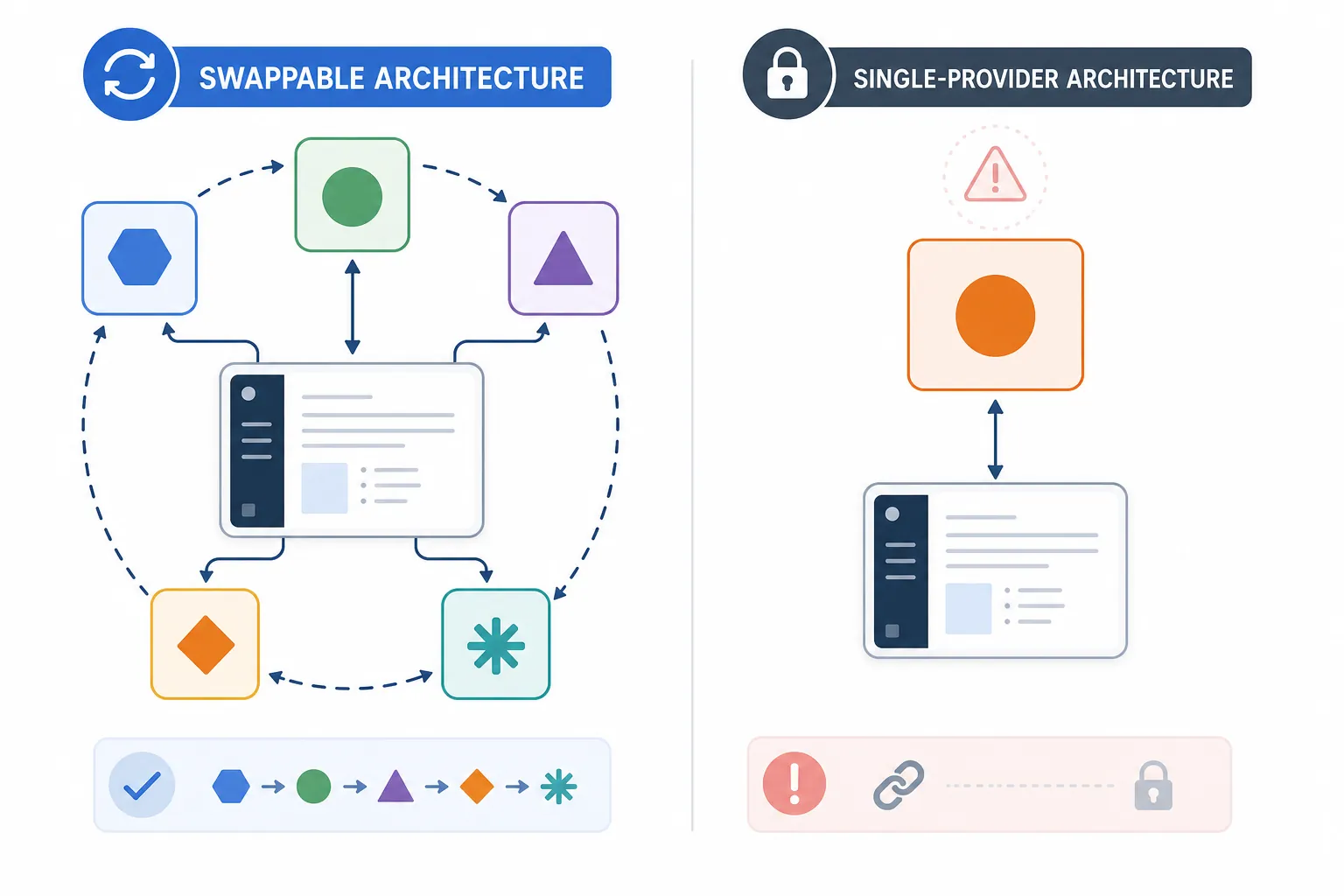
The consumer note-taking map is calmer than the Nova headline. The difference between the apps is not whether they “have AI.” It is whether the AI layer is a replaceable service, a multi-provider system, a user-chosen plugin, or a hard dependency on one outside provider.
| App or tool | Amazon Nova exposure | What the dependency says about risk |
|---|---|---|
| Ativion StudentKeeper | Affected in a note-taking-adjacent classroom workflow | Uses Nova Pro and Nova Lite, so the vendor must migrate or switch providers before relevant EOL deadlines. |
| GoodNotes | Not affected | Uses Anthropic Claude on Amazon Bedrock, and its history shows backend flexibility rather than a fixed Nova dependency. |
| Notion | Not affected | Uses a multi-model architecture with OpenAI GPT-4.1 and Anthropic Claude 3.7, reducing dependence on a single model family. |
| Obsidian | Not affected at the app level | AI risk depends on the user’s chosen plugin and provider, not on Obsidian itself. |
| Evernote | Not affected by Nova | Public AI materials point to OpenAI, making this a single-provider architecture risk rather than an active Nova problem. |
GoodNotes: Not Affected, but Instructive
GoodNotes is the useful counterexample because it is close to the kind of app people worry about: handwritten notes, study workflows, summaries, and AI assistance wrapped into a product that users may keep for years. AWS’s GoodNotes case study says the company uses Anthropic Claude on Amazon Bedrock, not Amazon Nova.[3]
The more important detail is not the provider name by itself. GoodNotes had previously worked with self-hosted large language models and then moved to Claude on Bedrock.[3] That is evidence of engineering mobility. If an app has already changed how it serves AI without asking users to rebuild their notebooks, that is a better sign than a polished launch video promising “AI notes” with no visible architecture underneath.
GoodNotes still has cloud AI dependency. Claude could change, Bedrock pricing could change, and supported regions or model versions could change. But Nova disappearing does not directly threaten GoodNotes, and the app’s past move from self-hosted models to a managed Bedrock setup suggests the AI backend is not welded permanently to one model family.
Notion: Multi-Model Does Real Work
Notion is also not a Nova casualty. Its recent AI architecture uses OpenAI GPT-4.1 and Anthropic Claude 3.7, according to VentureBeat’s reporting on the company’s integrated LLM strategy.[4] That matters because a multi-model setup gives the vendor more room to route tasks, tune performance, and adapt when a model changes.
Multi-provider architecture is not magic continuity. It does not guarantee that a particular summary style, search answer, or writing assistant behavior will stay identical. It does mean the product is less exposed to one provider’s lifecycle table. If OpenAI changes one model or Anthropic changes another, Notion has more room to rebalance than a tool built around a single model endpoint.
That is the better way to read Notion’s AI posture. It is not “safe forever.” It is “less brittle than a one-provider design.” Readers comparing Notion with Obsidian for AI-heavy notes may want to look at FlowDesk’s Obsidian vs Notion AI notes comparison, because the real choice is often between a managed multi-model workspace and a more user-controlled plugin stack.
Obsidian: The App Is Insulated, the Plugin May Not Be
Obsidian’s AI risk sits in a different place. The core app is local-first and does not depend on Amazon Nova. AI features usually arrive through community plugins, external scripts, or user-configured services that can point to providers such as OpenAI, Claude, Ollama, or other model endpoints.
That gives Obsidian users a kind of architectural escape hatch. If one provider becomes unsuitable, a plugin may allow another provider, or the user may replace the plugin. The price is that the user has more responsibility. You cannot just ask “Does Obsidian use Nova?” and stop there. You have to ask which plugin you installed, which API key it uses, where your prompts go, and whether the outputs are written back into ordinary Markdown notes.
This is why Obsidian often appeals to people who care about long-term note ownership. The base archive can remain readable even when an AI helper changes. That does not make every plugin well-maintained or every setup private by default. It means the failure boundary is usually smaller: a summarizer breaks, not the notebook itself. For a concrete example of plugin-based AI experimentation, see FlowDesk’s guide to testing AI prompts for math problems in Obsidian.
Evernote: No Nova Problem, Higher Single-Provider Exposure
Evernote is not affected by Amazon Nova. Its public AI features page points to OpenAI as the provider behind its AI-powered features.[5] That makes the current Nova shutdown irrelevant to Evernote users, but it also makes Evernote the cleanest example among the major apps of a single-provider AI dependency.
This is a forward-looking architecture risk, not an active outage warning. If OpenAI changes an API, retires a model, changes pricing, or alters availability, Evernote would need to absorb that change or rework its AI layer. Users would not necessarily lose their notes; the question is whether AI search, cleanup, summarization, or writing assistance would continue with the same behavior and availability.
The distinction matters. A single-provider dependency is not automatically bad. It can be simpler, faster to ship, and easier for a vendor to support. It is just less hedged. If your notes are long-term infrastructure, that lack of hedging belongs in the buying decision.
How to Audit Any Note App After the Nova Shutdown
The right response to Amazon Nova’s lifecycle change is not panic migration. It is a short dependency audit. Do it before you have a folder full of AI-generated class notes, meeting summaries, research digests, or handwritten conversions that only one vendor knows how to reproduce.
First, Find the Actual Provider
Start with the vendor’s AI page, privacy page, subprocessors page, help center, and enterprise security documents. You are looking for named providers, not just labels like “our AI assistant” or “advanced models.” A useful disclosure says something like OpenAI, Anthropic, Amazon Bedrock, Google, Azure OpenAI, or a named local model. A weaker disclosure says “third-party AI partners” and stops there.
If the app refuses to name the provider, treat that as an unknown dependency. Unknown is not the same as unsafe, but it is not auditable. For a long-lived note archive, that should bother you more than a missing formatting option.
Then Check Whether the Backend Is Swappable
A resilient app does not need to expose every model switch to users. It does need a realistic path when a model disappears. GoodNotes demonstrates this at the vendor level by having moved from self-hosted LLMs to Claude on Bedrock.[3] Notion demonstrates a different version through a multi-model architecture that includes GPT-4.1 and Claude 3.7.[4] Obsidian demonstrates it at the user level, where plugins and providers can often be changed without replacing the notes vault.
A brittle app has one named provider, one model family, no visible migration policy, and AI features that are described as native product behavior. That is where the risk gets quietly handed from vendor to user. The marketing page says “summarize my notes.” The engineering reality may be “send this content to one model endpoint whose lifecycle is controlled somewhere else.”
Make Sure AI Outputs Become Ordinary Notes
The safest AI note feature produces something you can keep: Markdown text, plain text, a normal note block, a PDF annotation, a transcript, a tag, or another object that remains usable without calling the model again. The riskier version stores value in a dynamic AI view that has to be regenerated, re-queried, or interpreted by the vendor’s current model layer.
For example, a hypothetical lecture app that turns handwriting into a normal editable note has a cleaner failure mode. If the handwriting model changes later, the converted note still exists. A hypothetical app that only shows “AI understanding” through a live chat panel is more exposed, because the user may have no durable artifact except the original raw material.
Test Export Without the AI Layer
Export is where continuity stops being a promise. Turn off the AI feature mentally and ask what remains. Can you export the notes, attachments, highlights, tags, OCR text, handwriting conversions, and summaries? Do exported files preserve enough structure to be useful elsewhere? Can you search them without the vendor’s AI search?
This is also where local-first tools have a practical advantage, although not a universal one. A folder of readable Markdown files is easier to recover from than a proprietary workspace whose best features exist only as cloud behaviors. If you are considering a move because of AI dependency concerns, FlowDesk’s Notion-to-Obsidian AI safety migration guide is a more useful starting point than reacting to the Nova news alone.
Look for a Migration Story Before You Need One
The best vendors leave clues. They mention model upgrades. They explain provider changes. They separate user data from model training claims. They have enterprise documentation that identifies subprocessors. They avoid pretending that an outside model is simply a permanent native capability.
The weakest vendors force users to infer everything after something breaks. If there is no named provider, no model policy, no export clarity, and no changelog history around AI infrastructure, you are being asked to trust a black box with your future workflow. Sometimes that is acceptable for a disposable assistant. It is harder to justify for school notes, research notebooks, medical study logs, legal work, or a multi-year personal knowledge base.
- Low risk: the app names its providers, supports multiple models or providers, stores AI outputs as normal notes, and exports usable files.
- Medium risk: the app names one provider and exports your underlying notes, but does not explain how AI features would migrate.
- High risk: the app markets AI as native, hides the provider, stores value in dynamic AI-only views, and offers weak export.
What to Do if Your App Uses Amazon Bedrock
Bedrock usage alone is not the problem. GoodNotes uses Claude on Bedrock and is not exposed to Nova’s shutdown.[3] Ativion StudentKeeper uses Nova Pro and Nova Lite and therefore has a concrete migration task.[2] The platform name tells you where the model is hosted; it does not tell you which model family your app depends on.
If a note app or education tool says it uses Bedrock, ask the next question: which model? If the answer is Nova 1 Pro, Nova Premier, Nova Sonic, Nova Canvas, or Nova Reel, the lifecycle table matters immediately.[1] If the answer is Claude, another non-Nova model on Bedrock, or a newer Nova 2 model, the current shutdown may not apply, although normal dependency risk still does.
The rumored or future Frontier Model Research successor should not change your decision today. Without a confirmed product name, date, capability set, or migration path, it is not an architecture plan. Treat it as possible future context, not as a reason to ignore a dated end-of-life notice.
The Calm Answer
If you use Notion, GoodNotes, Evernote, or Obsidian, Amazon Nova’s July 2026 discontinuation is not a reason to panic-migrate. The available public evidence does not show those apps relying on Nova. The direct known impact sits with a narrower note-taking-adjacent classroom tool, Ativion StudentKeeper, and with other products that built on the retiring Nova models.
But it is a good reason to audit your note app now. AI continuity is not a feature checkbox. It is an architecture question: whether the backend can be swapped, whether the vendor has a migration path, and whether your notes remain useful when the assistant layer changes or disappears.
References
- Amazon Bedrock model lifecycle, AWS Documentation
- Ativion Nova Case Study, AWS
- GoodNotes AWS Case Study, AWS
- Notion bets big on integrated LLMs, adds GPT-4.1 and Claude 3.7 to platform, VentureBeat
- AI Features, Evernote
- Migrate from Amazon Nova 1 to Amazon Nova 2 on Amazon Bedrock, AWS Machine Learning Blog