
Amazon’s July 2026 AGI retreat is useful precisely because it is not a note-taking story. The company did not stop caring about AI. It shut down an AGI Lab formed in December 2024 after about 18 months, wound down several Nova flagship model efforts, and redirected attention toward AI work that customers can actually use inside businesses.[1][2] That is a cleaner version of the choice hiding inside most AI note-taking app comparisons: are you buying a smarter private brain, or are you buying a system that turns messy input into work someone can use tomorrow?
The layoff part needs care. CNBC and Reuters reported layoffs tied to Amazon’s AGI unit, but Amazon did not disclose a precise headcount for that unit. Broader company layoff figures reported around the same period should not be casually converted into “AGI layoffs” as if they describe one team.[1][3] The more useful signal is strategic, not arithmetic: Amazon appears to have decided that chasing the most impressive standalone intelligence was less urgent than shipping AI into places where customers already have work waiting.
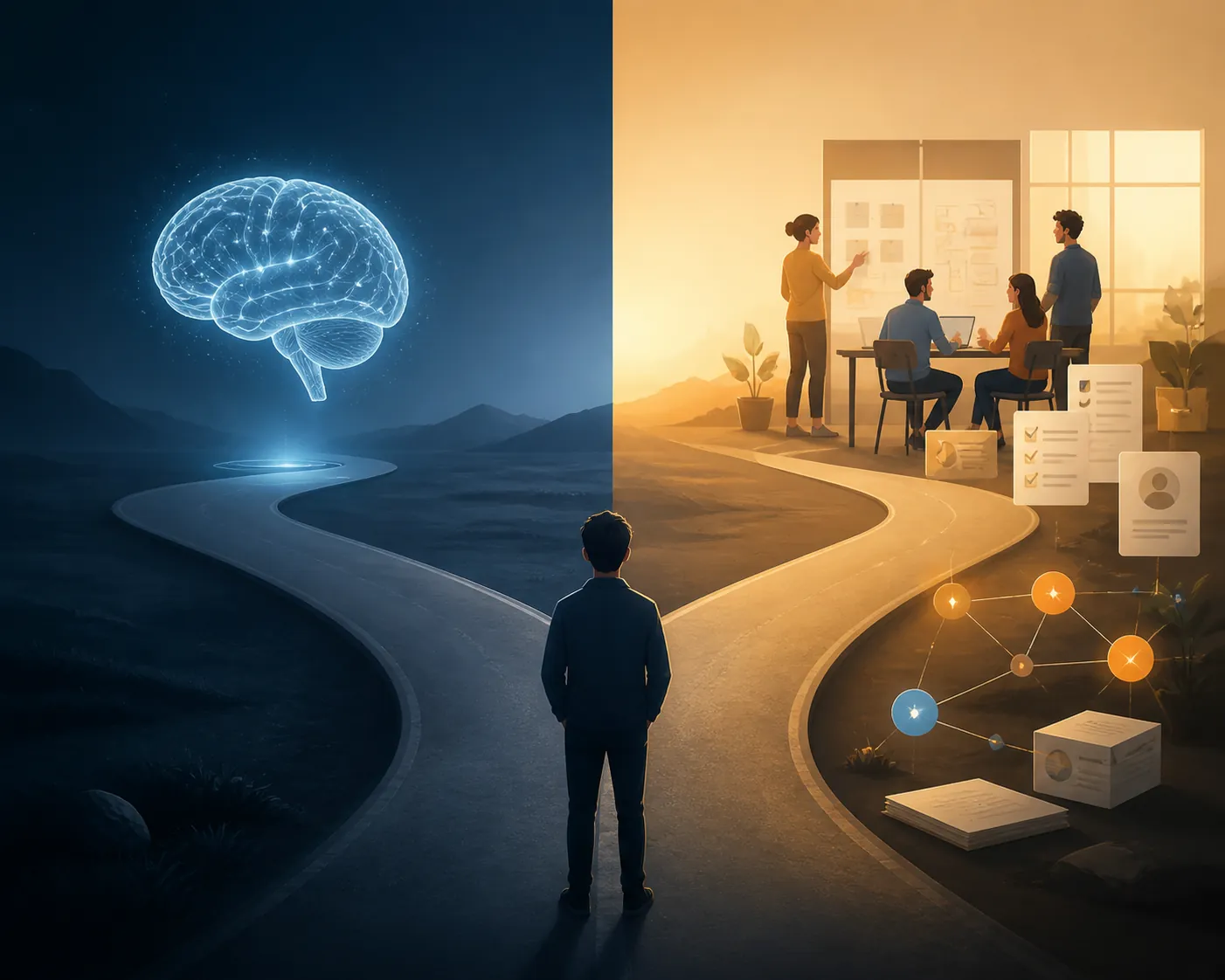
TNW put the pivot sharply: “the company that wants to power everyone else’s AI has stopped trying to build the cleverest brain itself.”[4] GeekWire’s reporting included an even better internal mood check, with the Lake Wobegon line: “All of the children in Lake Wobegon are above average,” used to describe the AGI unit’s self-assessment that it was not on a breakthrough path.[5] That is the kind of sentence that survives a press cycle because it admits the thing feature pages usually avoid: being above average is not the same as being the right tool for the job.
At the same time, Amazon expanded customer-facing AI work. AWS announced a $1 billion Forward Deployed Engineering program, and CNBC reported Amazon’s plan for $200 billion in 2026 capital expenditures, with AI infrastructure as a major part of the spend.[6][7] The company was not walking away from AI. It was moving effort closer to customers, workflows, infrastructure, and deliverables.
The same question sits inside AI note-taking apps
When a note-taking app says it has AI, the phrase can mean several different things. It may capture faster. It may transcribe. It may summarize. It may tag and connect notes. It may draft follow-up emails, turn meetings into tasks, update a CRM, generate a project brief, or create a shared decision log. Those are not interchangeable benefits.
A good demo often hides the handoff. The meeting ends, the transcript looks clean, the summary sounds plausible, and then someone still has to decide where the decisions live, who owns the next step, whether the account record changed, and which version of the project brief the team should trust. That is where the difference between capture-first and work-product-first note-taking starts to matter.
| What you are comparing | What it actually decides |
|---|---|
| Capture | How quickly thoughts, meetings, clips, and rough notes get into the system |
| Structure | Whether notes become linked, tagged, typed, or otherwise organized enough to reuse |
| Synthesis | Whether the app can produce summaries, briefs, decisions, tasks, or other outputs |
| Integration | Whether those outputs land in the tools where work is tracked, reviewed, or assigned |
Laxis’s 2026 benchmark is useful here, with a caveat. It claims that 75% of professionals now use an AI note-taker and argues that “the ROI multiplier is integration, not transcription,” meaning the larger value comes when outputs flow into CRM, project trackers, or support tools rather than stopping at a transcript.[8] Because Laxis sells in this market, the adoption number should be treated as vendor-produced context, not neutral census data. Still, the integration point matches what working teams discover quickly: a beautiful transcript is only halfway useful if the next person has to re-enter the useful parts somewhere else.
Capture-first tools are not failed workflow platforms
Mem, Reflect, Apple Notes, and Google Keep belong in the capture-first camp. That does not make them lightweight in a dismissive sense. Their job is different. They help one person get material down, find it later, and keep thinking without turning every fragment into a shared object.
For private work, that can be exactly right. A product manager collecting stray customer language, a founder keeping investor-call notes, a researcher saving article fragments, or a designer jotting impressions after a review may not need agent-readable team structure at the moment of capture. They need speed, low friction, search, and enough organization to return to the thought before it cools.
There is a kind of collaboration creep in note-taking software that turns every note into a potential project artifact. That helps some teams and irritates many individuals. Apple Notes and Google Keep still make sense when the problem is personal capture, not organizational choreography. Reflect and Mem make sense when the user wants memory, recall, and personal resurfacing before they want a task schema.
The limitation is equally plain. If a note must become a decision log, task list, meeting follow-up, customer record, or shared brief, capture-first tools often leave the last mile to the user. The app may help you remember what happened. It may not make the work land where the team expects it.
Work-product-first tools start with the handoff
Tana’s framing gives the cleanest dividing line: does the note become connected, shared work your team and its agents can act on, or does it stay personal material you organize and act on yourself?[9] That is a better question than asking which app has the most impressive AI button.
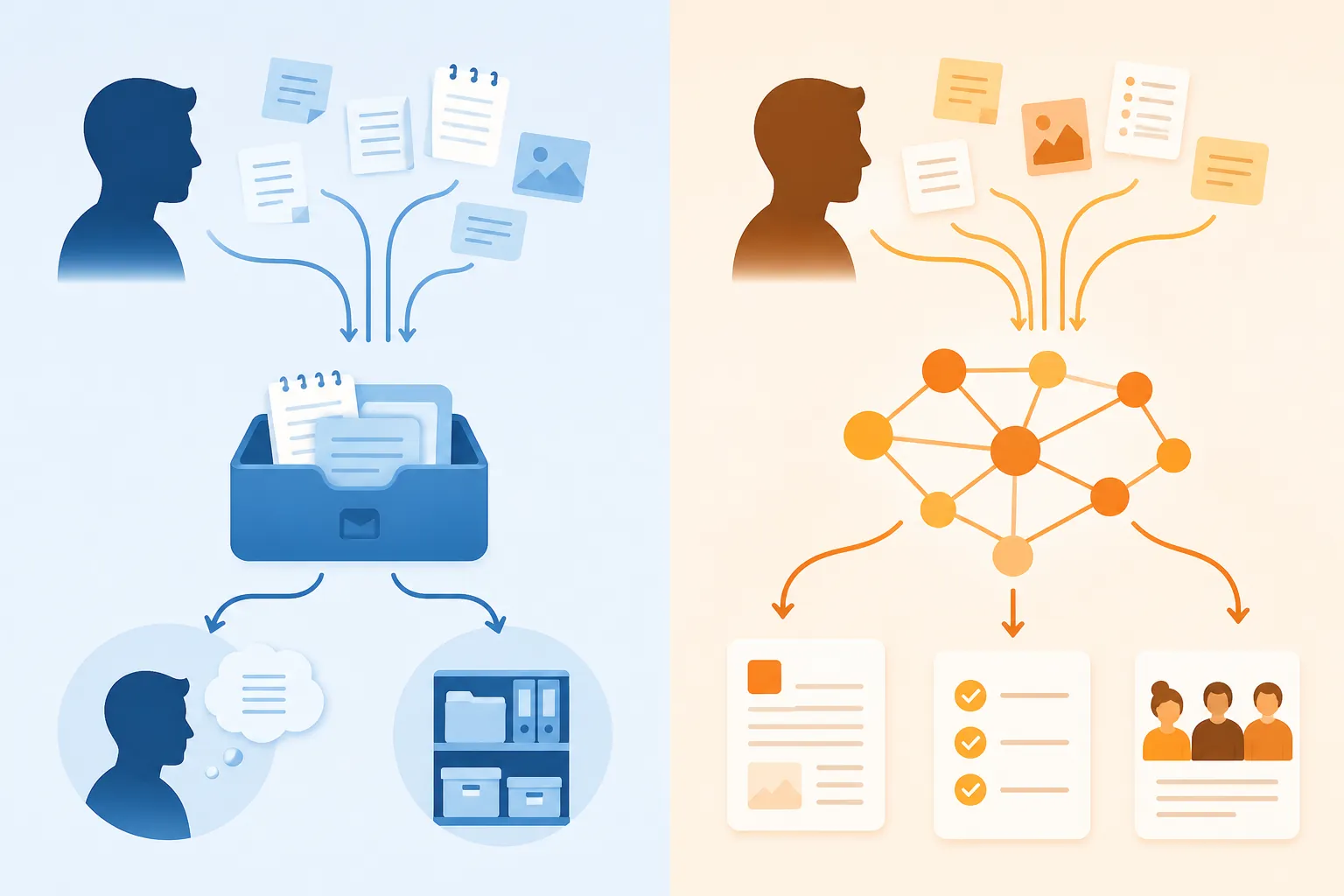
Tana, Notion AI, and Storyflow sit closer to the work-product-first side. They are more interesting when notes need to become structured material inside a shared workflow: connected nodes, project pages, briefs, tasks, summaries, or objects that another person or agent can act on. The point is not that every team should choose them. The point is that their AI value appears after capture, when raw input needs to become something with shape, ownership, and destination.
This is where Amazon’s pivot stops being tech-industry theater and becomes a useful filter. A model can be clever and still leave the customer doing cleanup. A note app can summarize beautifully and still fail the workflow if the summary has no reliable path into the systems where decisions, owners, dates, customers, and projects are tracked.
In a work-product-first setup, the important question after a meeting is not only “What did we discuss?” It is “What changed?” Did a task get assigned? Did a decision replace an open question? Did a customer objection become a CRM note? Did the research session produce a brief someone else can review? Did the project page update without forcing a second pass through the same material?
That last-mile work is where many AI notes become disappointing. The app did something. It just did not do the thing the next person was waiting for.
The honest answer may be two tools
Storyflow’s 2026 review of 12 AI note-taking apps makes a point worth separating from its own product ranking: “almost no app does all three jobs well,” referring to capture, structure, and synthesis.[10] Since Storyflow ranks its own product first, the ranking should be read as vendor content. The underlying observation still matches the market: the app that is best for fast private capture is not always the app that is best for turning notes into shared outputs.
A two-tool stack can be less elegant and more honest. One tool captures quickly. Another turns selected material into durable work products. That setup creates a migration step, which is annoying, but it can be better than forcing every thought into a team database or expecting a private notes app to behave like an operations layer.
The danger is pretending the handoff does not exist. If you capture in Apple Notes and run projects in Notion, someone must decide what moves over. If you think in Reflect but manage team work in Tana or Notion, the boundary needs to be explicit. If a meeting assistant creates a summary but the sales team works from the CRM, the useful output is not finished until the account record reflects what changed.
This is also why broad app rankings are usually less helpful than they look. The best app for a solo writer’s reading notes may be the wrong app for a customer success team. The best app for shared project memory may be too heavy for private capture. The most advanced AI feature may still be misplaced if it improves a step that was never your bottleneck.
A practical way to choose
Start by naming the failure mode you actually experience. If your notes never get written down, disappear across devices, or become impossible to find later, you have a capture and recall problem. A capture-first app is a sensible place to look. You should care about speed, mobile entry, search, resurfacing, and how little ceremony the app requires before a thought is saved.
If your notes already exist but do not become work, you have a downstream output problem. A work-product-first app deserves more attention. You should care about structure, shared spaces, task extraction, project context, permissions, integrations, and whether AI output can be reviewed and trusted by the people who inherit it.
If both problems are real, do not force the decision into one app too early. Use a two-tool stack only if the boundary is clear: what gets captured privately, what gets promoted into shared work, who performs that promotion, and what the final destination is. Without that rule, the stack becomes another inbox with better branding.
- Choose capture-first if the bottleneck is getting thoughts down quickly and finding them later.
- Choose work-product-first if the bottleneck is turning notes into shared, connected, actionable work.
- Choose a two-tool stack if private thinking and team outputs both matter, and one app forces a bad compromise.
- Be skeptical of AI demos that end before the note reaches the system where work is actually assigned, reviewed, or tracked.
Amazon’s lesson is not that frontier AI no longer matters. It is that intelligence in isolation is a poor proxy for usefulness. The same is true when choosing an AI note-taking app in 2026. The real comparison is where the note goes next.
References
- Amazon lays off workers in AGI unit — CNBC, Jul 22, 2026, link
- Amazon deprecating Nova Premier, Nova Omni, Reel, and Canvas models — Business Insider, Jul 28, 2026, link
- Amazon layoffs tied to AGI unit — Reuters, Jul 22, 2026, link
- The company that wants to power everyone else’s AI has stopped trying to build the cleverest brain itself — TNW, link
- Amazon shuts down AGI Lab after 18 months — GeekWire, Jul 22, 2026, link
- AWS announces $1B Forward Deployed Engineering program — About Amazon, link
- Amazon plans $200B in 2026 capital expenditures — CNBC, link
- 2026 Industry Benchmark — Laxis, link
- AI divide analysis — Tana, 2026, link
- 2026 review of 12 AI note-taking apps — Storyflow, 2026, link