
The first rule for how to use AI to solve complex math problems is to stop treating “AI” as one tool. A conversational model, a symbolic solver, and a verification method do different jobs. When they are collapsed into one black-box answer machine, the result can look polished while the algebra, assumptions, or numerical step underneath is wrong.
This distinction matters because large language models are built to generate likely text, not to perform symbolic mathematics by default. Stephen Wolfram’s explanation of bringing Wolfram|Alpha-style computation into ChatGPT is useful here: the language model is strong at conversation and representation, while the computational engine is built to calculate, transform, and evaluate mathematical objects directly.[1] That is why the same chat can give a graceful explanation of a theorem idea and then mishandle a derivative, a unit conversion, or a system of equations.
The safer workflow separates three roles: use a solver for computation, a tutor for reasoning and explanation, and a checker for verification. The answer is not finished when an AI says it is finished. It is finished when the result survives substitution, graphing, backsolving, a second tool, or an independent computational check.
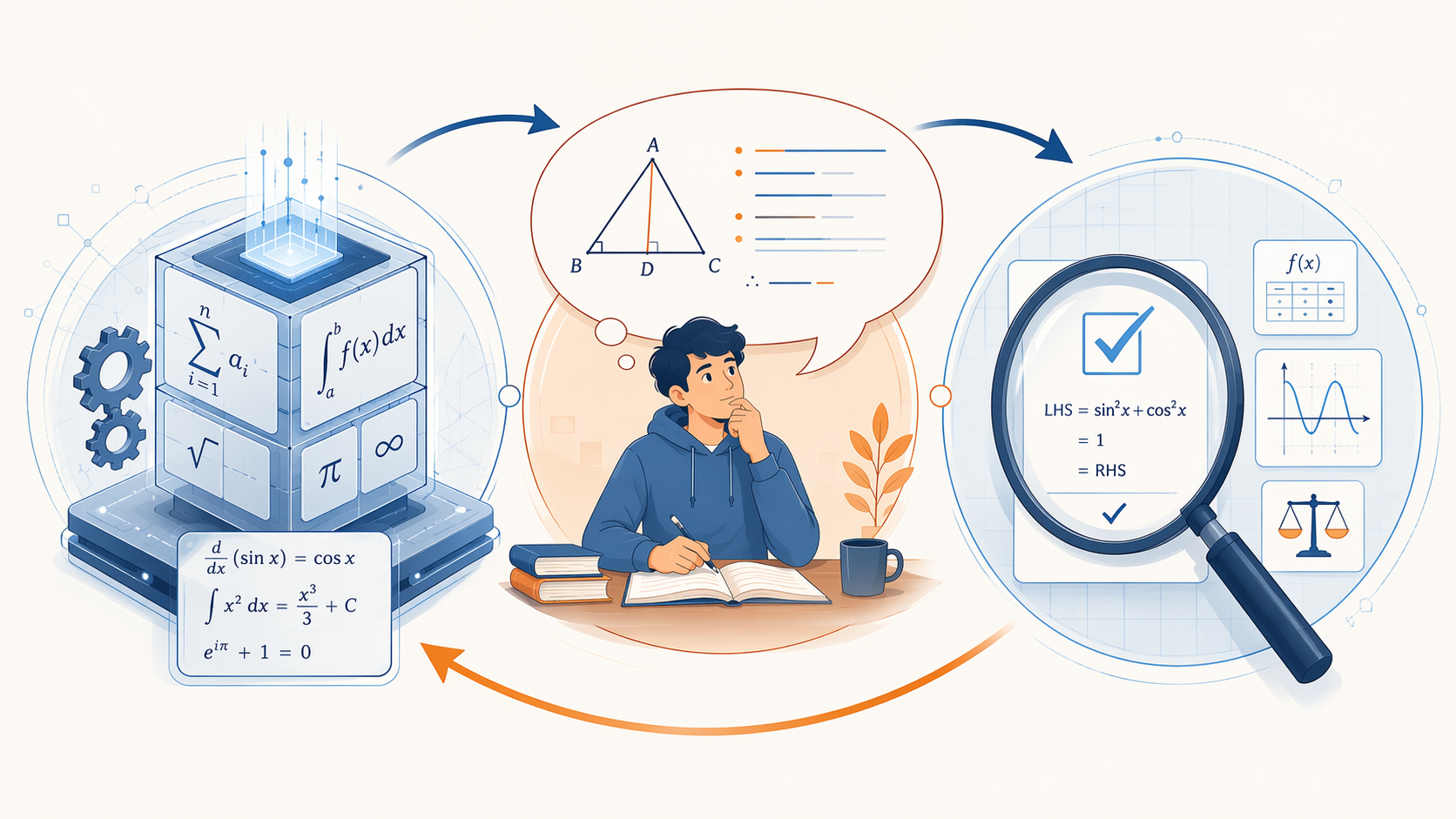
Why single-tool math solving fails
A wrong AI math answer often fails in a frustrating way: it is not obviously chaotic. It may have numbered steps, correct terminology, and a final expression in the expected form. That surface order can make the answer feel more trustworthy than a student’s own half-finished scratch work, even when the scratch work contains the better mathematical instinct.
The risk is not imaginary. One workflow guide cites a UC Berkeley study reporting hallucination rates around 27–32% on college-level math even with GPT-4, though that figure should be treated as a cited secondary claim until the original methodology, sample, and task mix are checked directly.[2] The practical lesson is narrower and more useful than panic: fluent output is not a verification method.
A 2025 study in the Journal of Pedagogical Research tested ChatGPT-4, Gemini, and Copilot on proportional-reasoning tasks. ChatGPT-4 scored highest among the tested tools with 10 correct out of 14, but the study also found that the tools reproduced common student error patterns.[3] That result is exactly the uncomfortable middle ground students actually face: good enough to be tempting, not reliable enough to submit without checking.
| Role | Best use | Bad use | Examples |
|---|---|---|---|
| Computational engine | Exact symbolic manipulation, equation solving, calculus, algebraic simplification | Explaining every conceptual choice as if it were a tutor | Wolfram Alpha, Symbolab |
| Conversational tutor | Understanding the problem, choosing an approach, explaining steps, finding possible mistakes | Acting as the only calculator for high-stakes work | ChatGPT, Claude, Gemini |
| Verification layer | Testing whether the result actually satisfies the original problem | Rubber-stamping the first answer | Substitution, graphing, Python, second solver, AI audit |
This is also why broad tool rankings are only partly helpful. If you need a general overview of categories, a broader comparison such as Best AI Tools in 2026 can help. For a hard math problem, the important question is not which product sounds most intelligent. It is whether each part of the workflow is assigned to a tool that can bear that part of the work.
Start with a plan, not a calculation
The first useful job for a conversational AI is not to produce the final answer. It is to slow the problem down before computation begins. In complex math, many errors enter before the first line of algebra: the variable is defined poorly, a constraint is missed, an approximation is used without permission, or the wrong theorem is selected.
Plan-and-Solve prompting addresses that early failure mode by asking the model to understand and plan before executing. The method is described as a way to reduce missing-step errors: first identify what is being asked, list knowns and unknowns, choose a method, then carry out the solution.[2] It does not make the model infallible. It changes the shape of the interaction so the student can inspect the route before accepting the trip.
Before solving, do not compute the final answer.

1. Restate the problem in your own words.
2. Identify the variables, constraints, and target quantity.
3. List two possible methods and choose one.
4. State any assumptions you would need to make.
5. Stop and wait for me to approve the plan.
That prompt is especially useful when the problem is long, interdisciplinary, or easy to misread. In an optimization problem, it can expose whether the model has found the actual objective function. In a differential-equations problem, it can separate the model selection step from the solving step. In a proof problem, it can reveal whether the AI is trying to prove a stronger or weaker statement than the one assigned.
Once the plan is visible, the student still has to judge it. If the AI suggests using a linear approximation, ask why that approximation is justified. If it chooses separation of variables, check whether the equation is actually separable. If it proposes induction, look for the base case and the induction hypothesis before any algebra starts.
Move computation to a tool built for computation
After the plan is approved, hand the computational part to a symbolic or numerical engine. Wolfram Alpha and Symbolab are built around mathematical computation rather than ordinary language continuation, and practical comparisons often frame them as stronger fits for exact solving while conversational models are stronger fits for tutoring and interpretation.[4]
The handoff should be explicit. Do not paste a messy paragraph and hope the solver infers the same structure you had in mind. Translate the problem into the cleanest mathematical form you can: equations, domains, parameter restrictions, requested form of the answer, and whether you need exact or numerical output.
| If the problem asks for | Give the solver | Watch for |
|---|---|---|
| Roots or solutions | The exact equation, variable, and domain | Extraneous roots, missing domain restrictions |
| A derivative or integral | The expression and variable of differentiation or integration | Constants, branch choices, simplification changes |
| A system | All equations and unknowns | Underdetermined systems, hidden assumptions |
| A numerical estimate | Precision needs, parameter values, units | Rounding, scale errors, unstable computation |
| A proof-related calculation | The algebraic subtask only | Mistaking a computed example for a proof |
A hybrid tool can reduce friction here. Wolfram’s ChatGPT integration was presented as a way to combine conversational interaction with Wolfram|Alpha’s computational knowledge system.[1] That is directionally promising, but the same discipline still applies: know when the language model is explaining and when the computational engine is calculating.
For students comparing ChatGPT, Claude, and Gemini as tutoring interfaces, the differences matter most around explanation style, context handling, and how well the model responds to correction. A model comparison such as ChatGPT Plus vs Claude Pro vs Gemini AI Pro is useful for that choice. It should not replace the solver-checker separation.
Bring the result back to the tutor
Once a solver returns an expression or numerical answer, the conversational model becomes useful again. Ask it to explain the result, interpret parameters, identify likely edge cases, and compare the answer with the original plan. This is a different request from “solve it.” The computation has already been done; the model is now being used to make the result intelligible.
Here is the solver output: [paste result].

Explain what each part of the result means.
Check whether it matches the original plan.
Identify any domain restrictions, extraneous solutions, or assumptions.
Do not invent a new answer unless you find a specific error.
This step is where AI can be genuinely helpful for learning. A solver may give a compact antiderivative, a matrix decomposition, or a family of solutions without much pedagogical context. A conversational model can unpack why the answer has that form, how to read it, and what would change if a parameter moved.
The danger is that explanation can drift away from the computed result. Keep the solver output visible. If the model starts simplifying, substituting, or deriving a parallel answer, treat that as new work that needs its own check.
Verify before you trust
Verification is not an optional polish step. It is the part of the workflow that turns an AI-assisted answer into a defensible result. A practical five-step routine is to substitute the answer back, graph or spot-check it, backsolve from the answer, compare with a second solver, and ask the AI to audit its own work.[2]
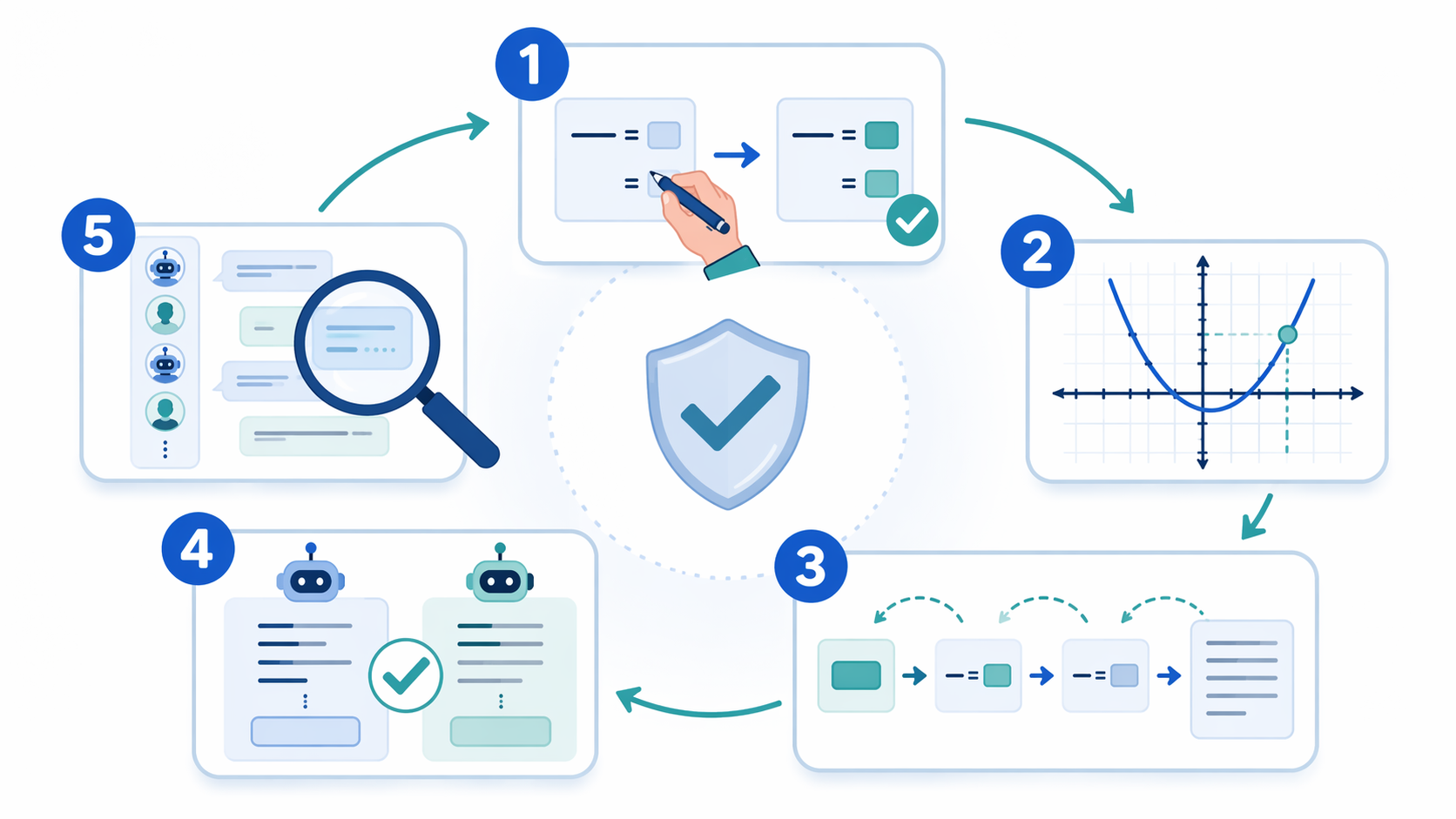
Substitute the answer back
For equations, plug the solution into the original equation, not into a simplified version created halfway through the work. For optimization, evaluate the constraint and objective. For differential equations, differentiate the proposed solution and check the original equation and initial condition. This catches many errors that a neat derivation hides.
Graph or spot-check
A graph does not prove a symbolic result, but it can expose nonsense quickly. If the computed intersection is far from where the curves meet, something is wrong. If an alleged minimum is visibly not a minimum, the derivative work needs review. If a numerical approximation behaves strangely at nearby values, precision or conditioning may be the real issue.
Backsolve from the answer
Backsolving asks whether the final result can reconstruct the given conditions. In a word problem, use the answer to regenerate the quantities in the prompt. In a linear algebra problem, multiply the proposed inverse or solution vector back through the original matrix. In a probability problem, check that probabilities stay in range and sum correctly where they must.
Compare with a second solver
A second solver is not automatically right, but disagreement is valuable. If Wolfram Alpha and Symbolab return different forms, ask whether they are algebraically equivalent, whether one includes domain restrictions the other omits, or whether one has introduced a numerical approximation. The point is not to vote. The point is to find the location of possible failure.
Ask for an audit, not reassurance
A weak audit prompt asks, “Is this correct?” A better audit prompt gives the model permission to be adversarial and specific.
Audit this solution for mathematical errors.

Focus on:
- invalid algebraic transformations
- missing domain restrictions
- extraneous solutions
- unjustified approximations
- arithmetic or sign errors

If the solution is correct, explain which checks support it.
If it is wrong, identify the first line where the error occurs.
This prompt still does not make the model an authority. It makes the model useful as a tireless reviewer. If it finds a plausible issue, verify that issue independently. If it finds nothing, the answer still needs at least one non-conversational check.
Use code when numerical verification matters
When the problem is numerical, code execution can move part of the task out of fluent text generation and into actual computation. The workflow guide emphasizes asking AI to write and run Python code as a reliability improvement, because the arithmetic, iteration, or simulation is performed by code rather than by the model’s next-token prediction alone.[2]
That shift is useful for numerical integration, matrix calculations, simulations, residual checks, and sensitivity tests. The model can draft the code; the code should do the calculation; the student should inspect whether the code matches the math.
import sympy as sp

x = sp.symbols('x')
solution = 2  # replace with the proposed solution
expr = x**2 - 4

residual = sp.simplify(expr.subs(x, solution))
print(residual)
The important number in that kind of check is often the residual: how far the proposed answer is from satisfying the original equation or condition. A residual of zero in exact symbolic arithmetic is strong evidence for a simple equation. A very small residual in floating-point arithmetic may be acceptable for a numerical method, but it should be interpreted in relation to scale, tolerance, and conditioning.
Do not let code create a new blind spot. If the AI writes code that checks the wrong expression, uses rounded constants too early, or silently changes units, the output can be precise and irrelevant. Ask the model to print intermediate values, state tolerances, and explain why the code corresponds to the original problem.
A complete AI-assisted math workflow
For an actual assignment, research calculation, or engineering estimate, the workflow can be compact. It does not require a ceremony around every problem. It does require that the final answer not come from the same unchecked channel that produced the first draft.
- Ask a conversational AI to restate the problem, identify variables and constraints, and propose a solution plan.
- Inspect the plan yourself, especially the assumptions, domain restrictions, and chosen method.
- Send the clean mathematical task to a computational engine for exact symbolic or numerical work.
- Bring the solver output back to the conversational AI for explanation, interpretation, and possible edge cases.
- Verify the result through substitution, graphing, backsolving, second-solver comparison, code execution, or an audit prompt.
- Write up the final solution in your own reasoning, citing tools only if your course, lab, or publication rules require it.
The three-role framing—solver, tutor, checker—appears in practical AI math tool guidance as a way to avoid asking one product to do incompatible jobs.[5] It is best understood as a workflow pattern, not a claim that every named product fits neatly into only one box. Some tools now blend roles. The user still has to keep the roles separate in the work.
What changes for harder math
As the math becomes more advanced, the workflow becomes more important, not less. At the graduate level or in applied research, there are fewer broad public benchmarks showing which AI tool is best across domains. Expert commentary is more common than formal evaluation. That means a confident model answer in topology, numerical PDEs, stochastic processes, or control theory deserves even less automatic trust than a standard calculus solution.
For proof-heavy work, use AI to test structure rather than to outsource judgment. Ask for possible lemmas, counterexamples, missing assumptions, or alternate proof strategies. Then verify each claim against definitions and known results. A model can suggest a path through unfamiliar territory; it cannot be the authority that the path is valid.
For engineering and computational work, preserve traceability. Keep the original equations, parameter values, units, solver settings, code, plots, and residual checks. The person who later has to defend the result needs more than a transcript that says the answer is reasonable.
For deadline work, the fastest safe path is usually not “ask one model again.” It is a short version of the same workflow: plan in chat, compute in a solver, substitute back, and run one independent check. Skipping verification saves minutes only if the answer happens to be right.
Where AI belongs in the final solution
The final write-up should not read like a pasted solver log. It should show the mathematical choices: why this method applies, how the computation follows, where restrictions enter, and how the result was checked. If AI helped explain a step, the submitted reasoning still has to be yours. If a solver produced an expression, the expression still has to satisfy the original problem.
AI can help solve complex math problems reliably when it is not allowed to be the endpoint. Use conversation to plan and understand. Use computation to calculate. Use verification to decide whether the result deserves trust.
References
- Wolfram|Alpha as the Way to Bring Computational Knowledge Superpowers to ChatGPT, Stephen Wolfram, January 2023
- Solving Math with AI — Workflow and Prompting Guide, test-ninjas.com
- Examining the potential and pitfalls of AI in problem solving, Journal of Pedagogical Research / IJOPR, 2025
- Comparing Symbolic and Generative AI: Wolfram Alpha & ChatGPT, IntuitionLabs
- Best AI for Math in 2026: Pick the Right Solver, Tutor, or Checker, laozhang.ai, 2026