
The familiar failure pattern starts before the app fails. You download a habit tracker, design a reasonable-looking routine, choose a calming color scheme, maybe set a morning reminder. For a few days, it feels like evidence that you have finally found the system. Then one day gets weird. The streak breaks. The app shows a reset, a gap, a sad little visual consequence. You stop opening it, not because you stopped caring, but because opening it now means looking at a record of another thing you did “wrong.”
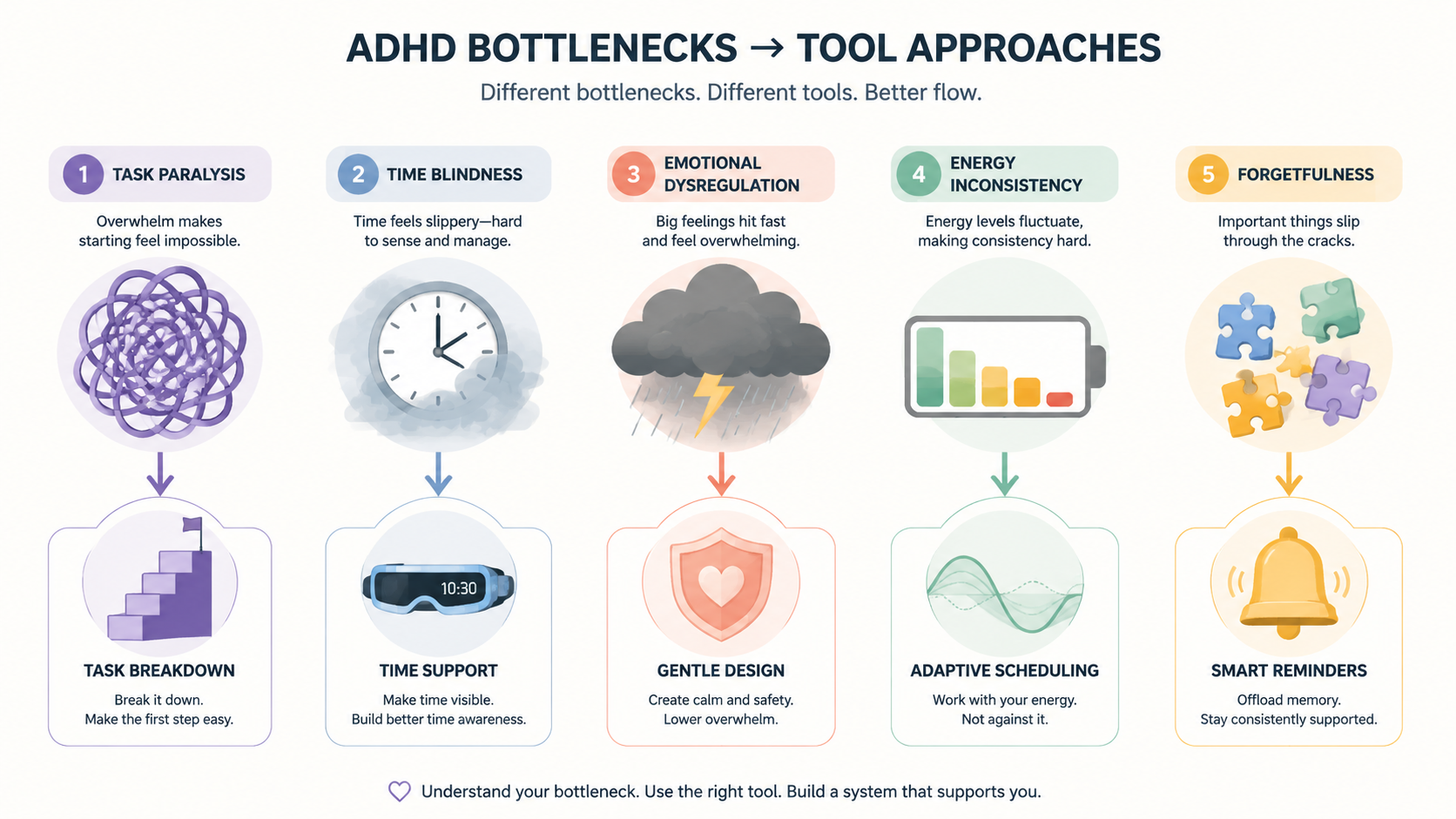
That is the problem an AI habit tracker for ADHD adults has to solve. Not “can it make a prettier checklist?” but “can it reduce the executive-function load at the exact point where ADHD usually breaks the routine?” For one person, that point is starting a vague task. For another, it is feeling time pass. For another, it is the emotional crash after missing a day.

The research gives the annoyance some shape. ADDA summarizes evidence that ADHD habit automaticity may take about 106–154 days, while also noting a much wider 18–335 day range depending on the person and the habit; the commonly cited neurotypical average from Lally and colleagues is about 66 days.[1] A tracker that treats day 12, day 21, or even day 45 as a test of character is using the wrong clock.
The best tools in this category do not win because they are “AI-powered.” They win when the AI changes the demand placed on the user: it turns the task into the first action, keeps the reminder alive without scolding, makes time visible, or adapts the day around energy instead of pretending every Tuesday has the same brain attached to it.
Start With the Bottleneck, Not the Brand
| If routines usually break because... | Start with | Why this match makes sense | Not for you if... |
|---|---|---|---|
| Tasks feel too vague to begin | Goblin.tools | It breaks an amorphous task into smaller, startable steps. | You need a full habit dashboard, calendar, or coaching program. |
| Time disappears or expands unpredictably | Tiimo | It uses visual and audio cues to support time perception. | You mainly need emotional motivation or task decomposition. |
| Shame makes you abandon the app | Finch | Its virtual pet design is gentle, and the pet does not die when you miss habits. | Gamification feels infantilizing or distracting. |
| Energy changes too much for fixed routines | Lifestack | It emphasizes energy-aware scheduling rather than rigid daily timing. | You want a simple tracker, not a planning system. |
| You forget to start even after deciding | Sprout | Its Nag Mode and persistent reminders are built around initiation and follow-through. | Repeated reminders feel invasive or increase anxiety. |
| You want education with the tracker | Inflow | It combines CBT-based skill-building with AI coaching and tracking. | You want a lightweight utility rather than a structured program. |
| Subscription cost is the first barrier | Saner.AI | It is positioned as a free ADHD app suite. | You need mature long-term outcome data before trusting a newer tool. |
If you are also comparing broader AI productivity software, the decision logic is similar: match the tool to the failure point, not to the longest feature list. A broader framework for that kind of choice is here: AI productivity apps compared by use case.
Why Streaks Break So Many ADHD Habit Systems
Streaks are not neutral decoration. A 2016 CHI conference paper discussed in Mad In America found that people abandon habit trackers because of streak dependency, not simply because they get bored.[2] That matters for ADHD because a missed day is rarely processed as clean information: “the reminder system failed,” “the task was too big,” or “the cue was badly placed.” It often lands as a verdict.
The same Mad In America critique cites PLOS ONE research placing emotional dysregulation prevalence in ADHD at 34–70%.[2] That range is wide, but the practical point is narrow and useful: for many ADHD adults, perceived failure can trigger shutdown. A broken streak may not create motivation; it may create avoidance.
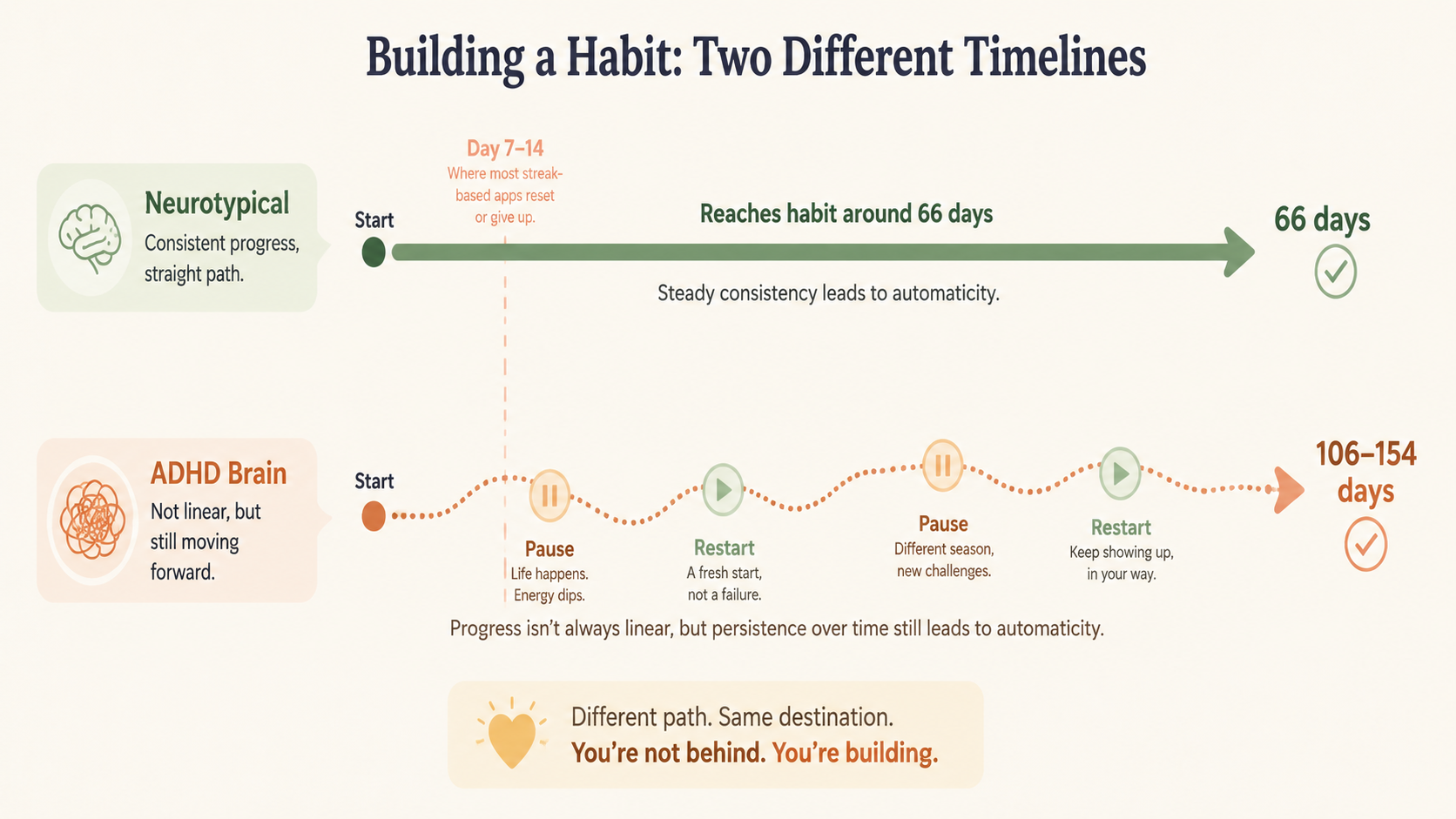
This is why the 106–154 day ADHD habit-formation estimate is so important without being a magic number.[1] It does not mean every ADHD adult needs exactly that long. It means inconsistency should be assumed in the design. The tool should expect restarts, pauses, forgotten check-ins, and uneven energy as part of the route, not as exceptions.
Goblin.tools: Best When the Task Is Too Vague to Start
Goblin.tools is the clearest match for task paralysis. Its value is not that it tracks a habit beautifully; it is that it can take “clean the kitchen,” “answer that email,” or “plan the appointment” and turn the blob into steps. CHADD identifies Goblin.tools as one of the AI tools that can help people with ADHD break down tasks and reduce planning friction.[3]
That makes it useful before a habit tracker even has something trackable. If “exercise three times a week” keeps failing because the first action is unclear, the tracker is not the first problem. The first problem is translation: what counts as starting, where the shoes are, what happens if the full workout is impossible, and what the smallest acceptable version looks like.
- Best fit: adults who freeze when a task has too many implied steps.
- Use it for: task breakdown, first-step generation, lowering activation energy.
- Not for you if: you want habit analytics, coaching, calendar planning, or streak alternatives inside one polished app.
- Pricing/platform note: verify current web and app-store options before paying; regional pricing may vary.
Tiimo: Best When Time Is the Thing You Cannot Feel
Tiimo is the better starting point when the problem is time blindness rather than motivation. Its strength is visual and audio support: routines become something you can see progressing instead of something you are supposed to hold in working memory. In ADHD terms, that is not cosmetic. It moves time from invisible background pressure into a visible cue.
This distinction matters because many habit trackers remind you once and then silently record the miss. Tiimo is more useful for the person who sincerely meant to start, looked up, and discovered that the morning had disappeared. If your habits fail because you cannot sense the transition between “soon,” “now,” and “too late,” prioritize time representation before motivational language.
- Best fit: adults who lose track of duration, transitions, or routine sequence.
- Use it for: visual schedules, audio cues, time scaffolding.
- Not for you if: your main barrier is emotional shame, budget, or task decomposition rather than time perception.
- Pricing/platform note: check current plan availability in your region before subscribing.
Readers who need time support beyond habit tracking may also want the broader comparison of time management software moving beyond surveillance.
Finch: Best When Motivation Has to Be Gentle
Finch is the tool I would look at first for emotional dysregulation and shame-sensitive habit building. Productive Fish reports Finch at a 4.9-star rating from more than 325,000 ratings, which is adoption and satisfaction evidence, not proof that it changes ADHD outcomes.[4] Still, the design choice matters: the virtual pet is encouraging, but it does not die when you miss a habit.
That small mercy is not small for the right user. A lot of habit apps make accountability feel like a tiny courtroom. Finch feels more like a soft landing pad. If a broken streak makes you avoid the app for three weeks, the emotional design is not a bonus feature; it is the accommodation.
- Best fit: adults who quit trackers after feeling judged, behind, or embarrassed.
- Use it for: gentle check-ins, self-care habits, mood-linked routines, low-shame motivation.
- Not for you if: virtual pets feel distracting, childish, or like another relationship to maintain.
- Pricing/platform note: verify current free and paid features before building your system around a premium function.
Lifestack: Best When Your Energy Is Not Predictable
Lifestack is aimed at a different failure point: the fantasy that a routine should happen at the same time with the same level of energy every day. Its habit-planner positioning emphasizes scheduling around energy rather than forcing every task into a fixed slot.[5]
That can be useful for ADHD adults whose routines do not fail because they forgot the plan, but because the plan was written for a version of themselves who is not available today. A rigid tracker says the habit is due at 7:00 a.m. An energy-aware planner asks whether the task belongs in a high-energy, medium-energy, or low-energy part of the day.
The caution is maturity. Several newer ADHD-oriented tools from the 2024–2026 wave do not yet have strong long-term retention data in the public material available for this comparison. Lifestack may be a promising match for energy inconsistency, but it should not be treated as proven to produce durable habit change.
- Best fit: adults whose capacity changes sharply across the day or week.
- Use it for: adaptive planning, energy-aware scheduling, deciding when a habit belongs.
- Not for you if: you want a tiny tracker with minimal setup, or if planning itself becomes procrastination.
- Pricing/platform note: check current pricing and platform support directly before subscribing.
Sprout: Best When Forgetting to Start Is the Pattern
Sprout’s most relevant idea is persistence. Its own ADHD habit-tracker writing emphasizes Nag Mode, shame-free progress, and reminders that keep working after the first ignored notification.[6] That is a real design distinction for people who do not need one polite ping; they need the cue to survive distraction.
A persistent reminder can be an accommodation or a torment, depending on the person. If reminders help you re-enter the task without self-attack, Sprout is worth a look. If repeated alerts make you feel hunted by your phone, this is exactly the kind of feature to avoid, however ADHD-friendly the copy sounds.
Sprout also publishes the claim that 57% of ADHD apps lose more than 40% of users within two weeks.[6] I would treat that as an industry heuristic rather than a peer-reviewed benchmark unless a primary source is provided. The broader point still holds: early abandonment is common enough that a tracker’s first two weeks deserve scrutiny.
- Best fit: adults who decide on a habit, then repeatedly forget to initiate it.
- Use it for: persistent reminders, task initiation, reducing silent missed check-ins.
- Not for you if: repeated notifications raise stress, create avoidance, or feel like being managed by a tiny supervisor.
- Pricing/platform note: newer-tool pricing and features can change quickly; verify the current plan before relying on a specific mode.
Inflow: Best When You Want Skills, Not Just Tracking
Inflow belongs in a different mental category from a lightweight habit app. CHADD describes Inflow as an AI-supported option for ADHD that combines coaching-style support with skill-building, and Inflow’s own 2026 app guide positions it around ADHD education and structured support.[3][7]
That makes it a better fit for someone who wants to understand the pattern behind the missed habit. If the question is “why do I keep building impossible mornings?” or “how do I change the environment around this routine?” a program with CBT-based education may help more than another checkbox.
The tradeoff is weight. Structured education asks for attention, time, and trust. If you are already overloaded, a coaching app can become another course you are behind on. Inflow is more appealing when you have some appetite for learning and reflection, not only a need for a reminder at 8:30.
- Best fit: adults who want ADHD-specific skill-building alongside tracking.
- Use it for: CBT-informed learning, coaching prompts, understanding recurring habit breakdowns.
- Not for you if: you need a fast, low-friction utility and will avoid anything that feels like homework.
- Pricing/platform note: confirm current subscription terms before joining, especially if cost affects whether you will keep using it.
If subscription cost is part of the decision, compare the habit app against the actual routine it replaces. For a wider cost-benefit approach, see which AI productivity apps actually pay for themselves.
Saner.AI: Best When Budget Is the Constraint
Saner.AI is the budget-conscious pick because its own review of free ADHD apps positions Saner.AI as a free ADHD app suite for adults.[8] That matters. A tool that requires a subscription before you know whether the system fits your brain can become another paid guilt object.
The fair caution is the same one that applies to several newer AI-native tools: free access and promising positioning are not the same as demonstrated long-term effectiveness. Use Saner.AI when the first need is reducing cost and experimenting safely, not when you require the most mature evidence base.
- Best fit: adults who want to test ADHD-oriented AI support without committing to another subscription.
- Use it for: low-cost experimentation, ADHD app-suite features, deciding what support you actually use.
- Not for you if: you prefer a tool with more public long-term retention data or a narrower, highly polished use case.
- Pricing/platform note: verify that the features you need remain free at the time you sign up.
The Compliance-Machine Test
The sharpest critique of this whole category is that many ADHD apps are compliance machines: they dress up monitoring as care, then ask the user to become more consistent for the app’s benefit. Mad In America made that argument directly in March 2026, criticizing ADHD habit-tracking apps for enforcing a disease-model view of the user.[2]
That critique should not be waved away just because an app has AI. AI can make a tool more accommodating, but it can also make the nagging more personalized, the coaching more opaque, and the productivity guilt more fluent. The useful question is simple: after using the app, is there less executive-function load, or merely more evidence that you failed to comply?
| Accommodation | Compliance-machine version | Better version |
|---|---|---|
| Reminder | One alert, then a missed-habit mark | Persistent or flexible cues that help you re-enter without shame |
| AI coaching | Generic motivational language after failure | Specific next action, smaller scope, or environmental adjustment |
| Progress | Streaks that reset to zero | Cumulative progress, restarts, or non-punitive history |
| Planning | Fixed ideal schedule | Energy-aware or context-aware timing |
| Gamification | Rewards that become another obligation | Playful cues that lower friction without punishment |
This is also where “not for you if” matters. A tracker can be excellent and still wrong for your nervous system. Persistent reminders help one person and overwhelm another. A pet companion softens shame for one user and creates pressure for another. A structured coaching program can clarify patterns or become a second inbox of unfinished lessons.
Why This Comparison Keeps Changing
The ADHD app market is moving quickly. Pretty Progress cites projections that the ADHD apps market will grow from $1.8 billion in 2025 to roughly $5.6–6.7 billion by 2033–2034.[9] Market growth does not prove better outcomes. It does mean the tool landscape is unstable: features, prices, and platform support can change faster than old “best app” lists can keep up.
That is why I would treat this as a starting-point comparison, not a permanent ranking. The safest decision is to pick one bottleneck, test one tool against that bottleneck, and ignore the rest until you know whether the point of failure has moved.
Which One Should You Try First?
Choose based on the moment your routine usually breaks:
- If you cannot start because the task is a fog, try Goblin.tools first.
- If you lose time or miss transitions, try Tiimo first.
- If shame makes you abandon trackers, try Finch first.
- If your energy changes too much for fixed routines, try Lifestack first.
- If you forget to initiate even after deciding, try Sprout first.
- If you want ADHD education and coaching with tracking, try Inflow first.
- If cost is the blocker, try Saner.AI first.
For a more general adoption sequence across AI tools, the AI productivity app decision framework can help you avoid stacking too many systems at once.
AI habit trackers are useful for ADHD adults only when they accommodate inconsistency instead of enforcing consistency with friendlier copy. The best tool is the one that removes your most predictable point of failure first.
References
- Building Habits With ADHD: Time it Takes & How to Succeed — ADDA — add.org/building-habits/
- The Compliance Machine: How ADHD Habit-Tracking Apps Enforce the Disease Model — Mad In America — March 2026 — madinamerica.com/2026/03/the-compliance-machine-how-adhd-habit-tracking-apps-enforce-the-disease-model/
- Harnessing Artificial Intelligence to Live Better with ADHD — CHADD — chadd.org/adhd-news/adhd-news-adults/attention-monthly-harnessing-artificial-intelligence-to-live-better-with-adhd/
- Best Habit Tracker Apps: 10 Tools Backed by Research (2026) — Productive Fish — productive.fish/blog/habit-tracking/
- Best Habit Tracker Planner Apps in 2026 — Lifestack — lifestack.ai/blog/habit-tracker-planner
- ADHD Habit Tracker: Why Most Fail and How to Find One That Works — Sprout Blog — sproutapp.tech/blog/adhd-habit-tracker
- The 12 Best Apps for ADHD in 2026 — Inflow — getinflow.io/post/best-apps-for-adhd
- Free ADHD Apps for Adults: We reviewed the best 8 apps — Saner.AI — saner.ai/blogs/free-adhd-apps-for-adults
- Top 10 ADHD Motivation Apps to Try in 2026 — Pretty Progress — prettyprogress.app/blog/adhd-motivation-app