
The mistake is not choosing the platform with fewer features. The expensive mistake is choosing a marketing automation workflow tool that looks affordable in the demo and then becomes awkward, capped, or financially hard to defend once real campaigns and real contact volumes arrive.
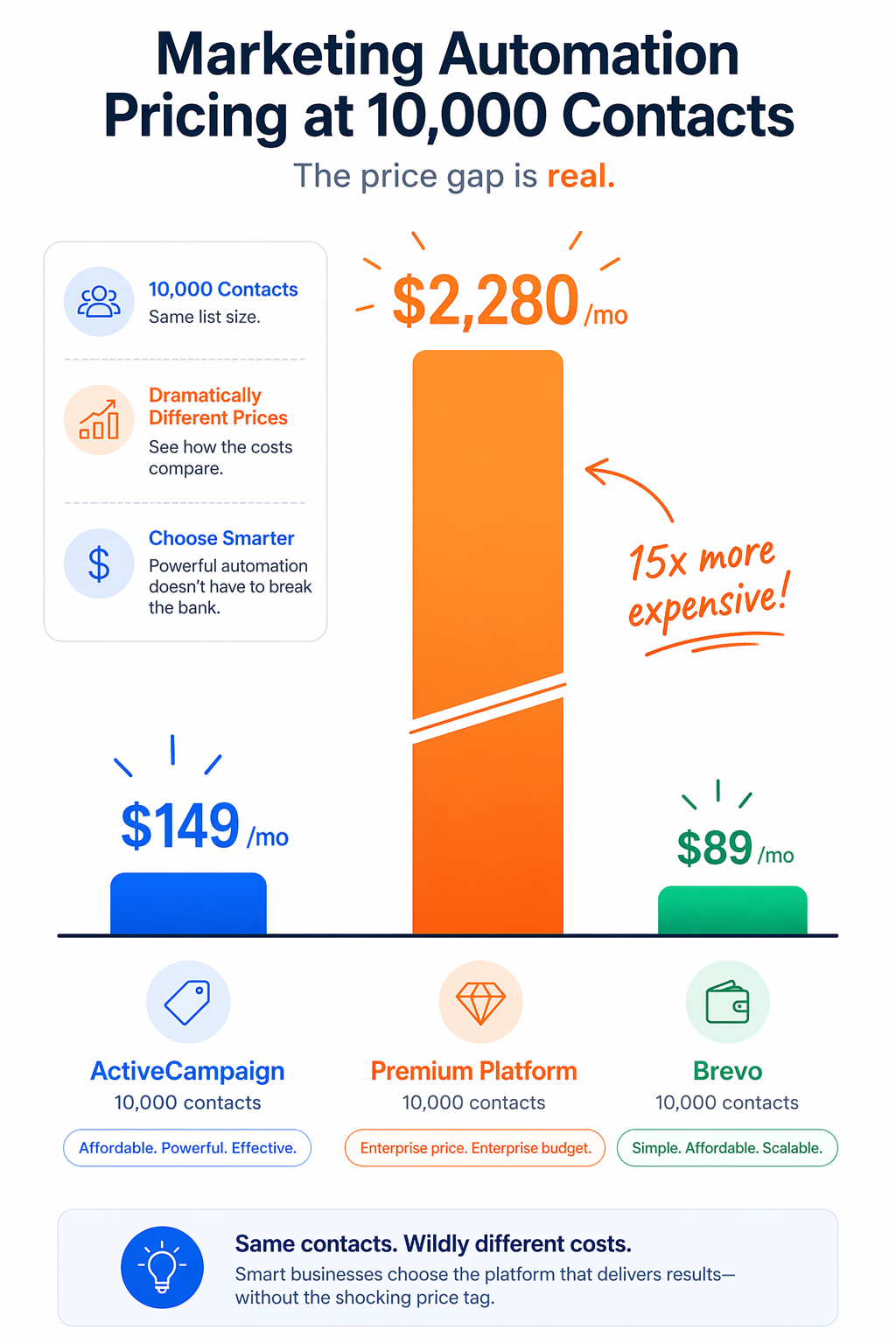
At 10,000 contacts, the comparison gets sharp fast: ActiveCampaign is listed at $149 per month on Starter, while HubSpot Professional is listed at roughly $2,280 per month for comparable workflow capabilities, a gap of about 15x before the operational differences even enter the room. HubSpot Professional also carries a mandatory $3,000 onboarding fee and a 12-month commitment, which puts the first-year floor at $12,600 or more before contact scaling is fully accounted for.[1]
That is why the practical verdict should come early. ActiveCampaign is the default winner for teams that need deep automation without committing HubSpot-level budget. HubSpot wins when CRM polish, revenue attribution, sales alignment, and executive reporting are valuable enough to justify the cost structure. Brevo is the sensible low-cost choice for simpler email volume, but it is not the tool I would pick for complex customer journeys unless the team has very modest workflow needs.
Last verified for this article: June 28, 2026, against the cited third-party comparison materials. Pricing, plan limits, onboarding rules, and AI packaging in this category move often, so the final buying step should still be a direct check against each vendor’s current pricing page.
The Short Version
| Platform | Best fit | Six-month surprise to check before buying |
|---|---|---|
| ActiveCampaign | Teams that need branching journeys, testing, predictive sending, and strong automation value | Plan packaging still matters; confirm which automation, AI, CRM, and sending features are included at your contact volume |
| HubSpot | Teams that need CRM-native marketing, sales handoff, attribution, and executive reporting in one polished system | Professional pricing, mandatory onboarding, and annual commitment can turn a marketing tool decision into a major budget line |
| Brevo | Teams sending simpler campaigns at low cost, especially where email volume matters more than journey complexity | Daily sending caps can turn a monthly allowance into a constraint during campaign bursts |
Marketing automation is worth taking seriously because the upside is real. One 2026 statistics roundup reports that 76% of marketers see positive ROI within 12 months, automated emails generate 320% more revenue than manual sends, and 52% cite data quality as their biggest obstacle.[2] Another reports that 91% of organizations see increased internal demand for automation, while only 9% of marketers say they have fully automated customer journeys.[3]
Those numbers explain the buying pressure. They do not make the decision for you. A team can buy a strong platform and still fail if the CRM is messy, lifecycle stages are undefined, or the sending plan does not match how campaigns actually go out.
Pricing At Scale Is The First Workflow Feature
Price is not separate from workflow depth. It decides whether the marketing team can experiment, whether lifecycle campaigns get built this quarter or postponed, and whether every new automation requires a budget conversation.
ActiveCampaign’s 10,000-contact pricing is the cleanest example of why it keeps showing up as the value pick. At $149 per month for Starter in EmailToolTester’s comparison, it sits far below HubSpot Professional’s roughly $2,280 per month at the same contact count.[1] The exact plan match will depend on which features a team needs, but the order of magnitude is the point. You can make a few imperfect tests inside ActiveCampaign without feeling like every experiment has to justify a board-slide line item.
HubSpot’s jump from Starter to Professional is the part teams often underestimate. Venture Harbour reports HubSpot Starter at $15 per seat per month and Professional at $890 per month plus a $3,000 onboarding fee, describing the move as roughly a 59x increase with no middle tier.[4] That does not make HubSpot a bad product. It makes it a product that needs a clearer business case than “we want better email automation.”
The onboarding fee matters because it changes the first-year conversation. A team evaluating HubSpot Professional is not just approving a monthly subscription; it is taking on a setup cost and a 12-month commitment. EmailToolTester lists mandatory onboarding at $3,000 for Professional and $7,000 for Enterprise.[1] If the company already has sales operations discipline, clean pipeline stages, and leadership that will actually use attribution reports, that cost may be rational. If marketing is mainly trying to send better lifecycle email, it is easy to buy more platform than the operation is ready to absorb.
Brevo sits in a different lane. Its appeal is affordability for email volume, and that can be exactly what a smaller team needs. The catch is the daily sending cap: EmailToolTester notes that the monthly allowance is divided by 30 days, which can create real pain during campaign bursts.[1] A monthly number can look generous until a launch, renewal push, webinar reminder sequence, or seasonal sale needs more sends on a specific day.
That cap is not a theoretical procurement footnote. It is the kind of limit that appears at 8:40 a.m. when a campaign is approved, the audience is loaded, and someone realizes the tool will not send the planned volume today. If your campaigns go out evenly, Brevo’s structure may be fine. If your business runs on bursts, the cap belongs in the buying decision.
What The Workflow Builder Actually Lets You Do
A marketing automation workflow starts to reveal the product’s real character once it has more than three steps. A welcome email is easy. A journey that changes by source, product interest, sales status, page behavior, email engagement, and time since last activity is where the builder either helps the team think clearly or forces workarounds.
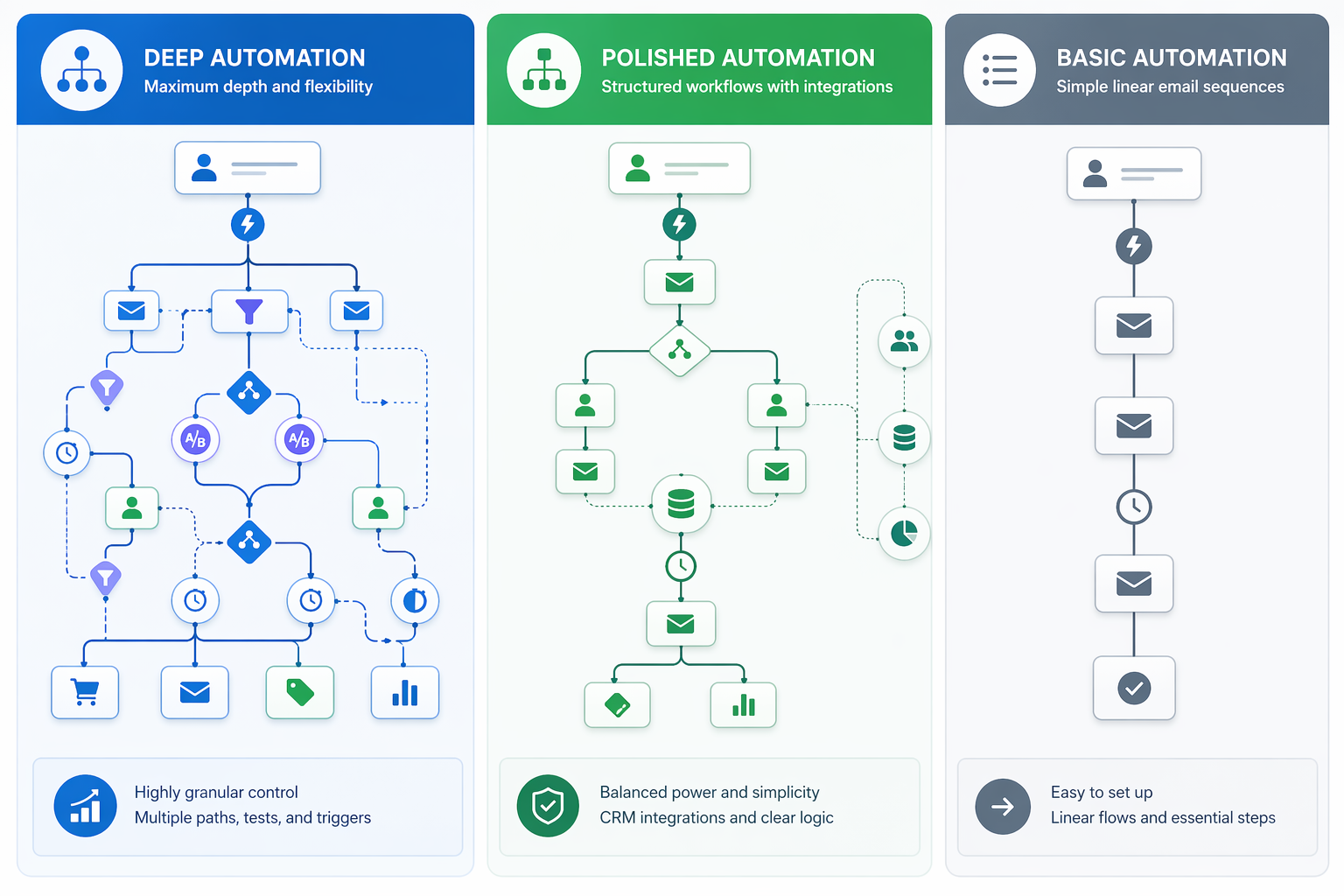
ActiveCampaign’s case is strongest here. Venture Harbour credits it with more than 135 triggers, conditional branching, the ability to split-test entire automation paths, and predictive sending, while noting that some comparable capabilities sit behind HubSpot Enterprise at $3,600 per month or more.[4] Those are not vanity features if the team is trying to build behavior-based journeys instead of linear drips.
The split-testing point deserves attention. Testing subject lines is useful, but testing a whole path is different. It lets a team compare journey logic: whether a lead should get a sales task before a nurture sequence, whether a case study should come before a product invite, whether waiting two days works better than waiting five. That is the level where automation stops being a scheduled email chain and starts becoming an operating model for customer movement.
Predictive sending also matters more than it sounds on a feature grid. If a platform can use engagement patterns to send when a contact is more likely to open, the team gets optimization without building a separate timing matrix by segment. Venture Harbour identifies predictive sending as part of ActiveCampaign’s automation depth.[4] The operational value is not magic; it is fewer manual rules for a lean team to maintain.
HubSpot’s workflow builder has a different center of gravity. It is most compelling when the workflow is tied to CRM records, sales handoff, lifecycle stage changes, and attribution. A lead becomes an opportunity, a deal moves stages, a sales owner needs context, and marketing wants to show which campaigns touched revenue. When those objects are properly maintained, HubSpot feels less like an email tool and more like the central revenue system.
That last clause is doing a lot of work. HubSpot rewards teams that can keep the CRM clean. If sales does not update deals, if lifecycle stages are political instead of operational, or if campaign governance is loose, the beautiful reporting layer will not rescue the implementation. The invoice will still arrive.
Brevo is easier to justify when the workflow is simple: capture a lead, send a sequence, apply basic segmentation, and keep email costs under control. That is a legitimate use case. It becomes weaker when the buyer expects sophisticated branching, multi-path testing, deeper CRM behavior, or many conditional journeys running at once. Brevo is the affordability pick for simpler email-volume needs, not the strongest choice for complex customer journeys.
Lead Nurturing And CRM Handoff
For lead nurturing, ActiveCampaign gives the marketing team more room to build logic without moving into enterprise pricing. A practical nurture might branch by lead magnet, product interest, page visits, email engagement, and whether a sales conversation has started. The advantage is not just that these paths can exist; it is that a small team can keep editing them as it learns.
HubSpot is better when the handoff itself is the high-stakes moment. If sales leadership wants a single view of source, contact history, deal stage, owner activity, and campaign influence, HubSpot’s CRM polish earns its reputation. That is especially true when marketing is being judged on pipeline and revenue contribution rather than campaign engagement alone.
The caution is that CRM attribution is only as credible as the data underneath it. The broader automation data is blunt on this point: 52% of marketers cite data quality as their biggest obstacle.[2] A team buying HubSpot mainly for attribution should budget time and ownership for CRM hygiene, not just onboarding.
Brevo can support straightforward nurturing, but I would not make it the center of a sales-and-marketing handoff process if the business depends on complex qualification logic or detailed pipeline attribution. It can be enough for a business that primarily needs email follow-up. It is less convincing as the operating layer between marketing activity and sales accountability.
Campaign Bursts Are Where Limits Stop Being Abstract
Most teams do not send in a perfectly even line. They launch products, run promotions, announce events, push renewals, follow up after webinars, and send reminders close together. That is why Brevo’s daily cap deserves more attention than it usually gets in comparison grids.
A company may have enough monthly allowance for its audience on paper, but if that allowance is divided into daily limits, a three-email launch week can still run into a cap. The marketing lead then has to split audiences, delay sends, upgrade, or explain why a campaign approved for today cannot fully go out today.
ActiveCampaign and HubSpot should still be checked for sending rules, contact tiers, and plan-specific limits before purchase. But the Brevo cap is especially important because it changes the meaning of volume. Monthly affordability is less useful if the business needs concentrated sending power.
Deliverability And AI Are Secondary, But Not Minor
Deliverability should not be treated as a decorative metric. EmailToolTester reports ActiveCampaign at a 94.2% inbox placement rate.[1] That does not guarantee the same result for every sender, because list quality, consent practices, content, and domain reputation still matter. It does mean ActiveCampaign has a strong enough deliverability result to support its value argument.
AI is harder to judge cleanly because packaging and claims are moving quickly. Venture Harbour describes ActiveCampaign’s Active Intelligence as learning from account historical data and writing style, while EmailToolTester notes that HubSpot’s Breeze Copilot is accessible on free and Starter tiers but limited in depth.[1][4] That makes the AI comparison less about whether a button exists and more about whether the assistant has useful context and enough permissions to reduce real work.
For most small and mid-size teams, AI should not outrank workflow depth, CRM fit, pricing, and deliverability. A capable assistant can speed up copy, segmentation ideas, and reporting drafts. It cannot compensate for a journey builder that cannot model your customer path or a CRM nobody maintains.
Where Each Platform Can Be The Wrong Choice
ActiveCampaign is not for you if
- Your executive team expects CRM-native reporting, sales attribution, and polished revenue dashboards more than flexible journey building.
- Your sales process already lives deeply in HubSpot and replacing that operating rhythm would create more cost than the subscription savings.
- Your team wants the broadest all-in-one CRM suite more than a strong automation builder at a lower price.
HubSpot is not for you if
- The team mainly needs email automation and cannot clearly justify Professional pricing, onboarding fees, and a 12-month commitment.
- Your CRM data is unreliable and nobody owns the cleanup work required to make attribution trustworthy.
- You need room to experiment with automation logic without making every new workflow feel expensive.
Brevo is not for you if
- Your campaigns depend on burst sending and daily caps would interfere with launch timing.
- You need complex branching, path testing, predictive sending, or deep CRM-connected journeys.
- The business is trying to automate the full customer journey, not just send affordable email sequences.
The Buying Decision
Choose ActiveCampaign if your main problem is building a serious marketing automation workflow at a price a small or mid-size team can live with. It is the strongest default for branching journeys, automation experimentation, predictive sending, and practical value. It gives a lean team the most room to build before the tool choice becomes a finance issue.
Choose HubSpot if the CRM is the center of the business and marketing automation has to plug into sales reporting, attribution, lifecycle governance, and executive visibility. The product can justify its cost when the organization is ready to use the whole system. It is much harder to justify when the actual need is just better lifecycle email.
Choose Brevo if affordability and straightforward email volume matter more than deep workflow logic. It is a reasonable choice for simpler sequences and cost-sensitive sending, provided the daily cap does not clash with how your campaigns actually run.
Before signing, re-check four things directly: your real contact count, the exact plan that unlocks the workflow features you need, onboarding or commitment rules, and sending limits during your busiest campaign days. Most bad platform decisions are not caused by missing a feature in a demo. They are caused by discovering too late which limits apply when the team finally starts using the tool as intended.
References
- ActiveCampaign vs HubSpot Detailed Comparison 2026 — EmailToolTester
- 39 Marketing Automation Statistics and Trends for 2026 — GTM 8020
- 39+ Major Marketing Automation Statistics to Know in 2026 — EmailVendorSelection
- 7 Best Marketing Automation Software (2026) — Venture Harbour