
Two people can say they “don’t have time to invest” and mean completely different things. One means the money never quite makes it from checking into an investment account. The other has investable cash, but the thought of choosing funds, checking allocations, and rebalancing the account keeps getting pushed to next weekend.
That distinction matters more than the usual Acorns vs. Fidelity Go robo advisor comparison. Acorns saves time by automating the saving habit. Fidelity Go saves time by automating portfolio management. Both can remove a meaningful amount of investing admin from the year, but they remove different chores from the calendar.
A reasonable working estimate is that automated investing can spare a DIY investor roughly 5–20 hours per year of research, fund selection, and portfolio maintenance. Treat that as a useful planning range, not a guaranteed personal stopwatch result; someone with a single index fund and a calm temperament may save less, while someone who repeatedly opens tabs, compares funds, and still postpones the decision may save more.[1]
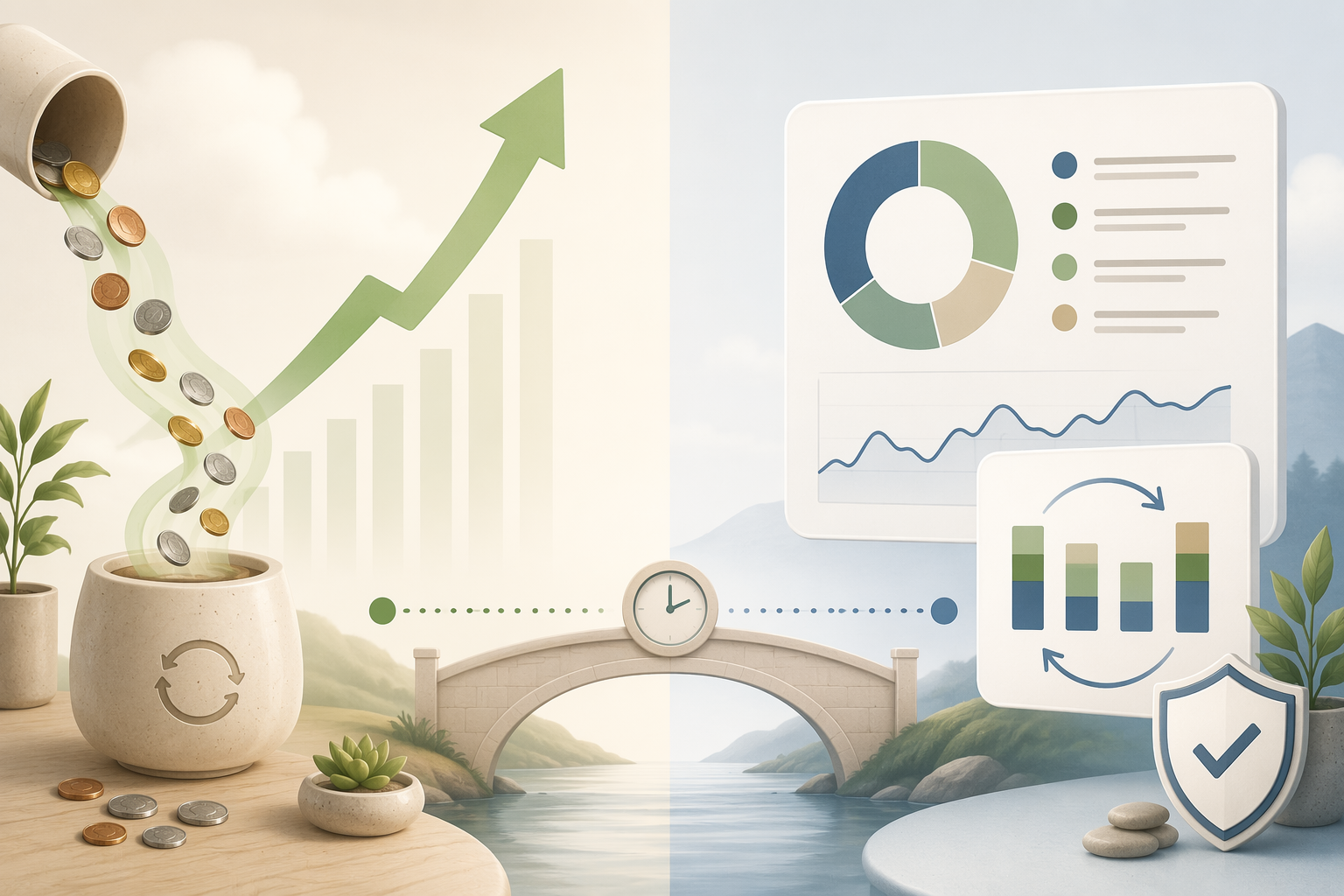
The fast decision scaffold is simple: choose Acorns if the recurring failure is getting money invested consistently; choose Fidelity Go if the recurring failure is managing the portfolio once the money is available. If both are true, start with the bottleneck that causes the most procrastination, not the one that looks more sophisticated.
The time savings start in different places
Acorns begins with a small behavioral trigger: link a card, choose a portfolio, and let Round-Ups invest spare change from everyday purchases. The setup is roughly a five-minute task, and the important part is not the five minutes. It is what happens afterward: the next coffee, grocery run, or rideshare can become an investing prompt without adding a reminder, spreadsheet, or Sunday-night transfer ritual.
Acorns has said its customers invested an average of about $45 per month through Round-Ups, based on company customer data as of July 2025.[2] That figure is not a promise; it depends on spending patterns, linked cards, and account settings. But it makes the productivity case concrete. The value is not that $45 is magical. The value is that the transfer can happen in the background after the account is configured.
Fidelity Go starts with a different kind of setup. The user answers a questionnaire, Fidelity Go recommends and builds a portfolio, and the account is managed on an ongoing basis. Fidelity describes the process as taking only a few minutes; roughly ten minutes is a reasonable expectation for the questionnaire-to-invested path.[3] Again, the setup time is not the main story. The main story is that fund selection, allocation decisions, and rebalancing move out of the user’s task list.
| If this is the recurring problem | The better time-saving fit | Why |
|---|---|---|
| You keep meaning to invest but do not make the transfer | Acorns | Round-Ups and recurring investments turn saving into a background behavior |
| You have cash to invest but avoid choosing funds | Fidelity Go | The questionnaire and managed portfolio remove fund-selection work |
| You dislike checking whether your portfolio drifted | Fidelity Go | Automated rebalancing and Strategic Advisers oversight handle maintenance |
| You need small prompts that survive a busy month | Acorns | Purchases and scheduled deposits become the triggers instead of willpower |
Acorns is strongest when the bottleneck is consistency
The most useful Acorns feature is not that it feels easy on day one. Many financial apps feel easy on day one. The useful part is that Round-Ups do not ask the user to keep recommitting. Once enabled, everyday spending can create repeated investment activity without a fresh decision each time.
That solves a very specific time leak: the tiny administrative delay between “I should invest” and “I actually moved money.” It is not dramatic. It is the checking-account glance, the mental math, the postponed transfer, the vague intention to do it after payday. A traditional investing reviewer may treat that as a soft feature. In real working life, it is often the whole problem.
Round-Ups are only one part of the Acorns automation stack. Recurring Investments can add scheduled contributions, which matters for anyone who does not want to make a monthly calendar event out of dollar-cost averaging. Acorns Gold also includes Money Manager, which can split one deposit across investing, saving, and spending buckets instead of asking the user to run several separate transfers each month.[4]
This is where Acorns earns its place in a productivity comparison rather than only a finance comparison. It is not trying to make the user better at reviewing portfolios. It is trying to make the act of contributing less dependent on attention. For the person whose investing plan collapses every time work gets busy, that is not cosmetic.
The limitation is just as important. Acorns does not provide human advisors or tax-loss harvesting.[5] It also does not eliminate every portfolio-management question for someone with more complex needs. If the real source of friction is “I do not know whether my allocation still fits my goal,” Round-Ups alone will not answer that. Acorns can keep money flowing into an investment account; it is less compelling as a full substitute for advice or tax-aware portfolio work.
Fidelity Go is strongest when the bottleneck is portfolio maintenance
Fidelity Go removes a different set of tasks. Instead of building a habit engine around purchases, it asks for information upfront and then manages the portfolio. Fidelity says Fidelity Go accounts are invested in Fidelity Flex mutual funds that do not charge fund-level expense ratios, and portfolios are monitored and rebalanced as needed.[3]
The oversight also matters. Fidelity Go is managed by Strategic Advisers LLC, a Fidelity affiliate. That means portfolio decisions are not simply a consumer app responding to a slider; a professional investment team is responsible for the managed account process.[3] This is not the same as having a dedicated personal advisor assigned to every account, and it should not be described that way. At balances of $25,000 or more, Fidelity Go provides access to one-on-one coaching calls.[3]
The time saved here is the annual or quarterly maintenance loop: checking whether stocks and bonds have drifted, deciding whether to rebalance, wondering whether the chosen funds still make sense, then putting off the trades because nothing feels urgent. Fidelity Go is built for the person who already has the money but does not want investment maintenance to become another recurring project.
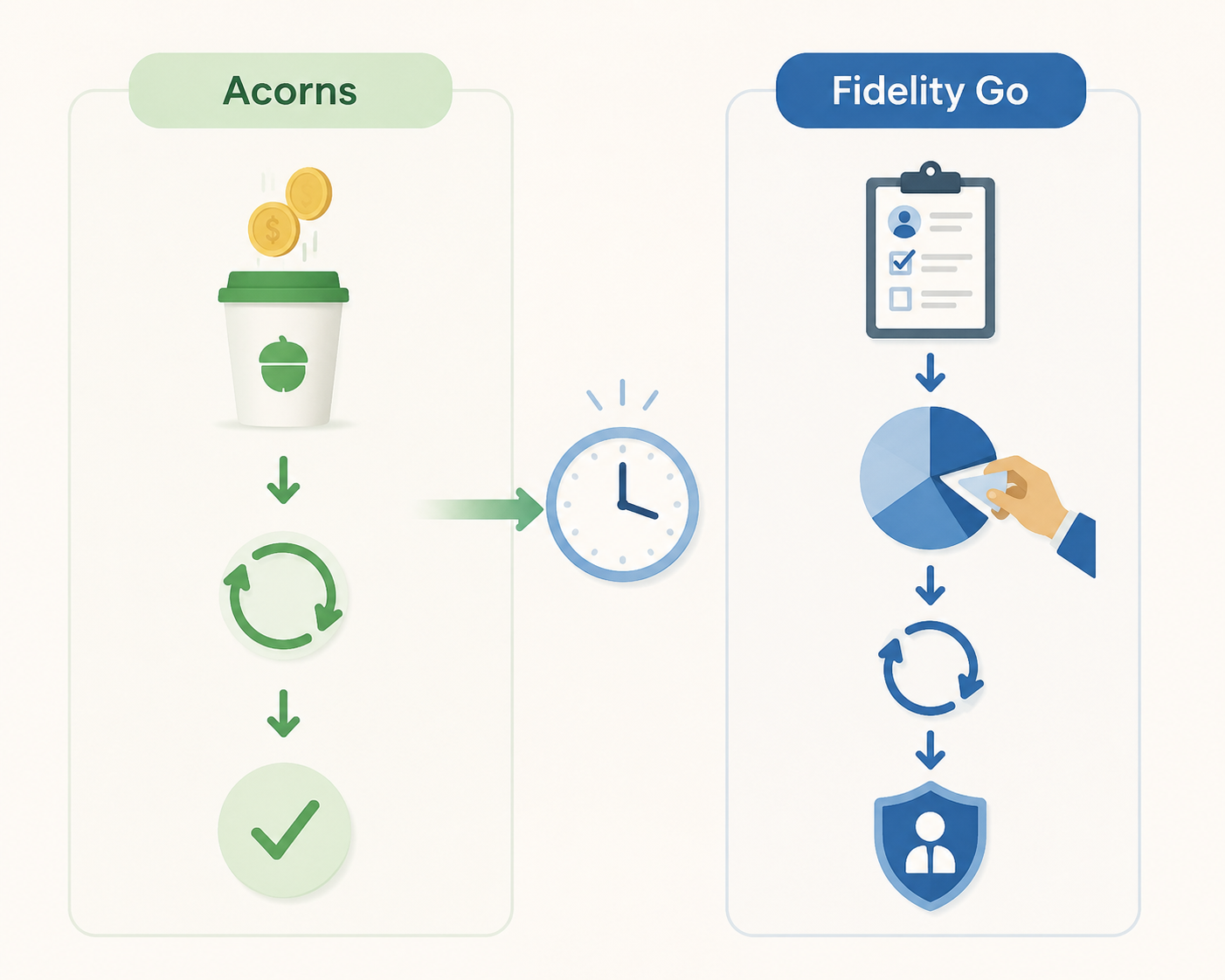
That makes Fidelity Go more convincing for someone who dreads portfolio housekeeping than for someone who simply forgets to contribute. It can manage the money that reaches the account. It will not round up a lunch purchase, convert spare change into deposits, or create a saving habit out of daily spending. If the money never arrives, the managed portfolio has less to manage.
This comparison also excludes Fidelity’s self-directed brokerage. Fidelity as a company offers far more than Fidelity Go, but the relevant product here is the robo-advisor service. A self-directed brokerage can be powerful; it can also hand the user back the exact research and rebalancing work this article is trying to measure.
Fees are easier to judge after the workflow is clear
A fee table by itself can make Acorns look expensive at small balances and make Fidelity Go look obviously cheaper. Sometimes that is the right conclusion. But the more useful question is narrower: what behavior are you paying to remove, and would you otherwise do it?
At a $5,000 balance, Acorns Bronze at $3 per month costs $36 per year, or an effective 0.72% of assets. Fidelity Go charges $0 for balances under $25,000.[3][4] At that balance, Fidelity Go is hard to beat on price if the goal is managed investing. The flat-fee structure is the catch with Acorns: the smaller the account, the heavier the percentage equivalent feels.
The same flat fee looks different at higher balances. At $50,000, the $36 annual Bronze fee works out to about 0.07% of assets. That does not make Acorns the right tool for every $50,000 account, but it does show why flat subscriptions should not be judged only from the smallest-balance example.
Acorns Gold complicates the calculation further for IRA users. Acorns describes a 3% IRA match on eligible contributions for Gold subscribers, capped by the first $7,500 in contributions; that example produces a $225 match against a $144 annual Gold subscription, or $81 ahead before market returns.[4] The conditions matter: the match applies under Acorns’ first-year subscription and holding-period rules, and matched contributions generally must remain invested for at least four years or they may be subject to recapture.[4]
So the fee-as-time-cost question is not “Which app has the prettier price?” It is closer to: if this service prevents several hours of avoided investing work, missed transfers, or portfolio-checking dread, is the annual cost lower than the value of the attention it returns? For a small account and a user who already contributes reliably, Fidelity Go’s $0 tier may be the cleaner answer. For someone whose main leak is not contributing at all, a low-cost managed portfolio does not fix the leak.
Where the automation stops
Acorns and Fidelity Go both reduce investing friction, but neither turns personal finance into a fully closed loop. Acorns can automate deposits, Round-Ups, and recurring investment behavior, but it does not provide tax-loss harvesting or human advisors.[5] Fidelity Go can handle portfolio construction and rebalancing, but it does not include Acorns-style Round-Ups or spare-change saving triggers.[3][5]
Both also still require some initial honesty. A questionnaire cannot know your comfort with risk if you answer aspirationally. A Round-Up feature cannot create meaningful progress if you never link the spending card you actually use. Automation is excellent at repeating a chosen behavior. It is less useful when the chosen behavior is vague.
There is also a scale issue. A new investor with a modest balance may care most about making contributions happen. A busier professional with accumulated cash may care more about preventing a portfolio from becoming another neglected system. The same person can move from one problem to the other over time.
Which one saves more time?
Acorns saves more time when investing fails at the habit layer. If the recurring issue is that payday arrives, work gets busy, and the transfer never happens, Acorns has the more relevant automation. Round-Ups, recurring investments, and deposit-splitting features are designed to reduce the number of moments when the user has to remember, decide, and act.
Fidelity Go saves more time when investing fails at the management layer. If the money is available but the drag is fund research, allocation choices, and rebalancing, Fidelity Go removes more of the work that would otherwise become an annual or quarterly maintenance task. Its strongest productivity case is not novelty; it is professional portfolio upkeep that keeps happening when the user stops thinking about it.
The honest diagnostic is not “Which robo-advisor is better?” It is: where does your investing workflow actually break? If the answer is “I do not start or contribute consistently,” Acorns is the better time-saver. If the answer is “I do not want to manage the portfolio once the money is there,” Fidelity Go is the better time-saver.
References
- Automate Your Savings, Fidelity
- Acorns Review 2026, NerdWallet
- Fidelity Go, Fidelity
- Is Acorns Worth It?, Acorns
- Best Robo-Advisors 2026, NerdWallet