
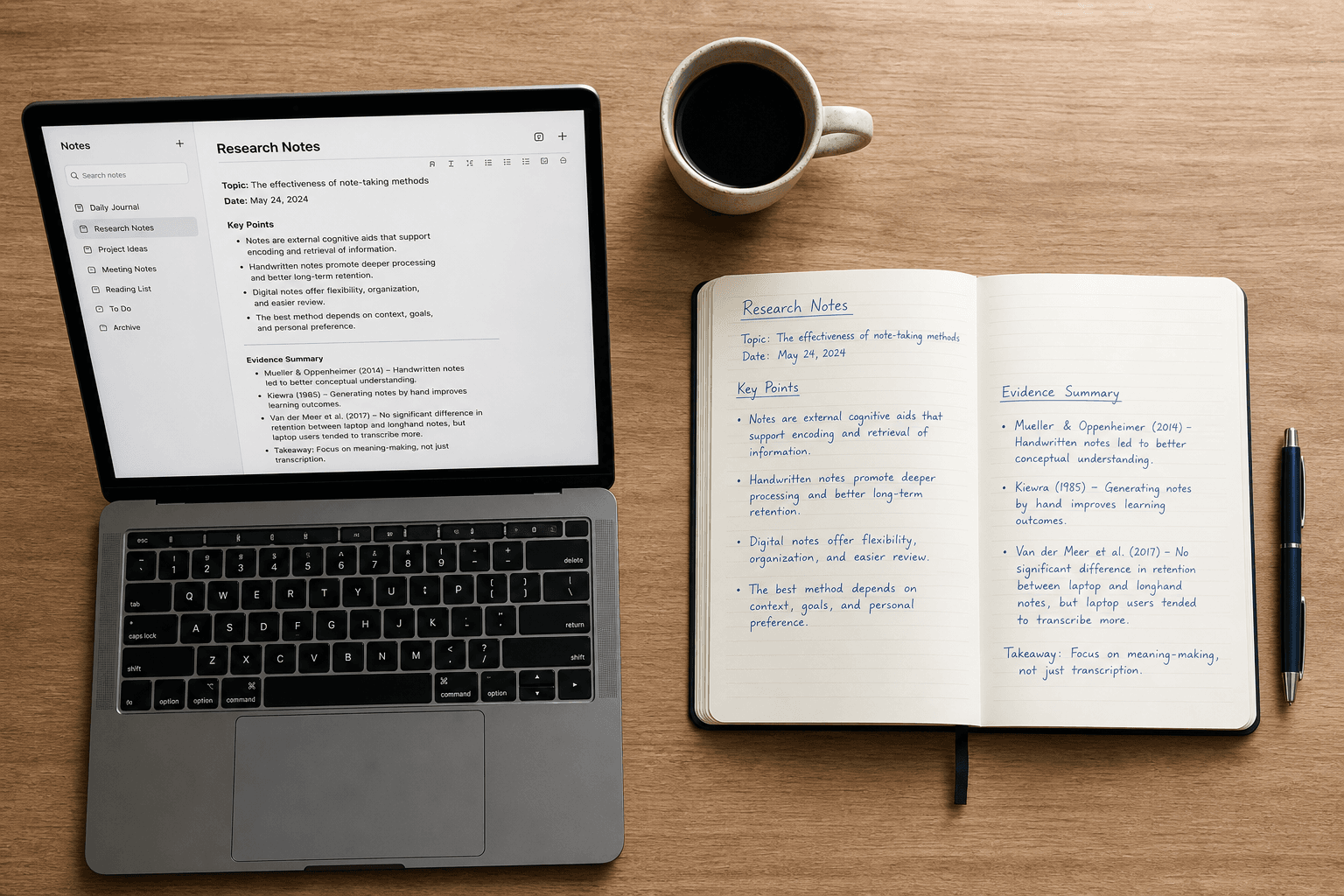
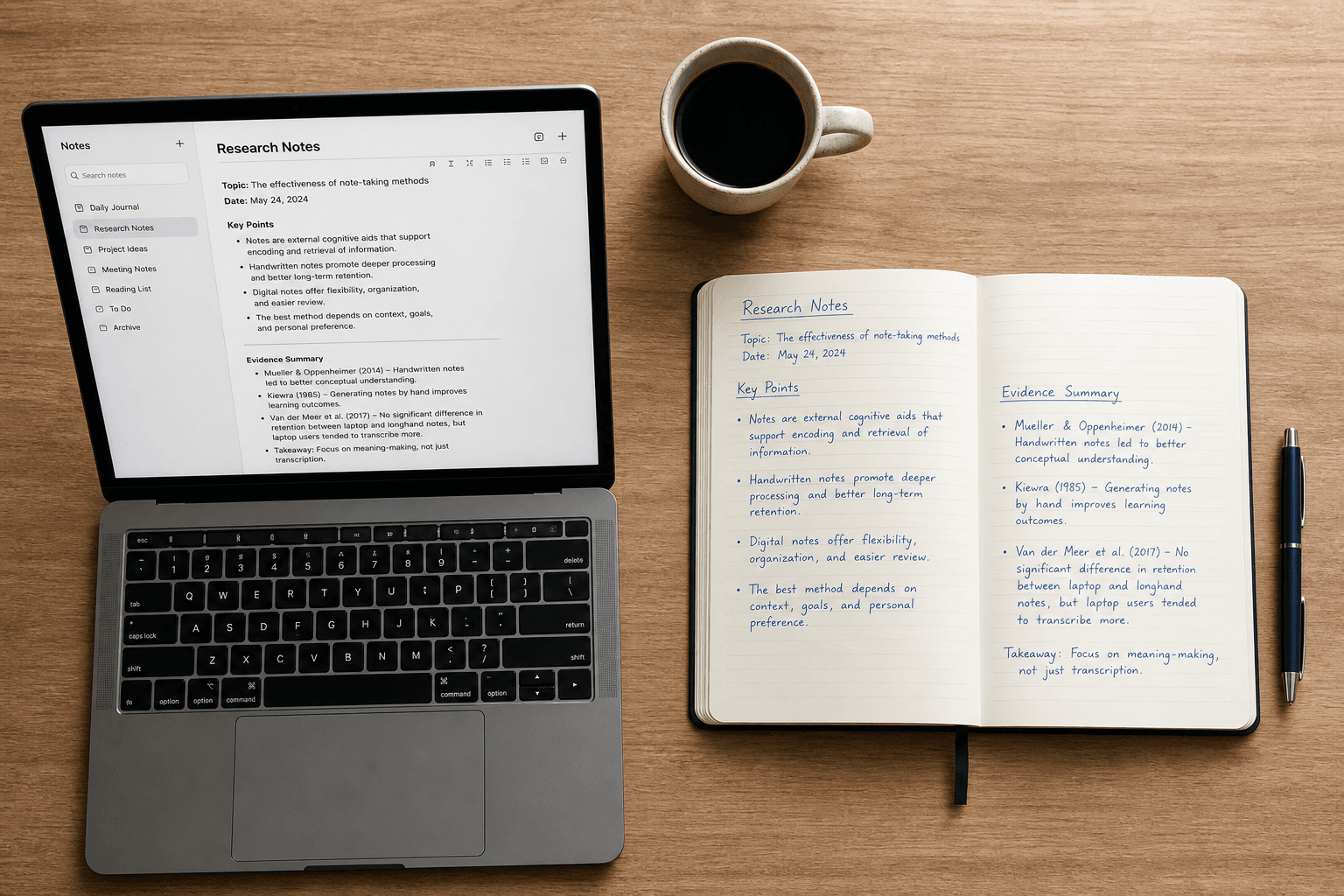
Introduction: The Guilt of the Laptop Note-Taker
If you've ever sat in a lecture hall, laptop open, fingers flying across the keyboard, and felt a quiet pang of guilt — you're not alone. A single study published in 2014, titled "The Pen Is Mightier Than the Keyboard," has been cited thousands of times in popular media and academic circles, creating a widespread belief that handwriting is inherently superior to typing for learning. The message was simple: students who wrote by hand performed better on conceptual questions than those who typed. Case closed, right?
Not quite. The full body of research tells a more complicated story — one that doesn't let laptop note-takers off the hook entirely, but also doesn't demand they abandon their keyboards. The real differentiator, as it turns out, has less to do with how you capture information and far more to do with what you do with it afterward.
The Viral Study and Its Limits
The Mueller and Oppenheimer (2014) study is the foundation of the pro-handwriting argument. In three experiments, the researchers found that students who took handwritten notes outperformed laptop note-takers on conceptual questions. The explanation was intuitive: typing encourages verbatim transcription, which bypasses the cognitive processing that handwriting supposedly forces. The study was published in a top-tier journal, covered by every major news outlet, and became the go-to citation for anyone arguing that laptops should be banned from classrooms.
But the study had a significant methodological limitation that is rarely mentioned in popular coverage. As the McGill University Office for Science and Society points out in its analysis, two of the three experiments did not allow students to review their notes before being tested. That's a critical omission. In real academic settings — midterms, finals, professional certification exams — students almost always have the opportunity to study their notes before the test. The study measured immediate recall without review, which does not reflect how learning actually happens.
This doesn't mean the study's findings are worthless. It means they are incomplete. The question isn't whether handwriting is better than typing in a vacuum — it's whether the advantage holds when students are allowed to study their notes, and whether the advantage is consistent across different types of content and different learning contexts.
What Subsequent Research Found
Follow-up studies have painted a more nuanced picture. One of the most important counterpoints comes from Bui (2013), which directly challenged the assumption that verbatim note-taking is always detrimental. Bui found that students who took verbatim notes on a computer and were allowed to study them actually performed better on a quiz than students who had studied concept-driven notes. In other words, the quality of the notes you study matters more than how you captured them.
Subsequent research by Luo, Fiorella, and others has further qualified the original findings. These studies suggest that the advantage of handwriting is context-dependent — it appears more consistently in certain types of learning tasks (conceptual synthesis, diagram-heavy subjects) and disappears or reverses in others (fact-dense material, fast-paced lectures where typing speed is an advantage).
| Study | Key Finding | Implication for Laptop Note-Taking |
|---|---|---|
| Mueller & Oppenheimer (2014) | Handwriting outperformed typing on conceptual questions when no review was allowed | Limited real-world applicability — most students review notes before exams |
| Bui (2013) | Verbatim laptop note-takers who studied their notes outperformed concept-driven note-takers | Reviewing typed notes can be more effective than studying handwritten summaries |
| Luo & Fiorella (multiple studies) | Handwriting advantage is context-dependent — varies by subject and task type | No single method is universally superior; match the method to the material |
The consistent thread running through all of this research is not about capture method at all. It's about review. Across every study, the students who reviewed their notes — regardless of whether they were typed or handwritten — performed better than those who did not. The act of revisiting, organizing, and elaborating on your notes after the lecture is the single most impactful step in the learning process.
Students Already Know This: The 2019 Survey
While the academic debate continues, students themselves have already figured out what works. A 2019 survey of a few hundred undergraduates, cited by the McGill University analysis, found that 74% of students adapt their note-taking method to the specific class they are in. The same student who pulls out a pen and notebook for organic chemistry will open their laptop for a history lecture. This intuitive adaptation reflects an understanding that different subjects demand different capture strategies — an insight that the popular science narrative around the 2014 study has largely ignored.
A 2019 survey of undergraduates found that 74% take notes differently depending on the class — organic chemistry benefits from pen, history from typing.
This finding is important for two reasons. First, it validates the idea that context-dependency is not just a theoretical concept from research papers — it's a practical reality that students experience daily. Second, it suggests that the guilt laptop note-takers feel is largely manufactured by a simplified media narrative, not by the actual evidence. Students who type their notes in a history lecture are not making a mistake; they are making a reasonable choice based on the demands of the material.
How Tablets and AI Tools Blur the Line
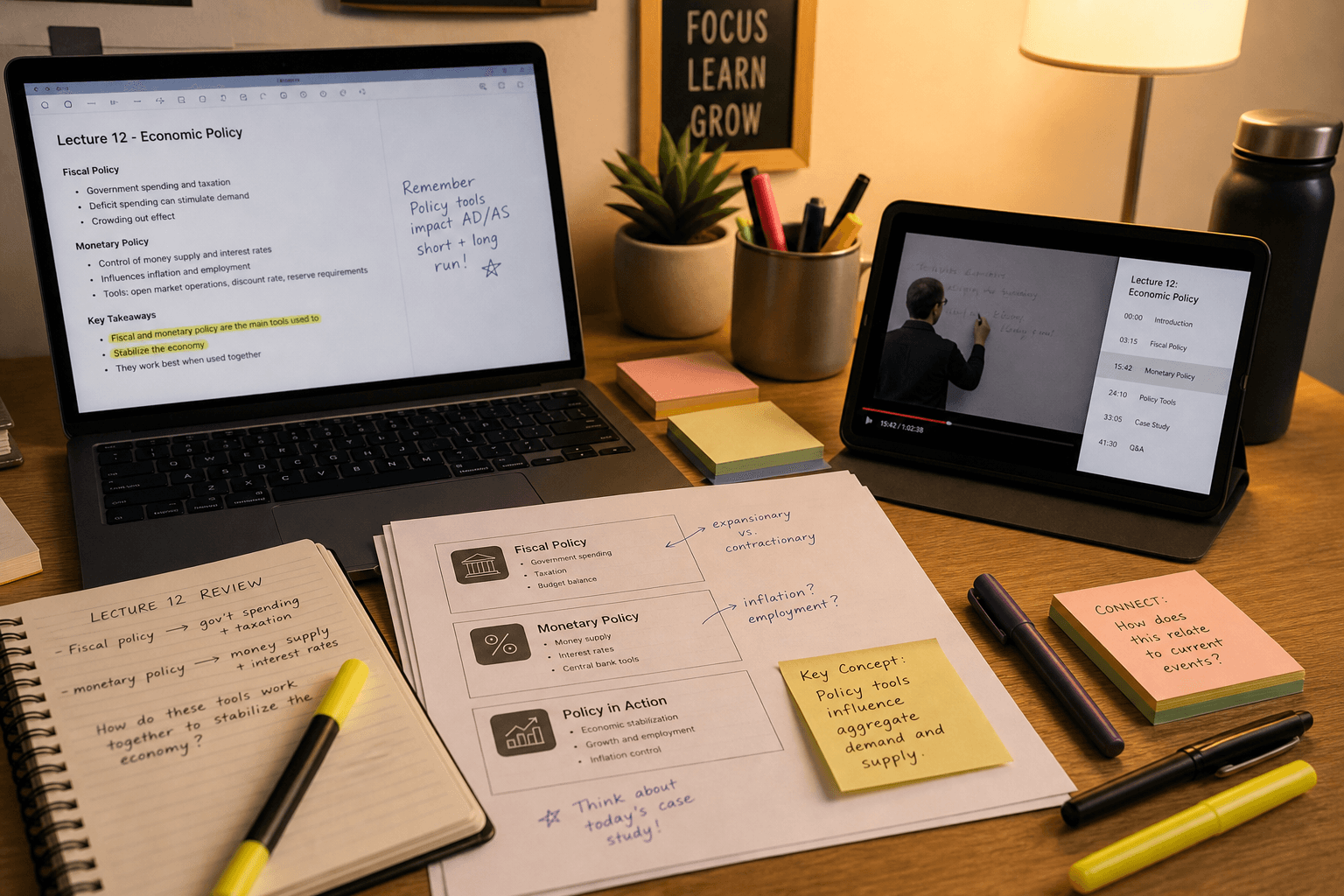
The laptop vs. pen debate has also been complicated by the rise of hybrid tools that combine the best of both worlds. Modern tablets with stylus support allow you to type, handwrite, draw diagrams, and annotate lecture slides — all within the same app. This is not a compromise between two methods; it's a genuinely new category of note-taking that didn't exist when the 2014 study was conducted.
For a detailed walkthrough of how to set up a modern hybrid system, see our Complete iPad Pro Note-Taking System guide, which covers hardware, apps, and a methodology that combines typing, handwriting, and audio recording into a single workflow.
AI tools have further blurred the line. Real-time transcription services can capture every word a lecturer says, freeing you to focus on understanding rather than transcription. AI summarization tools can then condense those transcripts into structured notes, effectively giving you the benefits of both verbatim capture (completeness) and conceptual processing (organization). When combined with manual annotation and review, these tools create a workflow that outperforms either pure typing or pure handwriting.
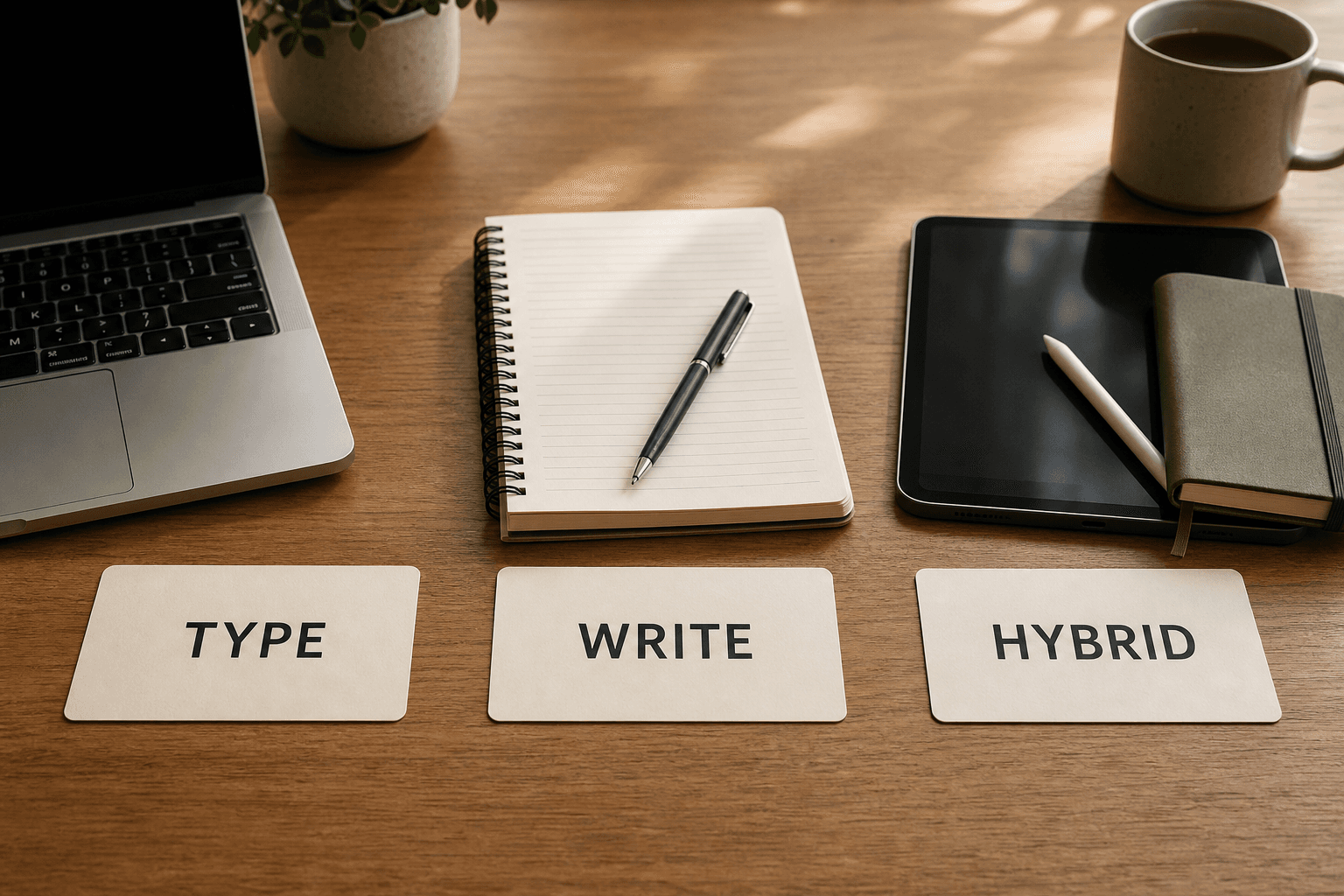
A Practical Framework: When to Type, When to Write, When to Hybrid
Based on the full body of research, here is a practical decision framework for choosing your note-taking method. The key principle is simple: match your capture method to the demands of the material, and prioritize review above all else.
| Scenario | Recommended Method | Why |
|---|---|---|
| Fast-paced lecture with dense factual content (e.g., history, biology) | Type on laptop | Typing speed allows you to capture more information accurately; review later compensates for any lack of on-the-fly processing |
| Concept-heavy subject requiring synthesis (e.g., philosophy, organic chemistry) | Write by hand or use stylus on tablet | Slower capture forces you to rephrase and connect ideas in real time, which aids conceptual understanding |
| Lecture with provided slides or handouts | Hybrid: type notes on laptop + annotate slides by hand | Typing captures the lecturer's elaboration; handwritten annotations on slides create visual connections and summaries |
| Technical or diagram-heavy content (e.g., engineering, anatomy) | Write by hand or use tablet with stylus | Diagrams, equations, and flowcharts are difficult to capture accurately with typing alone |
| Review session before an exam | Any method — focus on active recall and elaboration | The capture method matters far less than what you do with the notes: summarize, test yourself, and connect ideas |
For a structured approach to reviewing and organizing your notes after capture, see our guide on How to Build a Personal Knowledge Management System in 30 Days. It covers the consistent finding across all studies: the real value of note-taking comes from what you do with your notes afterward.
- For verbatim-heavy subjects (history, law, lecture-based courses): type on a laptop for speed and completeness, then review and summarize within 24 hours.
- For conceptual synthesis subjects (philosophy, theoretical science): write by hand or use a stylus to force real-time processing and connection-making.
- For technical or diagram-heavy subjects (engineering, anatomy, chemistry): use a tablet with stylus or paper to capture diagrams and equations accurately.
- For lectures with provided slides: type your own notes on the laptop while annotating printed or digital slides by hand — this hybrid approach captures both the lecturer's elaboration and your own connections.
- For all subjects: prioritize review. Spend at least 10–15 minutes after each lecture revisiting, organizing, and elaborating on your notes, regardless of how they were captured.
Conclusion: The Real Differentiator Is Review
The "pen is mightier than the keyboard" narrative makes for a compelling headline, but it doesn't hold up under scrutiny. The 2014 study that launched a thousand thinkpieces tested note-taking under conditions that don't reflect real academic life — no review, immediate testing, and a narrow definition of learning. Subsequent research has shown that the advantage of handwriting is context-dependent, that typed notes can be just as effective when reviewed, and that the most important factor in learning is not how you capture information but what you do with it afterward.
If you're a student or professional who takes notes on a laptop, you don't need to feel guilty. You need to be intentional. Choose the method that fits the material, build a review habit that works for you, and don't let a single study — no matter how famous — dictate how you learn.


Comments
Join the discussion with an anonymous comment.