
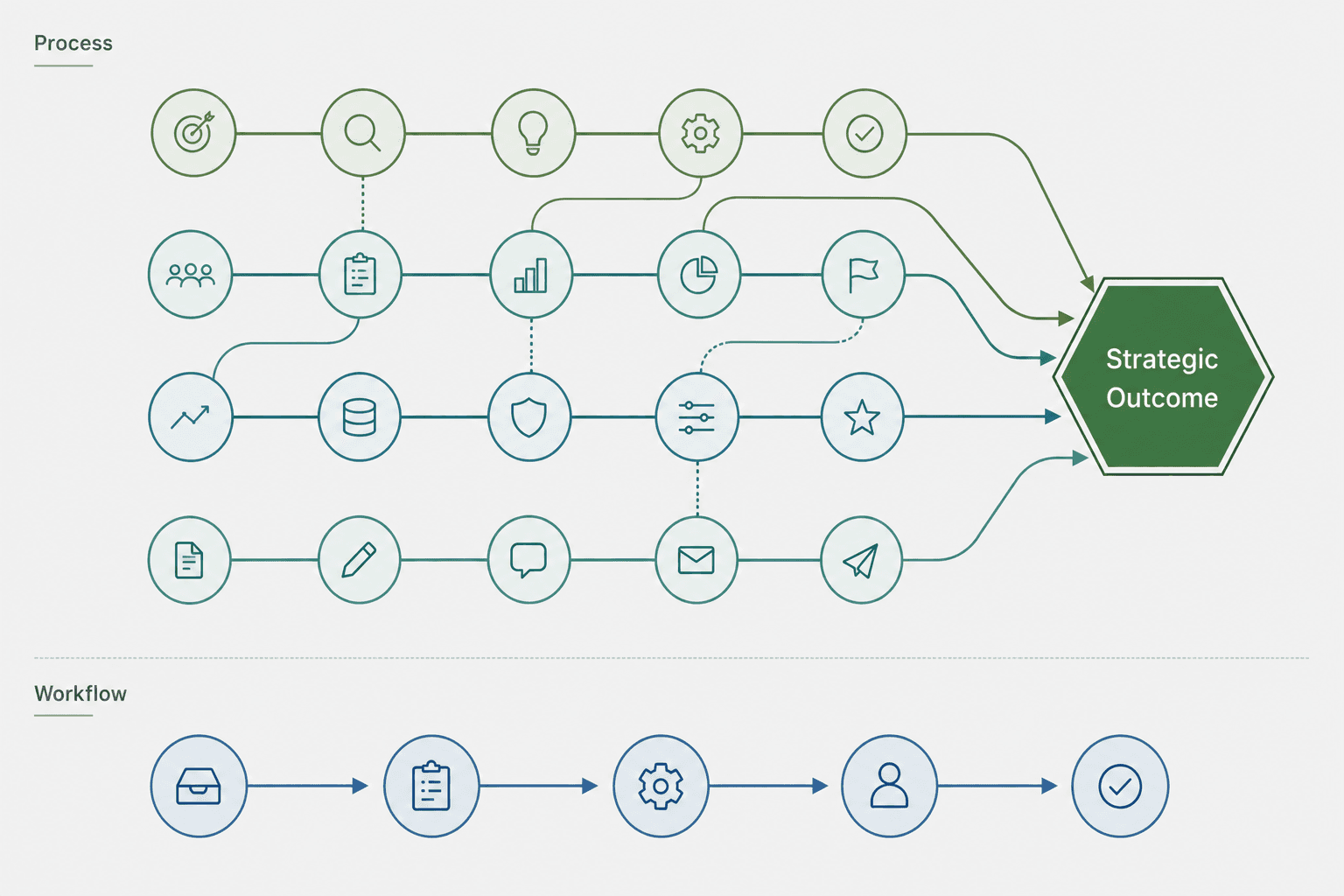
 Framework
Workflow vs. Process: A Practical Decision Framework for Teams
Most teams confuse workflows and processes, leading them to apply the wrong fix. This article provides a diagnostic framework to help project managers, operations leads, and team leads decide whether to fix a workflow or redesign a process — with real-world examples and specific signals for each level.
Origin: Kissflow, SAP Signavio, Atlassian, BMC, The Digital Project Manager, Businessmap
By Editorial Team
- workflow-automation
- BPM
- process-management
- decision-framework
- teams
Why Most Teams Apply the Wrong Fix
A team lead notices that the invoice approval cycle is taking twice as long as it did last quarter. The immediate instinct is to automate the approval step — add a routing rule, set up reminders, maybe even buy a workflow automation tool. Three weeks later, the approvals are faster, but the accounts payable department is still missing payment terms. The real problem was never the speed of the approval task. It was that the overall accounts payable process had a structural flaw: no one was checking payment terms against vendor contracts before the invoice reached the approval stage.
This scenario plays out in organizations every day. Teams confuse workflows with processes, and that confusion leads to costly missteps. They automate a broken workflow, producing what Kissflow calls "a faster broken workflow." Or they launch a full-scale process redesign when the actual bottleneck is a single task stuck at one handoff point — a problem that a simple workflow adjustment could have solved in an afternoon.
This article provides a diagnostic framework to help you decide which level to intervene at. It is written for project managers, operations leads, and team leads who need to distinguish between a workflow problem and a process problem — and apply the right fix the first time.
Workflow vs. Process: Clear Definitions
Before you can diagnose the problem, you need a precise understanding of what each term means. The distinction is not academic — it determines whether you spend your energy on a tactical fix or a strategic redesign.
What Is a Workflow?
A workflow is a repeatable sequence of tasks that moves a specific piece of work through defined steps to completion. It is task-oriented, tactical, and automation-ready. Atlassian identifies three types of workflows: sequential (tasks in strict order), parallel (multiple tasks simultaneously), and mixed (hybrid). A workflow answers the question "How does this specific piece of work get from start to finish?"
Examples of workflows include: an invoice approval sequence (submit → review → approve → pay), an IT provisioning checklist for new hires (create account → assign licenses → configure hardware), or a document review cycle (draft → review → revise → approve). Each of these is a defined, repeatable path for a single unit of work.
What Is a Process?
A business process is the coordinated system of workflows, people, and resources that delivers a repeatable business outcome. It is cross-functional, strategic, and requires ongoing governance. A process answers the question "How does the organization achieve this business outcome reliably?"
The key structural insight, as Kissflow explains, is that one process contains multiple workflows. Employee onboarding is a process. The IT provisioning step inside onboarding is a workflow. The document collection step is another workflow. The orientation scheduling step is yet another. The process is the orchestration of all these workflows toward a single outcome: a productive new employee.
Two analogies can make this concrete:
- The railway-track analogy (Kissflow): Each track section is a workflow — a defined path for a train to travel. The entire railway network — scheduling, maintenance, ticketing, signaling — is the process. You can optimize a single track section (workflow) without redesigning the whole network (process), but if the network is poorly designed, optimizing one section won't fix the system.
- The meal analogy (The Digital Project Manager): A workflow is a recipe for one dish. A process is the high-level plan for the entire meal — appetizer, main course, dessert, timing, table setting, and guest preferences. You can perfect the recipe for the main course (workflow), but if the meal plan (process) doesn't account for dietary restrictions, the dinner still fails.
The Core Distinction at a Glance
| Dimension | Workflow | Process |
|---|---|---|
| Scope | Single task or unit of work | Cross-functional, end-to-end business outcome |
| Focus | Task execution and handoffs | Strategic alignment and governance |
| Automation readiness | High — designed for automation | Requires design before automation |
| Governance | Minimal — defined by the task sequence | Ongoing — requires monitoring and optimization |
| Example | Invoice approval (submit → approve → pay) | Accounts payable management (procurement to payment) |
| Question it answers | How does this work get done? | How do we achieve this outcome reliably? |
Comments
Join the discussion with an anonymous comment.