
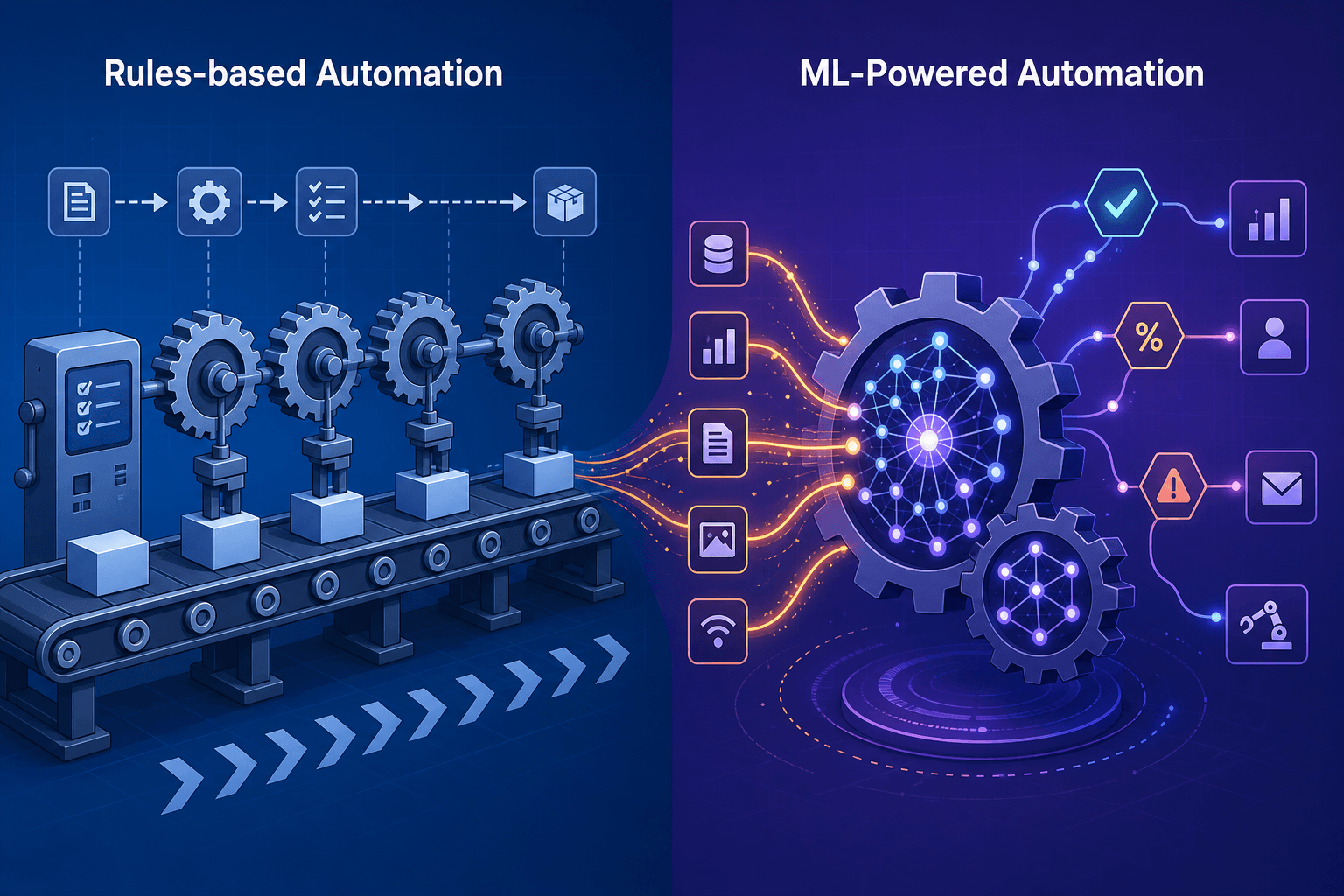
 Framework
AutoML Frameworks in 2026: Open-Source vs. Enterprise — A Strategic Comparison for Tech Leaders
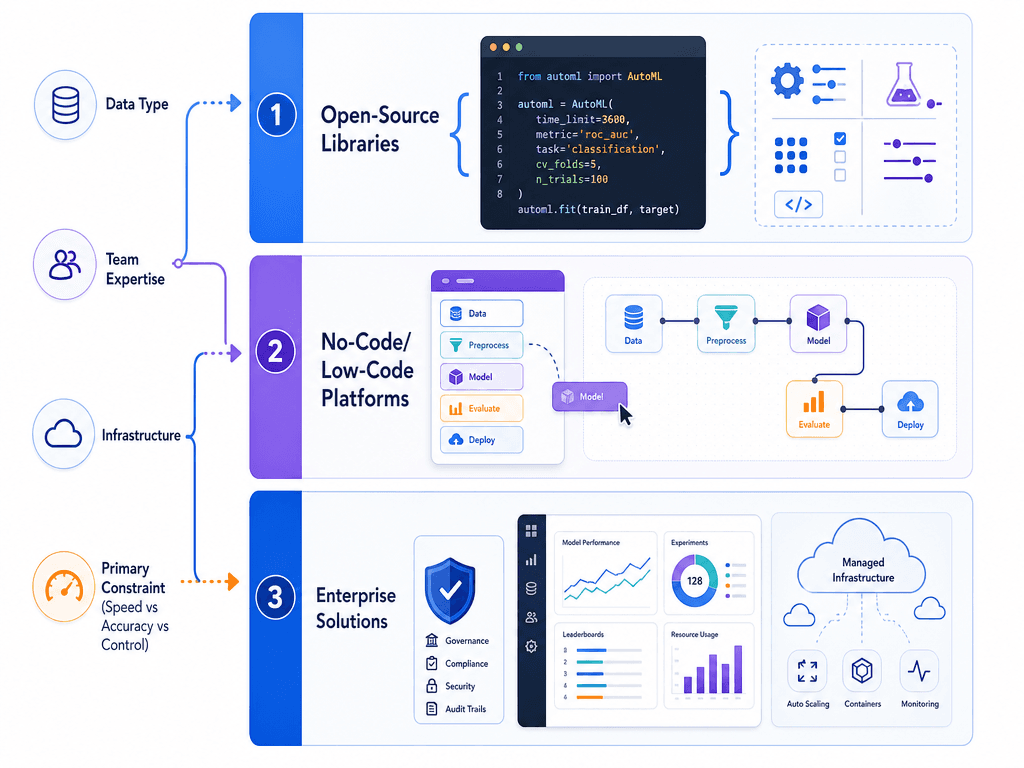
A tier-based comparison of the 2026 AutoML landscape for tech leads, CTOs, and data science managers. This article groups tools into three strategic tiers — open-source libraries, no-code/low-code platforms, and enterprise solutions — and provides a constraint-based decision framework to help you choose the right framework based on data type, infrastructure, team expertise, and your primary constraint (speed, accuracy, or control).
Origin: Grand View Research (market data)
By Editorial Team
- workflow-automation
- AI-tools
- teams
- no-code
- open-source
What AutoML Is and Why It Matters in 2026
Automated Machine Learning (AutoML) refers to the set of tools and frameworks that automate the end-to-end process of applying machine learning to real-world problems. For a tech lead or CTO, AutoML is not about replacing data scientists — it is about removing repetitive, low-value tasks such as hyperparameter tuning, model selection, and feature engineering so that your team can focus on problem framing, data quality, and deployment strategy.
The strategic importance of AutoML in 2026 is driven by market scale. The broader machine learning market is projected to grow from approximately $91.31 billion in 2025 to $1.88 trillion by 2035, and the AutoML segment alone is expanding at a compound annual growth rate (CAGR) of 42.2%, according to Grand View Research data cited by industry analysts. These numbers reflect a fundamental shift: organizations are no longer asking whether to adopt ML, but how to operationalize it efficiently.
For knowledge workers and non-data-scientist audiences, a separate primer on the broader concept is available in our guide AutoML vs. Traditional Automation: What Knowledge Workers Actually Need to Know. This article, however, is written for the person who needs to pick a framework and justify that choice to their team.
The Three Tiers of AutoML in 2026
The 2026 AutoML landscape has fragmented into three distinct tiers, each serving a different strategic need. Understanding which tier your team falls into is the first step in making a sound decision.
Tier 1: Open-Source Libraries
Open-source AutoML libraries offer the highest degree of customization and control. They are best suited for teams with dedicated ML engineering resources who need to integrate AutoML into existing codebases, deploy on custom infrastructure, or work with non-standard data types.
Representative tools in this tier include:
- AutoGluon — The strongest open-source choice for multimodal coverage (tabular, text, image, time series). It excels at ensemble performance and is actively maintained by AWS.
- H2O AutoML — The enterprise standard for distributed tabular workloads. Its Java-based POJO/MOJO deployment artifacts make it a natural fit for organizations with Java-centric infrastructure.
- FLAML — Developed by Microsoft, this library is optimized for compute-budget scenarios. It finds high-quality models with minimal computational cost.
- Auto-Sklearn 2.0 — A successor to the popular Auto-Sklearn, it improves upon its predecessor's meta-learning approach. Note that its latest release was in 2023, and development velocity has slowed.
- TPOT — A pipeline-search tool that uses genetic programming to discover optimal ML pipelines. It is best for teams that want to explore a wide space of possible model architectures.
Tier 2: No-Code / Low-Code Platforms
No-code and low-code AutoML platforms lower the barrier to entry for teams that lack deep ML expertise. They provide visual interfaces, automated reporting, and rapid prototyping capabilities. The trade-off is reduced flexibility compared to open-source libraries.
Key tools in this tier include:
- MLJAR AutoML — Leads in explainability and local-first business modeling. It generates artifact-rich reports (feature importance, SHAP explanations, model cards) and supports fairness-aware training. It is particularly strong for tabular data in regulated industries.
- PyCaret — A low-code Python library that wraps several ML frameworks. It is excellent for rapid experimentation and prototyping, though it may not be suitable for production-scale deployments without additional engineering.
- H2O Flow — A web-based interface for H2O's ML engine. It provides a visual notebook environment for users who want the power of H2O without writing Java or Python code.
Tier 3: Enterprise Solutions
Enterprise AutoML platforms trade customization for governance, explainability, and managed infrastructure. They are designed for organizations that need to operationalize ML at scale with built-in MLOps, compliance, and audit trails.
Leading enterprise solutions include:
- DataRobot — The most mature enterprise AutoML platform. It provides end-to-end MLOps with strong explainability features, automated documentation, and model governance. Best for organizations that prioritize compliance and auditability.
- Vertex AI AutoML — Google Cloud's managed AutoML service. It integrates deeply with the GCP ecosystem and supports tabular, image, text, and video data. Ideal for organizations already invested in Google Cloud.
- Amazon SageMaker Autopilot — AWS's AutoML offering. It automatically creates ML models from tabular data and integrates with SageMaker's broader MLOps pipeline. Best for AWS-native teams.
For a deeper dive into individual tool features, our existing article AutoML Platforms Compared: 10 Tools for Automating Machine Learning Workflows in 2026 provides a flat feature-list comparison. This article takes a different approach by focusing on tier-level trade-offs and strategic decision-making.
Head-to-Head Comparison: Key Dimensions Across All Tiers
The following table provides a scannable reference for comparing the major AutoML frameworks across the dimensions that matter most to technical decision-makers: ease of use, primary language, best use case, cost, and key differentiator.
| Tool | Tier | Ease of Use | Primary Language | Best Use Case | Cost | Key Differentiator |
|---|---|---|---|---|---|---|
| AutoGluon | Open-Source | Medium | Python | Multimodal ML (tabular, NLP, vision, time series) | Free | Broadest coverage; strong ensemble performance |
| H2O AutoML | Open-Source | Medium | Python, R, Java | Enterprise tabular ML with Java deployment | Free (open-source); H2O AI Cloud (paid) | Java-based POJO/MOJO deployment artifacts |
| FLAML | Open-Source | Medium | Python | Compute-budget-constrained scenarios | Free | Optimized for cost-efficient model search |
| Auto-Sklearn 2.0 | Open-Source | Medium | Python | Quick baselines with meta-learning | Free | Meta-learning for faster search (last release 2023) |
| TPOT | Open-Source | Medium | Python | Pipeline discovery via genetic programming | Free | Genetic algorithm-based pipeline search |
| MLJAR AutoML | No-Code/Low-Code | Easy | Python, Browser | Explainable local tabular modeling | Free (open-source); MLJAR Cloud (paid) | Artifact-rich reports; fairness-aware training |
| PyCaret | No-Code/Low-Code | Easy | Python | Rapid experimentation and prototyping | Free | Low-code wrapper for multiple ML frameworks |
| H2O Flow | No-Code/Low-Code | Easy | Browser | Visual ML with H2O engine | Free | Web-based notebook for non-programmers |
| DataRobot | Enterprise | Easy | Browser, API | Enterprise MLOps with governance | Paid (per-seat or usage-based) | End-to-end governance and explainability |
| Vertex AI AutoML | Enterprise | Easy | Browser, API | GCP-native ML automation | Pay-per-use | Deep GCP integration; multimodal support |
| SageMaker Autopilot | Enterprise | Easy | Browser, API | AWS-native tabular ML | Pay-per-use | Seamless SageMaker MLOps integration |
How to Choose: A Constraint-Based Decision Framework
Rather than presenting a flat list of pros and cons, we recommend a constraint-based decision framework. Work through these four questions in order to narrow your options.
1. What type of data are you working with?
Your data modality is the single most important factor in narrowing the field.
- Tabular data only: H2O AutoML, MLJAR AutoML, FLAML, Auto-Sklearn 2.0, TPOT, DataRobot, SageMaker Autopilot, Vertex AI AutoML.
- Multimodal (tabular + text + image + time series): AutoGluon is the strongest open-source choice. Vertex AI AutoML also supports multiple modalities.
- Time series specifically: AutoGluon has dedicated time series support. H2O AutoML and MLJAR also handle time series but with less specialized tuning.
- Deep learning / unstructured data (images, text, audio): AutoGluon, Ludwig, or enterprise platforms like Vertex AI AutoML.
2. What is your infrastructure and deployment environment?
Your existing infrastructure stack will heavily influence which frameworks are practical to adopt.
- Java-centric enterprise: H2O AutoML's POJO/MOJO deployment artifacts are a natural fit. You can export models as plain Java objects and deploy them directly into existing Java applications without needing a separate serving infrastructure.
- Python-centric team: AutoGluon, FLAML, Auto-Sklearn 2.0, TPOT, and PyCaret all integrate seamlessly with Python-based ML stacks (scikit-learn, pandas, NumPy).
- Cloud-native (AWS): SageMaker Autopilot offers the tightest integration with the AWS ecosystem, including IAM, S3, and SageMaker Pipelines.
- Cloud-native (GCP): Vertex AI AutoML is the obvious choice, with native integration into BigQuery, Cloud Storage, and Vertex AI Pipelines.
- On-premises or air-gapped: Open-source libraries (AutoGluon, H2O, FLAML, MLJAR) can be deployed entirely on-premises. Enterprise platforms may require cloud connectivity.
3. What is your primary constraint — speed, accuracy, or control?
Every AutoML project involves a three-way trade-off. Identifying your primary constraint will guide you to the right tier.
- Speed (time-to-baseline is critical): FLAML and Auto-Sklearn 2.0 are optimized for finding good models quickly with minimal compute. MLJAR's rapid prototyping mode also delivers fast results.
- Accuracy (model performance is paramount): AutoGluon's ensemble-based approach consistently produces state-of-the-art results, especially on multimodal data. Enterprise platforms like DataRobot also invest heavily in ensemble optimization.
- Control (customization, transparency, and auditability are non-negotiable): Open-source libraries give you full access to the underlying code and model artifacts. MLJAR's explainability features and H2O's POJO/MOJO artifacts provide a strong middle ground. Enterprise platforms trade some control for governance.
4. What is your team's expertise level?
Be honest about your team's current capabilities. Overestimating ML maturity is a common source of failed AutoML initiatives.
- No dedicated ML engineers: Start with no-code/low-code platforms (MLJAR, H2O Flow) or enterprise solutions (DataRobot, Vertex AI AutoML). These platforms abstract away most ML complexity.
- Data analysts with Python skills: PyCaret or MLJAR AutoML provide a gentle learning curve while still offering substantial customization.
- Experienced ML engineers: Open-source libraries (AutoGluon, H2O, FLAML) offer the flexibility and control that experienced teams need to fine-tune models and integrate with custom pipelines.
- Mixed team (some ML expertise, some not): Consider a tiered approach — use MLJAR or PyCaret for rapid prototyping by less experienced team members, and AutoGluon or H2O for production deployment by the ML engineering team.
Key Limitations to Know Before Committing
AutoML is a powerful productivity multiplier, but it is not a silver bullet. Understanding its limitations will help you set realistic expectations and avoid costly mistakes.
Unsupervised Learning Remains Largely Unsupported
The vast majority of AutoML frameworks are designed for supervised learning tasks — classification and regression. If your project involves clustering, anomaly detection, dimensionality reduction, or association rule mining, you will likely need to build custom pipelines. Some tools (like H2O) offer limited unsupervised capabilities, but they are not the primary focus.
Risk of Local Optima
AutoML frameworks search a predefined space of algorithms and hyperparameters. They can get stuck in local optima — finding a model that performs well on the search space but misses better solutions outside it. Human-in-the-loop validation remains essential. As the Geniusee analysis notes, experienced data scientists are still needed to question the output, validate assumptions, and explore alternative approaches that the automated search might miss.
LLM Integration Is Still Nascent
While large language models (LLMs) have captured the industry's imagination, their integration into AutoML pipelines is still in early stages. Most AutoML frameworks do not natively support fine-tuning or prompt engineering for LLMs. Some tools (like AutoGluon) are beginning to incorporate foundation models, but this is an emerging capability rather than a mature feature.
Agent-Based AutoML Is Emerging but Research-Oriented
A new category of AutoML — agent-based systems — is gaining attention. Tools like AIDE, AutoGluon Assistant (also known as MLZero), and MLE-STAR attempt to automate the entire experiment loop: writing code, debugging, running experiments, and iterating based on results. According to the MLJAR blog, these systems represent the frontier of AutoML, but they still require careful human review and are not yet production-ready for most organizations.
Verdict: Which Framework for Which Scenario?
Based on the constraint-based framework above, here are our recommendations for common scenarios.
- Best open-source multimodal choice: AutoGluon. If your data spans tabular, text, image, and time series, AutoGluon offers the broadest coverage and strongest ensemble performance among open-source tools.
- Best for enterprise tabular workloads: H2O AutoML. Its Java-based POJO/MOJO deployment artifacts make it the natural choice for organizations with Java-centric infrastructure and a need for distributed, production-grade tabular ML.
- Best for explainability and local-first modeling: MLJAR AutoML. If your team operates in a regulated industry or needs to generate artifact-rich reports (feature importance, SHAP values, model cards) for stakeholders, MLJAR leads the field.
- Best for compute-budget scenarios: FLAML or Auto-Sklearn 2.0. When time-to-baseline or computational cost is your primary constraint, these tools deliver strong results with minimal resource expenditure.
- Best for enterprise governance and MLOps: DataRobot. If your organization requires end-to-end model governance, automated documentation, and audit trails, DataRobot's enterprise platform is the most mature option.
- Best for cloud-native teams: Vertex AI AutoML (GCP) or SageMaker Autopilot (AWS). Choose based on your existing cloud provider. Both offer deep integration with their respective ecosystems and reduce operational overhead.
The emerging agent-based AutoML category (AIDE, AutoGluon Assistant) is worth monitoring for teams that want to push the boundaries of automation. However, as of mid-2026, these tools remain research-oriented and should be evaluated with caution for production workloads. The most reliable path for most organizations is to start with a well-established framework from one of the three tiers, validate it against your specific constraints, and then consider experimenting with agent-based systems for specific use cases.
Comments
Join the discussion with an anonymous comment.